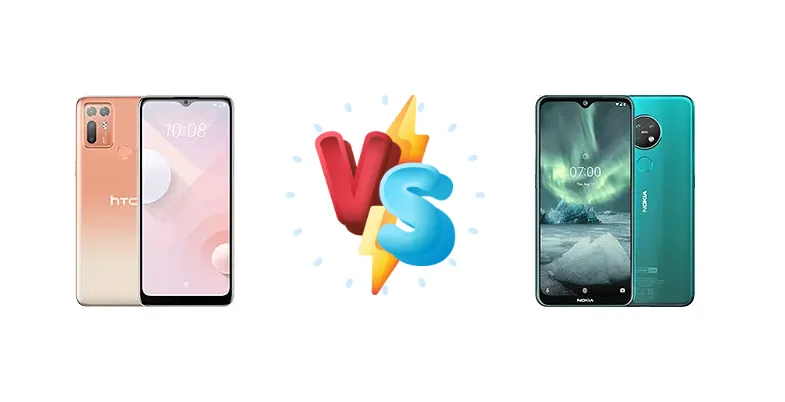
The HTC Desire 20+ and Nokia 7.2 represent different approaches to the mid-range smartphone market. The Nokia 7.2, released in 2019, prioritized a clean software experience and a respectable camera, while the Desire 20+, arriving later, aimed to deliver improved performance with a newer Qualcomm chipset. This comparison dissects their key differences to determine which device offers the best value in today's market.
🏆 Quick Verdict
For the average user, the HTC Desire 20+ is the better choice. Its Snapdragon 720G chipset provides a substantial performance uplift over the Nokia 7.2’s Snapdragon 660, translating to smoother multitasking and a more responsive user experience. While both phones offer similar battery endurance, the Desire 20+’s faster charging is a welcome addition.
| Network |
|---|
| 2G bands | GSM 850 / 900 / 1800 / 1900 | GSM 850 / 900 / 1800 / 1900 |
| 3G bands | HSDPA 850 / 900 / 1900 / 2100 | HSDPA 850 / 900 / 2100 - ROW |
| 4G bands | 1, 3, 5, 7, 8, 20, 28, 38, 40, 41 | 1, 3, 5, 7, 8, 20, 28, 38, 40, 41 - ROW |
| Speed | HSPA 42.2/5.76 Mbps, LTE, Cat6 300/75 Mbps | HSPA 42.2/5.76 Mbps, LTE (2CA) Cat6 300/50 Mbps or LTE Cat4 150/50 Mbps |
| Technology | GSM / HSPA / LTE | GSM / HSPA / LTE |
| | - | 1, 3, 5, 8, 40, 41 - IN |
| Launch |
|---|
| Announced | 2020, October 19. Released 2020, October 22 | 2019, September 05. Released 2019, September 23 |
| Status | Discontinued | Discontinued |
| Body |
|---|
| Build | - | Glass front (Gorilla Glass 3), glass back (Gorilla Glass 3), plastic frame |
| Dimensions | 164.9 x 75.7 x 9 mm (6.49 x 2.98 x 0.35 in) | 159.9 x 75.2 x 8.3 mm (6.30 x 2.96 x 0.33 in) |
| SIM | Nano-SIM + Nano-SIM | · Nano-SIM· Nano-SIM + Nano-SIM |
| Weight | 203 g (7.16 oz) | 180 g (6.35 oz) |
| Display |
|---|
| Protection | - | Corning Gorilla Glass 3 |
| Resolution | 720 x 1600 pixels, 20:9 ratio (~270 ppi density) | 1080 x 2280 pixels, 19:9 ratio (~400 ppi density) |
| Size | 6.5 inches, 102.0 cm2 (~81.7% screen-to-body ratio) | 6.3 inches, 99.1 cm2 (~82.4% screen-to-body ratio) |
| Type | IPS LCD | IPS LCD, HDR10 |
| Platform |
|---|
| CPU | Octa-core (2x2.3 GHz Kryo 465 Gold & 6x1.8 GHz Kryo 465 Silver) | Octa-core (4x2.2 GHz Kryo 260 Gold & 4x1.8 GHz Kryo 260 Silver) |
| Chipset | Qualcomm SM7125 Snapdragon 720G (8 nm) | Qualcomm SDM660 Snapdragon 660 (14 nm) |
| GPU | Adreno 618 | Adreno 512 |
| OS | Android 10 | Android 9.0 (Pie), upgradable to Android 11, Android One |
| Memory |
|---|
| Card slot | microSDXC | microSDXC (dedicated slot) |
| Internal | 128GB 6GB RAM | 64GB 4GB RAM, 64GB 6GB RAM, 128GB 4GB RAM, 128GB 6GB RAM |
| | - | eMMC 5.1 |
| Main Camera |
|---|
| Features | Dual-LED flash, HDR, panorama | Zeiss optics, LED flash, panorama, HDR |
| Quad | 48 MP, f/1.8, 26mm (wide), 1/2.0", 0.8µm, PDAF
5 MP, f/2.2, 115˚ (ultrawide)
2 MP (macro)
Auxiliary lens | - |
| Triple | - | 48 MP, f/1.8, (wide), 1/2.0", 0.8µm, PDAF
8 MP, f/2.2, 13mm (ultrawide), 1/4.0", 1.12µm
Auxiliary lens |
| Video | 4K@30fps, 1080p@30fps | 4K@30fps, 1080p@30fps (gyro-EIS) |
| Selfie camera |
|---|
| Features | HDR | Zeiss optics, HDR |
| Single | 16 MP, f/2.0, (wide) | 20 MP, f/2.0, (wide), 1/3", 0.9µm |
| Video | 1080p@30fps | 1080p@30fps |
| Sound |
|---|
| 3.5mm jack | - | Yes |
| 35mm jack | Yes | Yes |
| Loudspeaker | Yes | Yes |
| Comms |
|---|
| Bluetooth | 5.0, A2DP, LE | 5.0, A2DP, EDR, LE, aptX |
| NFC | Yes | Yes (excl. India) |
| Positioning | GPS, GLONASS, GALILEO, BDS | GPS, GLONASS, GALILEO, BDS |
| Radio | No | FM radio |
| USB | USB Type-C 2.0, OTG | USB Type-C 2.0, OTG |
| WLAN | Wi-Fi 802.11 a/b/g/n/ac, dual-band, Wi-Fi Direct | Wi-Fi 802.11 b/g/n/ac, dual-band, Wi-Fi Direct |
| Features |
|---|
| Sensors | Fingerprint (rear-mounted), accelerometer, gyro, proximity, compass | Fingerprint (rear-mounted), accelerometer, gyro, proximity, compass |
| Battery |
|---|
| Charging | 15W wired, QC4 | 10W wired |
| Type | Li-Po 5000 mAh | Li-Po 3500 mAh, non-removable |
| Misc |
|---|
| Colors | Dawn Orange, Twilight Black, Blue | Cyan Green, Charcoal, Ice |
| Models | - | TA-1193, TA-1178, TA-1196, TA-1181 |
| Price | About 250 EUR | About 240 EUR |
| SAR | - | 1.15 W/kg (head) 0.90 W/kg (body) |
| SAR EU | - | 0.99 W/kg (head) 1.44 W/kg (body) |
| Tests |
|---|
| Audio quality | - |
Noise -93.0dB / Crosstalk -93.4dB |
| Battery life | - |
Endurance rating 69h
|
| Camera | - |
Photo / Video |
| Display | - |
Contrast ratio: 1342:1 (nominal) |
| Loudspeaker | - |
-29.6 LUFS (Average)
|
| Performance | - |
AnTuTu: 139495 (v7), 164484 (v8)
GeekBench: 5440 (v4.4), 1398 (v5.1)
GFXBench: 8.1fps (ES 3.1 onscreen) |
HTC Desire 20+
- Significantly faster processor (Snapdragon 720G)
- Faster charging (15W with QC4)
- More efficient 8nm chipset
- Display specs not fully available
- HTC's software update track record is less consistent than Nokia's
Nokia 7.2
- Brighter display (585 nits)
- Clean Android experience (historically)
- Good battery endurance (69h)
- Older, less powerful processor (Snapdragon 660)
- Slower charging (10W)
- Less efficient 14nm chipset
Display Comparison
Both the HTC Desire 20+ and Nokia 7.2 feature displays with a 1342:1 contrast ratio, suggesting similar visual pop. However, the Nokia 7.2 boasts a measured peak brightness of 585 nits, offering a potentially more visible screen outdoors. While the Desire 20+'s display specs are not provided, the Nokia 7.2’s brightness advantage is a tangible benefit for users frequently exposed to sunlight. The lack of high refresh rate panels on either device means scrolling and animations won't be as fluid as on more modern phones.
Camera Comparison
Both devices are listed as having Photo/Video capabilities, but specific details are lacking. Without sensor size or aperture information, a direct comparison is difficult. However, the age difference suggests the Desire 20+ likely benefits from improved image processing algorithms. The Nokia 7.2’s camera was considered decent for its time, but the Desire 20+’s newer chipset could offer faster image capture and potentially better low-light performance. It's important to note that the presence of a 2MP macro lens on either device is unlikely to significantly impact image quality.
Performance
The core difference between these two phones lies in their chipsets. The HTC Desire 20+ utilizes the Qualcomm SM7125 Snapdragon 720G, built on an 8nm process, while the Nokia 7.2 relies on the older Snapdragon 660 fabricated on a less efficient 14nm node. This translates to a significant performance advantage for the Desire 20+, with its octa-core CPU (2x2.3 GHz Kryo 465 Gold & 6x1.8 GHz Kryo 465 Silver) outperforming the Nokia 7.2’s (4x2.2 GHz Kryo 260 Gold & 4x1.8 GHz Kryo 260 Silver). The 8nm process also contributes to better thermal efficiency, reducing the likelihood of throttling during sustained workloads. Gamers and power users will find the Desire 20+ a far more capable device.
Battery Life
Both the HTC Desire 20+ and Nokia 7.2 achieve an endurance rating of 69 hours, indicating comparable battery life under similar usage conditions. However, the Desire 20+ features 15W wired charging with Quick Charge 4 (QC4) support, while the Nokia 7.2 is limited to 10W charging. This means the Desire 20+ can be charged from 0-100% significantly faster, a crucial advantage for users who prioritize convenience.
Buying Guide
Buy the HTC Desire 20+ if you prioritize performance for gaming, streaming, and everyday multitasking. The Snapdragon 720G offers a noticeable improvement over the 660. Buy the Nokia 7.2 if you value a clean Android experience with guaranteed updates (historically a Nokia strength) and a slightly brighter display, and are willing to compromise on processing power. The Nokia 7.2 is a good option for basic smartphone tasks.
Frequently Asked Questions
❓ Will the Snapdragon 720G in the Desire 20+ handle demanding games like PUBG or Call of Duty Mobile?
Yes, the Snapdragon 720G is capable of running PUBG and Call of Duty Mobile at medium to high settings with playable frame rates. While it won't match the performance of flagship chipsets, it provides a significantly better gaming experience than the Snapdragon 660 in the Nokia 7.2.
❓ How does Nokia's software update policy compare to HTC's for these models?
Historically, Nokia has been known for providing timely Android updates and security patches, even for their budget devices. HTC's update track record is less consistent, and the Desire 20+ may not receive the same level of long-term software support as the Nokia 7.2. This is a key consideration for users who prioritize software security and features.
❓ Is the 15W charging on the Desire 20+ a significant improvement over the 10W charging on the Nokia 7.2?
Yes, the 15W charging with Quick Charge 4 support on the Desire 20+ will noticeably reduce charging times. While exact 0-100% times aren't available, you can expect the Desire 20+ to charge considerably faster than the Nokia 7.2, making it more convenient for users who need to quickly top up their battery.