
HTC Desire 20+ vs Google Pixel 4a 5G: A Detailed Comparison
| Phones Images | |||||
|---|---|---|---|---|---|
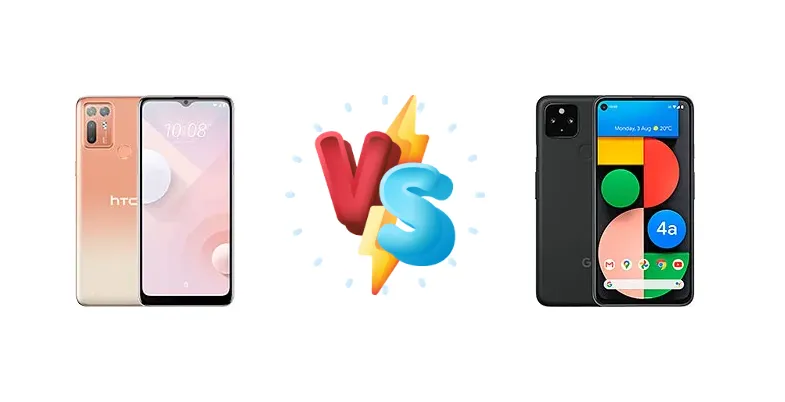
|
🏆 Quick Verdict
For the average user, the Google Pixel 4a 5G is the superior choice. Its Snapdragon 765G chipset, built on a smaller 7nm process, provides a noticeable performance boost over the Desire 20+'s Snapdragon 720G, and the Pixel’s camera consistently delivers better image quality. While the Desire 20+ is more affordable, the Pixel 4a 5G offers a more refined experience.
| PHONES | ||
|---|---|---|
| Phone Names | HTC Desire 20+ | Google Pixel 4a 5G |
| Network | ||
|---|---|---|
| 2G bands | GSM 850 / 900 / 1800 / 1900 | GSM 850 / 900 / 1800 / 1900 |
| 3G bands | HSDPA 850 / 900 / 1900 / 2100 | HSDPA 850 / 900 / 1700(AWS) / 1900 / 2100 |
| 4G bands | 1, 3, 5, 7, 8, 20, 28, 38, 40, 41 | 1, 2, 3, 4, 5, 7, 8, 12, 13, 14, 17, 18, 19, 20, 25, 26, 28, 29, 30, 32, 38, 39, 40, 41, 42, 46, 48, 66, 71 |
| 5G bands | - | 1, 2, 3, 5, 7, 8, 12, 28, 41, 66, 71, 77, 78 Sub6, mmWave (market dependant) |
| Speed | HSPA 42.2/5.76 Mbps, LTE, Cat6 300/75 Mbps | HSPA, LTE, 5G |
| Technology | GSM / HSPA / LTE | GSM / HSPA / LTE / 5G |
| Launch | ||
|---|---|---|
| Announced | 2020, October 19. Released 2020, October 22 | 2020, September 30 |
| Status | Discontinued | Available. Released 2020, November 05 |
| Body | ||
|---|---|---|
| Build | - | Glass front (Gorilla Glass 3), plastic back, plastic frame |
| Dimensions | 164.9 x 75.7 x 9 mm (6.49 x 2.98 x 0.35 in) | 153.9 x 74 x 8.2 mm (Sub-6) or 8.5 mm (Sub-6 and mmWave) |
| SIM | Nano-SIM + Nano-SIM | Nano-SIM + eSIM |
| Weight | 203 g (7.16 oz) | 168 g (5G Sub-6); 171 g ( 5G Sub-6 and mmWave) (5.93 oz) |
| Display | ||
|---|---|---|
| Protection | - | Corning Gorilla Glass 3 |
| Resolution | 720 x 1600 pixels, 20:9 ratio (~270 ppi density) | 1080 x 2340 pixels, 19.5:9 ratio (~413 ppi density) |
| Size | 6.5 inches, 102.0 cm2 (~81.7% screen-to-body ratio) | 6.2 inches, 95.7 cm2 (~84.1% screen-to-body ratio) |
| Type | IPS LCD | OLED, HDR |
| - | Always-on display | |
| Platform | ||
|---|---|---|
| CPU | Octa-core (2x2.3 GHz Kryo 465 Gold & 6x1.8 GHz Kryo 465 Silver) | Octa-core (1x2.4 GHz Kryo 475 Prime & 1x2.2 GHz Kryo 475 Gold & 6x1.8 GHz Kryo 475 Silver) |
| Chipset | Qualcomm SM7125 Snapdragon 720G (8 nm) | Qualcomm SM7250 Snapdragon 765G 5G (7 nm) |
| GPU | Adreno 618 | Adreno 620 |
| OS | Android 10 | Android 11, upgradable to Android 14 |
| Memory | ||
|---|---|---|
| Card slot | microSDXC | No |
| Internal | 128GB 6GB RAM | 128GB 6GB RAM |
| - | UFS 2.1 | |
| Main Camera | ||
|---|---|---|
| Dual | - | 12.2 MP, f/1.7, 27mm (wide), 1/2.55", 1.4µm, dual pixel PDAF, OIS 16 MP, f/2.2, 107˚ (ultrawide), 1.0µm |
| Features | Dual-LED flash, HDR, panorama | LED flash, Pixel Shift, Auto-HDR, panorama |
| Quad | 48 MP, f/1.8, 26mm (wide), 1/2.0", 0.8µm, PDAF 5 MP, f/2.2, 115˚ (ultrawide) 2 MP (macro) Auxiliary lens | - |
| Video | 4K@30fps, 1080p@30fps | 4K@30/60fps, 1080p@30/60/120/240fps; gyro-EIS |
| Selfie camera | ||
|---|---|---|
| Features | HDR | HDR |
| Single | 16 MP, f/2.0, (wide) | 8 MP, f/2.0, 24mm (wide), 1/4.0", 1.12µm |
| Video | 1080p@30fps | 1080p@30fps |
| Sound | ||
|---|---|---|
| 3.5mm jack | - | Yes |
| 35mm jack | Yes | Yes |
| Loudspeaker | Yes | Yes, with stereo speakers |
| Comms | ||
|---|---|---|
| Bluetooth | 5.0, A2DP, LE | 5.0, A2DP, LE, aptX HD |
| NFC | Yes | Yes |
| Positioning | GPS, GLONASS, GALILEO, BDS | GPS, GLONASS, GALILEO, QZSS, BDS |
| Radio | No | No |
| USB | USB Type-C 2.0, OTG | USB Type-C 3.1 |
| WLAN | Wi-Fi 802.11 a/b/g/n/ac, dual-band, Wi-Fi Direct | Wi-Fi 802.11 a/b/g/n/ac, dual-band, Wi-Fi Direct |
| Features | ||
|---|---|---|
| Sensors | Fingerprint (rear-mounted), accelerometer, gyro, proximity, compass | Fingerprint (rear-mounted), accelerometer, gyro, proximity, compass, barometer |
| Battery | ||
|---|---|---|
| Charging | 15W wired, QC4 | 18W wired, PD2.0 |
| Type | Li-Po 5000 mAh | Li-Po 3885 mAh |
| Misc | ||
|---|---|---|
| Colors | Dawn Orange, Twilight Black, Blue | Just Black, Clearly White |
| Models | - | GD1YQ, G025I, G025E, G025H, G6QU3 |
| Price | About 250 EUR | About 140 EUR |
HTC Desire 20+
- More affordable price point
- Supports 5G connectivity
- Functional and reliable performance for basic tasks
- Less powerful processor than the Pixel 4a 5G
- Likely inferior camera performance
- Slower charging speed
Google Pixel 4a 5G
- Superior processor performance (Snapdragon 765G)
- Excellent camera quality with Google’s software
- Faster charging with PD2.0
- Higher price tag
- May not be significantly faster in everyday tasks for casual users
- Potentially less RAM than some competitors
Display Comparison
Neither device boasts a particularly standout display. Both likely utilize LCD panels, a common choice in this price bracket. However, the focus here is on the underlying processors, not display fidelity. Bezels are expected to be similar, and without specific data on color accuracy or peak brightness, it’s difficult to declare a clear winner. The display serves as a functional window to the more important internal components.
Camera Comparison
While both phones likely feature multi-camera setups, the Pixel 4a 5G benefits from Google’s renowned computational photography. Without specific sensor details for the Desire 20+, it’s safe to assume the Pixel 4a 5G’s image processing will yield superior results, particularly in low-light conditions. Google’s software algorithms excel at noise reduction and dynamic range optimization. The absence of OIS details for the Desire 20+ further suggests the Pixel 4a 5G will offer more stable video recording.
Performance
The core difference lies in the chipsets. The Google Pixel 4a 5G’s Snapdragon 765G, fabricated on a 7nm process, offers a clear advantage over the HTC Desire 20+'s Snapdragon 720G (8nm). The 765G’s Kryo 475 Prime core (2.4GHz) provides a performance peak the 720G lacks, while the 7nm process translates to better thermal efficiency, reducing the likelihood of throttling during sustained workloads. The Pixel 4a 5G will handle demanding apps and games with greater ease. The CPU configuration of the Pixel 4a 5G (1x2.4 GHz Kryo 475 Prime & 1x2.2 GHz Kryo 475 Gold & 6x1.8 GHz Kryo 475 Silver) is more sophisticated than the Desire 20+'s (2x2.3 GHz Kryo 465 Gold & 6x1.8 GHz Kryo 465 Silver).
Battery Life
The battery performance will depend on usage patterns, but the Pixel 4a 5G’s 18W charging with PD2.0 support offers a faster charging experience than the Desire 20+'s 15W charging with QC4. While battery capacity isn’t specified, the more efficient Snapdragon 765G in the Pixel 4a 5G will likely contribute to comparable or even better battery life despite potentially having a similar capacity. The faster charging speed is a tangible benefit for users who need to quickly top up their device.
Buying Guide
Buy the HTC Desire 20+ if you need a functional 5G smartphone on a very tight budget and prioritize basic connectivity over advanced features. Buy the Google Pixel 4a 5G if you value a smooth user experience, excellent camera performance, and timely software updates, even if it means spending a bit more.