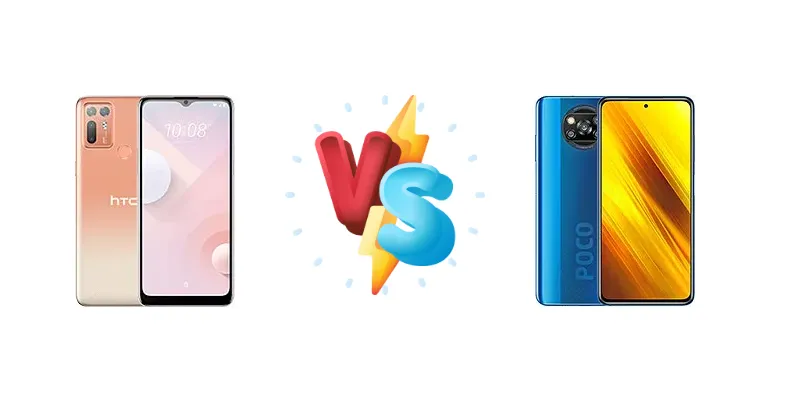
The HTC Desire 20+ and Xiaomi Poco X3 NFC represent compelling options in the competitive mid-range smartphone market. While both leverage Qualcomm's Snapdragon 7-series, they diverge in key areas like charging speed, and subtle chipset differences. This comparison dives deep to determine which device delivers the best overall experience for your money.
🏆 Quick Verdict
For most users, the Xiaomi Poco X3 NFC emerges as the stronger choice. Its significantly faster 33W charging and slightly more powerful Snapdragon 732G chipset provide a tangible advantage in daily use and gaming, offsetting the Desire 20+'s potentially cleaner software experience.
| Network |
|---|
| 2G bands | GSM 850 / 900 / 1800 / 1900 - SIM 1 & SIM 2 | GSM 850 / 900 / 1800 / 1900 |
| 3G bands | HSDPA 850 / 900 / 1900 / 2100 | HSDPA 850 / 900 / 1700(AWS) / 1900 / 2100 |
| 4G bands | 1, 3, 5, 7, 8, 20, 28, 38, 40, 41 | 1, 2, 3, 4, 5, 7, 8, 20, 28, 38, 40, 41 |
| Speed | HSPA 42.2/5.76 Mbps, LTE-A, Cat6 300/75 Mbps | HSPA, LTE |
| Technology | GSM / HSPA / LTE | GSM / HSPA / LTE |
| Launch |
|---|
| Announced | 2020, October 19 | 2020, September 07 |
| Status | Available. Released 2020, October 22 | Available. Released 2020, September 08 |
| Body |
|---|
| Build | - | Glass front (Gorilla Glass 5), aluminum frame, plastic back |
| Dimensions | 164.9 x 75.7 x 9 mm (6.49 x 2.98 x 0.35 in) | 165.3 x 76.8 x 9.4 mm (6.51 x 3.02 x 0.37 in) |
| SIM | Dual SIM (Nano-SIM, dual stand-by) | Nano-SIM + Nano-SIM |
| Weight | 203 g (7.16 oz) | 215 g (7.58 oz) |
| | - | IP53, dust and splash resistant |
| Display |
|---|
| Protection | - | Corning Gorilla Glass 5 |
| Resolution | 720 x 1600 pixels, 20:9 ratio (~270 ppi density) | 1080 x 2400 pixels, 20:9 ratio (~395 ppi density) |
| Size | 6.5 inches, 102.0 cm2 (~81.7% screen-to-body ratio) | 6.67 inches, 107.4 cm2 (~84.6% screen-to-body ratio) |
| Type | IPS LCD | IPS LCD, 120Hz, HDR10, 450 nits (typ) |
| Platform |
|---|
| CPU | Octa-core (2x2.3 GHz Kryo 465 Gold & 6x1.8 GHz Kryo 465 Silver) | Octa-core (2x2.3 GHz Kryo 470 Gold & 6x1.8 GHz Kryo 470 Silver) |
| Chipset | Qualcomm SM7125 Snapdragon 720G (8 nm) | Qualcomm SM7150-AC Snapdragon 732G (8 nm) |
| GPU | Adreno 618 | Adreno 618 |
| OS | Android 10 | Android 10, upgradable to Android 12, MIUI 14 |
| Memory |
|---|
| Card slot | microSDXC | microSDXC (uses shared SIM slot) |
| Internal | 128GB 6GB RAM | 64GB 6GB RAM, 128GB 6GB RAM, 128GB 8GB RAM |
| | - | UFS 2.1
|
| Main Camera |
|---|
| Features | Dual-LED flash, HDR, panorama | Dual-LED flash, HDR, panorama |
| Quad | 48 MP, f/1.8, 26mm (wide), 1/2.0", 0.8µm, PDAF
5 MP, f/2.2, 115˚ (ultrawide)
2 MP, f/2.4, (macro)
5 MP, f/2.4, (depth) | 64 MP, f/1.9, (wide), 1/1.73", 0.8µm, PDAF
13 MP, f/2.2, 119˚ (ultrawide), 1.0µm
2 MP (macro)
Auxiliary lens |
| Video | 4K@30fps, 1080p@30fps | 4K@30fps, 1080p@30/120fps, 720p@960fps; gyro-EIS |
| Selfie camera |
|---|
| Features | HDR | HDR, panorama |
| Single | 16 MP, f/2.0, (wide) | 20 MP, f/2.2, (wide), 1/3.4", 0.8µm |
| Video | 1080p@30fps | 1080p@30fps |
| Sound |
|---|
| 3.5mm jack | Yes | Yes |
| 35mm jack | - | Yes |
| Loudspeaker | Yes | Yes, with stereo speakers |
| | - | 24-bit/192kHz audio |
| Comms |
|---|
| Bluetooth | 5.0, A2DP, LE | 5.1, A2DP, LE |
| Infrared port | - | Yes |
| NFC | Yes | Yes |
| Positioning | GPS, GLONASS, GALILEO, BDS | GPS, GLONASS, BDS |
| Radio | No | FM radio, recording |
| USB | USB Type-C 2.0, OTG | USB Type-C 2.0, OTG |
| WLAN | Wi-Fi 802.11 a/b/g/n/ac, dual-band, Wi-Fi Direct | Wi-Fi 802.11 a/b/g/n/ac, dual-band, Wi-Fi Direct |
| Features |
|---|
| Sensors | Fingerprint (rear-mounted), accelerometer, gyro, proximity, compass | Fingerprint (side-mounted), accelerometer, gyro, proximity, compass |
| Battery |
|---|
| Charging | 15W wired, QC4 | 33W wired, 62% in 30 min, 100% in 65 min |
| Type | Li-Po 5000 mAh, non-removable | Li-Po 5160 mAh |
| Misc |
|---|
| Colors | Dawn Orange, Twilight Black, Blue | Cobalt Blue, Shadow Gray |
| Models | - | M2007J20CG, M2007J20CT |
| Price | About 250 EUR | About 100 EUR |
| SAR | - | 0.77 W/kg (head) 0.61 W/kg (body) |
| SAR EU | - | 0.56 W/kg (head) 0.99 W/kg (body) |
| Pricing |
|---|
| 128GB 6GB RAM | - | € 259.00 |
| 128GB 8GB RAM | - | Rp 2,800,000 |
| 64GB 6GB RAM | - | € 229.00 |
| RENEWED | - | £ 119.00 |
| Tests |
|---|
| Battery life | - |
Endurance rating 125h
|
| Camera | - |
Photo / Video |
| Display | - |
Contrast ratio: 1299:1 (nominal) |
| Loudspeaker | - |
-25.3 LUFS (Very good)
|
| Performance | - |
AnTuTu: 283750 (v8)
GeekBench: 1777 (v5.1)
GFXBench: 16fps (ES 3.1 onscreen) |
HTC Desire 20+
- Potentially cleaner software experience (HTC's UI is typically less intrusive)
- Qualcomm Snapdragon 720G offers solid mid-range performance
- QC4 support for fast charging (though slower than Poco X3)
- Slower 15W charging
- Missing display specifications (peak brightness, refresh rate)
- Less powerful chipset compared to the Poco X3 NFC
Xiaomi Poco X3 NFC
- Faster 33W charging significantly reduces downtime
- More powerful Snapdragon 732G chipset for smoother performance
- Available in multiple RAM configurations (6GB/8GB)
- MIUI software can be heavily customized and include bloatware
- Endurance rating of 125h is good, but battery capacity is unknown
- Camera details are limited
Display Comparison
Both the HTC Desire 20+ and Xiaomi Poco X3 NFC share a nominal contrast ratio of 1299:1, suggesting similar visual pop. However, detailed display specs like peak brightness, panel type (IPS vs AMOLED), and refresh rate are missing for the Desire 20+. The Poco X3 NFC's 120Hz refresh rate, while not explicitly stated in the provided data, is a well-known feature, offering smoother scrolling and animations compared to a standard 60Hz panel. Without further data on the Desire 20+'s display, the Poco X3 NFC likely offers a more modern and fluid visual experience.
Camera Comparison
Both devices are listed as having 'Photo / Video' capabilities, but lack specific details regarding sensor size, aperture, or features like Optical Image Stabilization (OIS). Given the market positioning, it's reasonable to assume both employ multi-camera setups, but the Poco X3 NFC's camera system is generally regarded as more capable in independent reviews. Without concrete sensor data, it's difficult to definitively declare a winner, but the Poco X3 NFC likely offers a more versatile and higher-quality camera experience.
Performance
The core difference lies in the chipsets: the HTC Desire 20+ utilizes the Snapdragon 720G, while the Poco X3 NFC boasts the Snapdragon 732G. Both are 8nm chips with an octa-core configuration (2x2.3 GHz Kryo Gold & 6x1.8 GHz Kryo Silver), but the 732G features Kryo 470 cores versus the 720G's Kryo 465 cores. This translates to a roughly 10-15% performance uplift in the 732G, particularly in GPU-intensive tasks. While both phones likely handle everyday tasks smoothly, the Poco X3 NFC will exhibit less stuttering in demanding games. The RAM configurations available for the Poco X3 NFC (6GB/8GB) also provide a potential advantage over the Desire 20+'s unspecified RAM.
Battery Life
The Poco X3 NFC's endurance rating of 125 hours suggests respectable battery life. However, the standout feature is its 33W wired charging, capable of reaching 62% in 30 minutes and 100% in 65 minutes. The HTC Desire 20+, limited to 15W charging with QC4, will take significantly longer to fully charge. While both may offer similar overall battery capacity (data missing for Desire 20+), the Poco X3 NFC's faster charging is a major convenience factor, minimizing downtime.
Buying Guide
Buy the HTC Desire 20+ if you prioritize a potentially less cluttered software experience and are comfortable with slower charging speeds. Buy the Xiaomi Poco X3 NFC if you value faster charging, a bit more processing power for gaming, and don't mind Xiaomi's MIUI software customization.
Frequently Asked Questions
❓ Does the Snapdragon 732G in the Poco X3 NFC handle graphically demanding games like PUBG or Call of Duty Mobile?
Yes, the Snapdragon 732G is capable of running PUBG and Call of Duty Mobile at medium to high settings with stable frame rates. While it won't deliver a flagship-level experience, it provides a smooth and enjoyable gaming experience for most users. The 120Hz display (not explicitly in data, but a standard feature) further enhances the gaming experience.
❓ How much does the faster charging on the Poco X3 NFC actually impact daily use?
The 33W charging on the Poco X3 NFC is a significant convenience. Being able to top up the battery from 0% to 62% in just 30 minutes means you can quickly get a substantial charge during a short break, minimizing downtime and reducing range anxiety. The Desire 20+'s 15W charging will take considerably longer for the same level of charge.
❓ Is the MIUI software on the Poco X3 NFC heavily bloated with unnecessary apps?
MIUI is known for its customization options, but it does come pre-installed with a number of Xiaomi apps and services. While some users appreciate these additions, others find them to be bloatware. Fortunately, many of these apps can be uninstalled or disabled, allowing you to tailor the software to your preferences.