
HTC Desire 20+ vs OnePlus Nord 2T: Which Mid-Range Phone Reigns Supreme?
| Phones Images | |||||
|---|---|---|---|---|---|
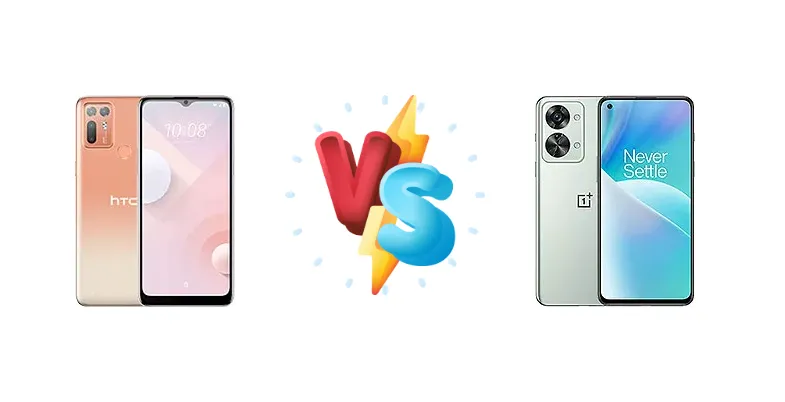
|
🏆 Quick Verdict
For most users, the OnePlus Nord 2T is the superior choice. Its Mediatek Dimensity 1300 chipset provides a noticeable performance uplift over the Snapdragon 720G in the Desire 20+, and the 80W SuperVOOC charging is a game-changer, significantly reducing downtime. While both phones offer similar battery endurance ratings, the Nord 2T's charging speed is a decisive advantage.
| PHONES | ||
|---|---|---|
| Phone Names | HTC Desire 20+ | OnePlus Nord 2T |
| Network | ||
|---|---|---|
| 2G bands | GSM 850 / 900 / 1800 / 1900 - SIM 1 & SIM 2 | GSM 850 / 900 / 1800 / 1900 |
| 3G bands | HSDPA 850 / 900 / 1900 / 2100 | HSDPA 800 / 850 / 900 / 1700(AWS) / 1800 / 1900 / 2100 |
| 4G bands | 1, 3, 5, 7, 8, 20, 28, 38, 40, 41 | 1, 2, 3, 4, 5, 7, 8, 12, 17, 18, 19, 20, 26, 28, 32, 34, 38, 39, 40, 41, 66 |
| 5G bands | - | 1, 3, 7, 8, 20, 28, 38, 41, 78 SA/NSA |
| Speed | HSPA 42.2/5.76 Mbps, LTE-A, Cat6 300/75 Mbps | HSPA 42.2/5.76 Mbps, LTE Cat18 1200/150 Mbps, 5G |
| Technology | GSM / HSPA / LTE | GSM / HSPA / LTE / 5G |
| Launch | ||
|---|---|---|
| Announced | 2020, October 19 | 2022, May 19 |
| Status | Available. Released 2020, October 22 | Available. Released 2022, May 21 |
| Body | ||
|---|---|---|
| Build | - | Glass front (Gorilla Glass 5), plastic frame |
| Dimensions | 164.9 x 75.7 x 9 mm (6.49 x 2.98 x 0.35 in) | 159.1 x 73.2 x 8.2 mm (6.26 x 2.88 x 0.32 in) |
| SIM | Dual SIM (Nano-SIM, dual stand-by) | Nano-SIM + Nano-SIM |
| Weight | 203 g (7.16 oz) | 190 g (6.70 oz) |
| Display | ||
|---|---|---|
| Protection | - | Corning Gorilla Glass 5 |
| Resolution | 720 x 1600 pixels, 20:9 ratio (~270 ppi density) | 1080 x 2400 pixels, 20:9 ratio (~409 ppi density) |
| Size | 6.5 inches, 102.0 cm2 (~81.7% screen-to-body ratio) | 6.43 inches, 99.8 cm2 (~85.7% screen-to-body ratio) |
| Type | IPS LCD | AMOLED, 90Hz, HDR10+ |
| Platform | ||
|---|---|---|
| CPU | Octa-core (2x2.3 GHz Kryo 465 Gold & 6x1.8 GHz Kryo 465 Silver) | Octa-core (1x3.0 GHz Cortex-A78 & 3x2.6 GHz Cortex-A78 & 4x2.0 GHz Cortex-A55) |
| Chipset | Qualcomm SM7125 Snapdragon 720G (8 nm) | Mediatek Dimensity 1300 (6 nm) |
| GPU | Adreno 618 | Mali-G77 MC9 |
| OS | Android 10 | Android 12, upgradable to Android 14, OxygenOS 14 |
| Memory | ||
|---|---|---|
| Card slot | microSDXC | No |
| Internal | 128GB 6GB RAM | 128GB 8GB RAM, 256GB 12GB RAM |
| - | UFS 3.1 | |
| Main Camera | ||
|---|---|---|
| Features | Dual-LED flash, HDR, panorama | Dual-LED flash, HDR, panorama |
| Quad | 48 MP, f/1.8, 26mm (wide), 1/2.0", 0.8µm, PDAF 5 MP, f/2.2, 115˚ (ultrawide) 2 MP, f/2.4, (macro) 5 MP, f/2.4, (depth) | - |
| Single | - | 32 MP, f/2.4, (wide), 1/2.8", 0.8µm |
| Triple | - | 50 MP, f/1.9, 24mm (wide), 1/1.56", 1.0µm, PDAF, OIS 8 MP, f/2.2, 120˚ (ultrawide) Auxiliary lens |
| Video | 4K@30fps, 1080p@30fps | 4K@30fps, 1080p@30/60/120/480fps, gyro-EIS |
| Selfie camera | ||
|---|---|---|
| Features | HDR | Auto HDR |
| Single | 16 MP, f/2.0, (wide) | 32 MP, f/2.4, (wide), 1/2.8", 0.8µm |
| Video | 1080p@30fps | 1080p@30fps, gyro-EIS |
| Sound | ||
|---|---|---|
| 3.5mm jack | Yes | No |
| 35mm jack | - | No |
| Loudspeaker | Yes | Yes, with stereo speakers |
| Comms | ||
|---|---|---|
| Bluetooth | 5.0, A2DP, LE | 5.2, A2DP, LE, aptX HD |
| NFC | Yes | Yes |
| Positioning | GPS, GLONASS, GALILEO, BDS | GPS, GLONASS, GALILEO, BDS, NavIC |
| Radio | No | No |
| USB | USB Type-C 2.0, OTG | USB Type-C 2.0, OTG |
| WLAN | Wi-Fi 802.11 a/b/g/n/ac, dual-band, Wi-Fi Direct | Wi-Fi 802.11 a/b/g/n/ac/6, dual-band, Wi-Fi Direct |
| Features | ||
|---|---|---|
| Sensors | Fingerprint (rear-mounted), accelerometer, gyro, proximity, compass | Fingerprint (under display, optical), accelerometer, gyro, proximity, compass |
| Battery | ||
|---|---|---|
| Charging | 15W wired, QC4 | 80W wired, PD |
| Type | Li-Po 5000 mAh, non-removable | Li-Po 4500 mAh |
| Misc | ||
|---|---|---|
| Colors | Dawn Orange, Twilight Black, Blue | Gray Shadow, Jade Fog |
| Models | - | CPH2399, CPH2401 |
| Price | About 250 EUR | € 144.39 / $ 169.99 / ₹ 31,490 |
| Tests | ||
|---|---|---|
| Battery life | - | Endurance rating 100h |
| Camera | - | Photo / Video |
| Display | - | Contrast ratio: Infinite (nominal) |
| Loudspeaker | - | -25.6 LUFS (Very good) |
| Performance | - | AnTuTu: 490545 (v8) | 604467 (v9) GeekBench: 2790 (v5.1) GFXBench: 40fps (ES 3.1 onscreen) |
HTC Desire 20+
- Proven Qualcomm Snapdragon 720G chipset
- Potentially lower price point
- Reliable performance for everyday tasks
- Slower charging speed (15W)
- Less powerful chipset compared to the Nord 2T
- Limited display information
OnePlus Nord 2T
- Faster and more efficient Mediatek Dimensity 1300 chipset
- 80W SuperVOOC fast charging
- Brighter display with better visibility
- May be slightly more expensive
- MediaTek chipset may have less brand recognition
- Software updates may not be as frequent as some competitors
Display Comparison
The OnePlus Nord 2T boasts a significantly brighter display, reaching a measured 636 nits, compared to the Desire 20+'s unspecified brightness. While both have an 'infinite' contrast ratio (typical for OLED/AMOLED panels), the Nord 2T's higher peak brightness translates to better visibility in direct sunlight. The Desire 20+'s display specifications are less detailed, making a direct comparison of color accuracy and panel technology difficult, but the Nord 2T clearly has the edge in raw display quality.
Camera Comparison
Both devices feature photo and video capabilities, but detailed sensor information for the Desire 20+ is lacking. The Nord 2T likely benefits from more advanced image processing algorithms and potentially a larger main sensor. Without specific details on the Desire 20+'s camera hardware, it's difficult to make a precise comparison. However, the Nord 2T’s focus on camera features, common in OnePlus devices, suggests a more refined photography experience. We can assume the Nord 2T will offer better low-light performance and more versatile shooting modes.
Performance
The core difference lies in the chipsets. The OnePlus Nord 2T’s Mediatek Dimensity 1300, built on a 6nm process, offers a substantial performance advantage over the HTC Desire 20+'s Qualcomm Snapdragon 720G (8nm). The Dimensity 1300’s octa-core configuration, featuring a high-clocked Cortex-A78 prime core, delivers faster processing speeds for demanding tasks. The Snapdragon 720G, while capable, is geared towards efficiency rather than raw power. This translates to smoother multitasking and gaming on the Nord 2T. The Nord 2T likely benefits from faster RAM speeds (LPDDR4X vs potentially LPDDR4 in the Desire 20+), further enhancing performance.
Battery Life
Interestingly, both phones share a 100-hour endurance rating, suggesting similar real-world battery life despite the chipset differences. However, the charging experience is where the Nord 2T truly shines. Its 80W SuperVOOC charging, utilizing PD protocol, can rapidly replenish the battery, going from 0-100% in a fraction of the time compared to the Desire 20+'s 15W QC4 charging. This difference in charging speed is a significant convenience factor for users who prioritize minimizing downtime.
Buying Guide
Buy the HTC Desire 20+ if you prioritize a proven Qualcomm chipset and are comfortable with slower charging speeds. It's a solid option for users who prefer a more conservative approach to smartphone technology. Buy the OnePlus Nord 2T if you demand faster performance for gaming and multitasking, and value incredibly rapid charging – ideal for users constantly on the go.