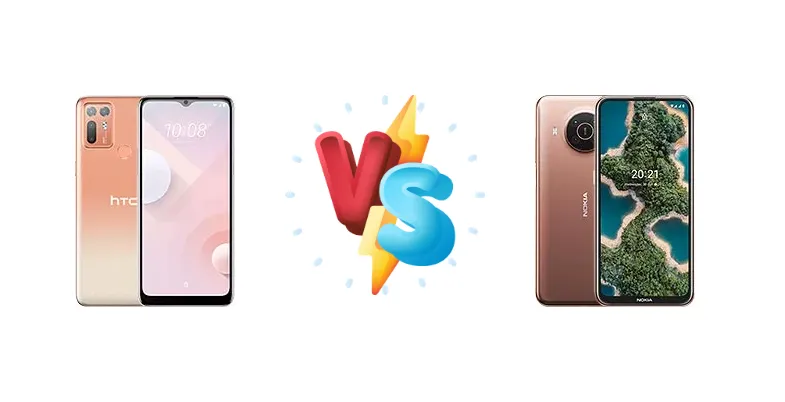
The HTC Desire 20+ and Nokia X20 represent distinct approaches to the mid-range smartphone market. The Desire 20+ leverages the established Snapdragon 720G, while the Nokia X20 embraces Qualcomm’s 5G-enabled Snapdragon 480. This comparison dissects their core components to determine which device delivers the best balance of performance, features, and value.
🏆 Quick Verdict
For the average user prioritizing consistent performance and a slightly smoother experience, the HTC Desire 20+ emerges as the better choice. Its Snapdragon 720G offers a noticeable edge in CPU and GPU capabilities, making it more suitable for demanding tasks and gaming, despite the Nokia X20's 5G connectivity.
| Network |
|---|
| 2G bands | GSM 850 / 900 / 1800 / 1900 - SIM 1 & SIM 2 | GSM 850 / 900 / 1800 / 1900 |
| 3G bands | HSDPA 850 / 900 / 1900 / 2100 | HSDPA 850 / 900 / 1700(AWS) / 1900 / 2100 |
| 4G bands | 1, 3, 5, 7, 8, 20, 28, 38, 40, 41 | 1, 2, 3, 4, 5, 7, 8, 12, 20, 28, 66, 38, 39, 40, 41 |
| 5G bands | - | 1, 2, 3, 5, 7, 28, 38, 41, 66, 78 SA/NSA/Sub6 |
| Speed | HSPA 42.2/5.76 Mbps, LTE-A, Cat6 300/75 Mbps | HSPA, LTE, 5G |
| Technology | GSM / HSPA / LTE | GSM / HSPA / LTE / 5G |
| Launch |
|---|
| Announced | 2020, October 19 | 2021, April 08 |
| Status | Available. Released 2020, October 22 | Available. Released 2021, May 12 |
| Body |
|---|
| Dimensions | 164.9 x 75.7 x 9 mm (6.49 x 2.98 x 0.35 in) | 168.9 x 79.7 x 9.1 mm (6.65 x 3.14 x 0.36 in) |
| SIM | Dual SIM (Nano-SIM, dual stand-by) | · Nano-SIM· Nano-SIM + Nano-SIM |
| Weight | 203 g (7.16 oz) | 220 g (7.76 oz) |
| Display |
|---|
| Protection | - | Corning Gorilla Glass 5 |
| Resolution | 720 x 1600 pixels, 20:9 ratio (~270 ppi density) | 1080 x 2400 pixels, 20:9 ratio (~395 ppi density) |
| Size | 6.5 inches, 102.0 cm2 (~81.7% screen-to-body ratio) | 6.67 inches, 107.4 cm2 (~79.8% screen-to-body ratio) |
| Type | IPS LCD | IPS LCD, 450 nits (typ) |
| Platform |
|---|
| CPU | Octa-core (2x2.3 GHz Kryo 465 Gold & 6x1.8 GHz Kryo 465 Silver) | Octa-core (2x2.0 GHz Kryo 460 & 6x1.8 GHz Kryo 460) |
| Chipset | Qualcomm SM7125 Snapdragon 720G (8 nm) | Qualcomm SM4350 Snapdragon 480 5G (8 nm) |
| GPU | Adreno 618 | Adreno 619 |
| OS | Android 10 | Android 11, upgradable to Android 14 |
| Memory |
|---|
| Card slot | microSDXC | microSDXC (uses shared SIM slot) |
| Internal | 128GB 6GB RAM | 128GB 6GB RAM, 128GB 8GB RAM |
| Main Camera |
|---|
| Features | Dual-LED flash, HDR, panorama | Zeiss optics, LED flash, HDR, panorama |
| Quad | 48 MP, f/1.8, 26mm (wide), 1/2.0", 0.8µm, PDAF
5 MP, f/2.2, 115˚ (ultrawide)
2 MP, f/2.4, (macro)
5 MP, f/2.4, (depth) | 64 MP, (wide), PDAF
5 MP, (ultrawide)
2 MP (macro)
Auxiliary lens |
| Single | - | 32 MP, (wide) |
| Video | 4K@30fps, 1080p@30fps | 1080p@30/60fps |
| Selfie camera |
|---|
| Features | HDR | - |
| Single | 16 MP, f/2.0, (wide) | 32 MP, (wide) |
| Video | 1080p@30fps | 1080p@30fps |
| Sound |
|---|
| 3.5mm jack | Yes | Yes |
| 35mm jack | - | Yes |
| Loudspeaker | Yes | Yes |
| Comms |
|---|
| Bluetooth | 5.0, A2DP, LE | 5.0, A2DP, LE, aptX HD |
| NFC | Yes | Yes |
| Positioning | GPS, GLONASS, GALILEO, BDS | GPS, GLONASS, GALILEO |
| Radio | No | FM radio |
| USB | USB Type-C 2.0, OTG | USB Type-C 2.0, OTG |
| WLAN | Wi-Fi 802.11 a/b/g/n/ac, dual-band, Wi-Fi Direct | Wi-Fi 802.11 a/b/g/n/ac, dual-band, Wi-Fi Direct |
| Features |
|---|
| Sensors | Fingerprint (rear-mounted), accelerometer, gyro, proximity, compass | Fingerprint (side-mounted), accelerometer, gyro, proximity |
| Battery |
|---|
| Charging | 15W wired, QC4 | 18W wired |
| Type | Li-Po 5000 mAh, non-removable | Li-Po 4470 mAh |
| Misc |
|---|
| Colors | Dawn Orange, Twilight Black, Blue | Midnight Sun, Nordic Blue |
| Models | - | TA-1341, TA-1344 |
| Price | About 250 EUR | About 130 EUR |
| SAR | - | 1.04 W/kg (head) 0.62 W/kg (body) |
| SAR EU | - | 0.51 W/kg (head) 1.29 W/kg (body) |
HTC Desire 20+
- Stronger CPU and GPU performance with Snapdragon 720G
- Potentially better power efficiency
- Faster processing for demanding apps
- Lacks 5G connectivity
- Slower charging speed (15W)
Nokia X20
- 5G connectivity for faster data speeds
- Faster charging (18W)
- Nokia's commitment to software updates
- Less powerful Snapdragon 480 chipset
- Potentially lower gaming performance
- May experience more thermal throttling
Display Comparison
Neither device boasts a standout display. Given the limited data, we can assume both utilize LCD panels common in this price bracket. The focus here shifts to processing power, as display quality is unlikely to be a differentiating factor. Bezels are likely comparable, and color accuracy will depend on software calibration, which is unknown for both.
Camera Comparison
Without detailed camera specs, a direct comparison is difficult. However, the chipset plays a role. The Snapdragon 720G’s image signal processor (ISP) is more advanced than the 480’s, potentially leading to better image processing, especially in low-light conditions. The Nokia X20’s 5G modem might consume more power, potentially impacting camera performance due to thermal constraints. We can assume both phones will feature a multi-camera setup, but the quality will depend heavily on sensor size and lens apertures, data not provided.
Performance
The core difference lies in the chipsets. The HTC Desire 20+’s Snapdragon 720G, built on an 8nm process, features a Kryo 465 CPU with a 2x2.3 GHz Gold and 6x1.8 GHz Silver configuration. This contrasts with the Nokia X20’s Snapdragon 480 5G, also 8nm, but with a 2x2.0 GHz Kryo 460 and 6x1.8 GHz Kryo 460 setup. While both have six efficiency cores running at the same speed, the 720G’s higher-clocked performance cores provide a clear advantage in single-core tasks and overall responsiveness. The 720G also benefits from a more capable Adreno 618 GPU, offering superior graphics performance compared to the 480’s Adreno 619. This translates to smoother gaming and faster rendering speeds for the Desire 20+.
Battery Life
The Nokia X20 has an 18W charging capability, slightly faster than the Desire 20+'s 15W QC4 charging. However, charging speed isn't everything. The Snapdragon 720G is generally more power-efficient than the 480, meaning the Desire 20+ might achieve comparable or even better battery life despite potentially having a similar or smaller battery capacity. The 720G’s efficiency allows it to complete tasks faster, spending less time at peak power draw.
Buying Guide
Buy the HTC Desire 20+ if you need a phone that handles multitasking and moderate gaming with ease, and aren't heavily reliant on 5G connectivity. Buy the Nokia X20 if 5G is a non-negotiable requirement and you prioritize future-proofing over raw processing power, and appreciate Nokia's software update commitment.
Frequently Asked Questions
❓ Will the Snapdragon 480 in the Nokia X20 struggle with graphically intensive games like PUBG Mobile?
Yes, the Snapdragon 480's Adreno 619 GPU is less powerful than the Adreno 618 in the Desire 20+. While PUBG Mobile will likely be playable, you'll likely need to lower graphics settings to maintain a smooth frame rate, and may experience occasional stuttering. The Desire 20+ will offer a more consistent gaming experience.
❓ Does the Nokia X20's 5G connectivity significantly impact battery life compared to the Desire 20+?
Potentially. 5G modems consume more power than 4G modems. While the Nokia X20 has a slightly faster charging speed, the Snapdragon 480's increased power draw could negate that advantage, resulting in shorter battery life during 5G usage. The Desire 20+'s more efficient Snapdragon 720G should offer better longevity on 4G networks.
❓ Is the difference in CPU performance between the Snapdragon 720G and 480 noticeable in everyday tasks?
Yes, the higher clock speeds of the Snapdragon 720G's performance cores will result in snappier app launches, smoother multitasking, and a more responsive user interface. While both phones are capable of handling basic tasks, the Desire 20+ will feel noticeably faster and more fluid.