
HTC Desire 20+ vs Motorola Edge 20 Fusion: A Deep Dive into Mid-Range Performance
| Phones Images | |||||
|---|---|---|---|---|---|
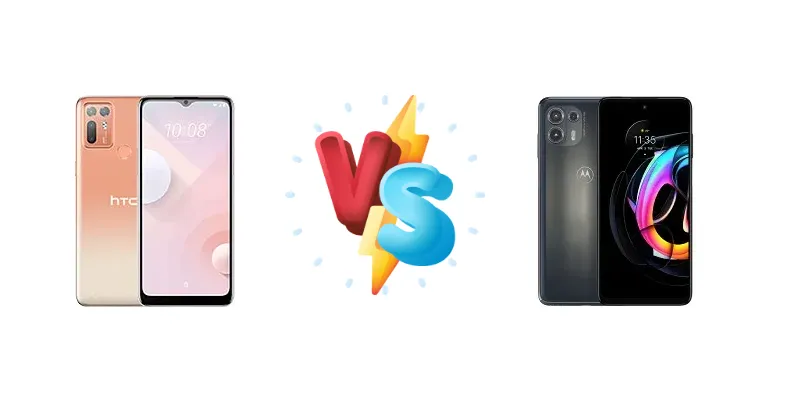
|
🏆 Quick Verdict
For the average user prioritizing responsiveness and future-proofing, the Motorola Edge 20 Fusion is the better choice. Its Mediatek Dimensity 800U chipset, built on a 7nm process, offers a noticeable performance advantage over the HTC Desire 20+'s Snapdragon 720G, and the 30W charging significantly reduces downtime.
| PHONES | ||
|---|---|---|
| Phone Names | HTC Desire 20+ | Motorola Edge 20 Fusion |
| Network | ||
|---|---|---|
| 2G bands | GSM 850 / 900 / 1800 / 1900 - SIM 1 & SIM 2 | GSM 850 / 900 / 1800 / 1900 |
| 3G bands | HSDPA 850 / 900 / 1900 / 2100 | HSDPA 850 / 900 / 1700(AWS) / 1900 / 2100 |
| 4G bands | 1, 3, 5, 7, 8, 20, 28, 38, 40, 41 | 1, 2, 3, 4, 5, 7, 8, 12, 13, 17, 18, 19, 20, 26, 28, 32, 34, 38, 39, 40, 41, 42, 43, 66 |
| 5G bands | - | 1, 3, 5, 7, 8, 20, 28, 38, 40, 41, 77, 78, 66 SA/NSA/Sub6 |
| Speed | HSPA 42.2/5.76 Mbps, LTE-A, Cat6 300/75 Mbps | HSPA 42.2/5.76 Mbps, LTE Cat18 1200/150 Mbps, 5G |
| Technology | GSM / HSPA / LTE | GSM / HSPA / LTE / 5G |
| Launch | ||
|---|---|---|
| Announced | 2020, October 19 | 2021, August 17 |
| Status | Available. Released 2020, October 22 | Available. Released 2021, August 27 |
| Body | ||
|---|---|---|
| Build | - | Glass front |
| Dimensions | 164.9 x 75.7 x 9 mm (6.49 x 2.98 x 0.35 in) | 166 x 76 x 8.3 mm (6.54 x 2.99 x 0.33 in) |
| SIM | Dual SIM (Nano-SIM, dual stand-by) | Nano-SIM + Nano-SIM |
| Weight | 203 g (7.16 oz) | 185 g (6.53 oz) |
| - | Water-repellent design | |
| Display | ||
|---|---|---|
| Resolution | 720 x 1600 pixels, 20:9 ratio (~270 ppi density) | 1080 x 2400 pixels, 20:9 ratio (~393 ppi density) |
| Size | 6.5 inches, 102.0 cm2 (~81.7% screen-to-body ratio) | 6.7 inches, 108.4 cm2 (~85.9% screen-to-body ratio) |
| Type | IPS LCD | OLED, 1B colors, 90Hz, HDR10+ |
| Platform | ||
|---|---|---|
| CPU | Octa-core (2x2.3 GHz Kryo 465 Gold & 6x1.8 GHz Kryo 465 Silver) | Octa-core (2x2.4 GHz Cortex-A76 & 6x2.0 GHz Cortex-A55) |
| Chipset | Qualcomm SM7125 Snapdragon 720G (8 nm) | Mediatek Dimensity 800U (7 nm) |
| GPU | Adreno 618 | Mali-G57 MC3 |
| OS | Android 10 | Android 11 |
| Memory | ||
|---|---|---|
| Card slot | microSDXC | microSDXC |
| Internal | 128GB 6GB RAM | 128GB 6GB RAM, 128GB 8GB RAM |
| Main Camera | ||
|---|---|---|
| Features | Dual-LED flash, HDR, panorama | LED flash, HDR, panorama |
| Quad | 48 MP, f/1.8, 26mm (wide), 1/2.0", 0.8µm, PDAF 5 MP, f/2.2, 115˚ (ultrawide) 2 MP, f/2.4, (macro) 5 MP, f/2.4, (depth) | - |
| Triple | - | 108 MP, f/1.9, (wide), 1/1.52", 0.7µm, PDAF 8 MP, f/2.2, 118˚ (ultrawide) Auxiliary lens |
| Video | 4K@30fps, 1080p@30fps | 4K@30fps, 1080p@30/60/120fps, gyro-EIS |
| Selfie camera | ||
|---|---|---|
| Features | HDR | HDR |
| Single | 16 MP, f/2.0, (wide) | 32 MP, f/2.3, (wide), 0.7µm |
| Video | 1080p@30fps | 1080p@30fps |
| Sound | ||
|---|---|---|
| 3.5mm jack | Yes | Yes |
| 35mm jack | - | Yes |
| Loudspeaker | Yes | Yes |
| Comms | ||
|---|---|---|
| Bluetooth | 5.0, A2DP, LE | 5.0, A2DP, LE |
| NFC | Yes | Yes |
| Positioning | GPS, GLONASS, GALILEO, BDS | GPS, GLONASS, GALILEO |
| Radio | No | FM radio |
| USB | USB Type-C 2.0, OTG | USB Type-C 2.0 |
| WLAN | Wi-Fi 802.11 a/b/g/n/ac, dual-band, Wi-Fi Direct | Wi-Fi 802.11 a/b/g/n/ac, dual-band, Wi-Fi Direct |
| Features | ||
|---|---|---|
| Sensors | Fingerprint (rear-mounted), accelerometer, gyro, proximity, compass | Fingerprint (side-mounted), accelerometer, gyro, proximity, compass |
| Battery | ||
|---|---|---|
| Charging | 15W wired, QC4 | 30W wired |
| Type | Li-Po 5000 mAh, non-removable | Li-Po 5000 mAh |
| Misc | ||
|---|---|---|
| Colors | Dawn Orange, Twilight Black, Blue | Electric Graphite, Cyber Teal |
| Price | About 250 EUR | About 250 EUR |
HTC Desire 20+
- Familiar HTC brand
- Potentially lower price point
- Qualcomm chipset offers good stability
- Slower Snapdragon 720G processor
- Slower 15W charging
- 8nm process less efficient than 7nm
Motorola Edge 20 Fusion
- Faster Mediatek Dimensity 800U processor
- Faster 30W charging
- 7nm process for better efficiency
- Motorola's software update track record can be inconsistent
- May be slightly more expensive than the Desire 20+
Display Comparison
Neither device boasts a standout display. While specific panel details (like peak brightness or color gamut coverage) are unavailable, the focus here is on the underlying processors. Display quality will likely be similar, leaning towards adequate for the price point. Bezels are expected to be comparable, typical of mid-range devices. The absence of high refresh rate panels on both devices suggests a focus on power efficiency rather than visual fluidity.
Camera Comparison
Without detailed camera specs beyond the chipsets, a direct comparison is limited. However, the processing capabilities of the Dimensity 800U generally offer more advanced image signal processing (ISP) features, potentially leading to better dynamic range and noise reduction in photos and videos. The Snapdragon 720G is capable, but the Edge 20 Fusion likely benefits from a more modern ISP. The prevalence of 2MP macro lenses on both devices suggests they are included for marketing purposes rather than significant photographic value.
Performance
The Motorola Edge 20 Fusion’s Mediatek Dimensity 800U, fabricated on a 7nm process, holds a clear advantage over the HTC Desire 20+'s Qualcomm Snapdragon 720G (8nm). The 7nm node allows for greater transistor density and improved power efficiency, translating to sustained performance under load. The Dimensity 800U’s Cortex-A76 cores, clocked at 2.4 GHz, outperform the Snapdragon 720G’s Kryo 465 Gold cores (2.3 GHz) in CPU-intensive tasks. While both utilize octa-core configurations, the architectural differences favor the Motorola. This difference will be most noticeable in demanding applications like gaming and video editing.
Battery Life
The battery capacity of both devices is not specified, making a direct mAh comparison impossible. However, the Motorola Edge 20 Fusion’s 30W wired charging is a significant advantage over the HTC Desire 20+'s 15W charging. This means the Edge 20 Fusion can replenish its battery much faster, reducing downtime. Even if the Desire 20+ had a slightly larger battery, the Edge 20 Fusion’s faster charging would likely make it more convenient for users who frequently need to top up their device.
Buying Guide
Buy the HTC Desire 20+ if you prioritize a familiar brand experience and are comfortable with slower charging speeds. It's a solid option for basic smartphone tasks and light media consumption. Buy the Motorola Edge 20 Fusion if you value faster performance for gaming and multitasking, and appreciate the convenience of rapid 30W charging. It’s the better pick for users who demand more from their device.