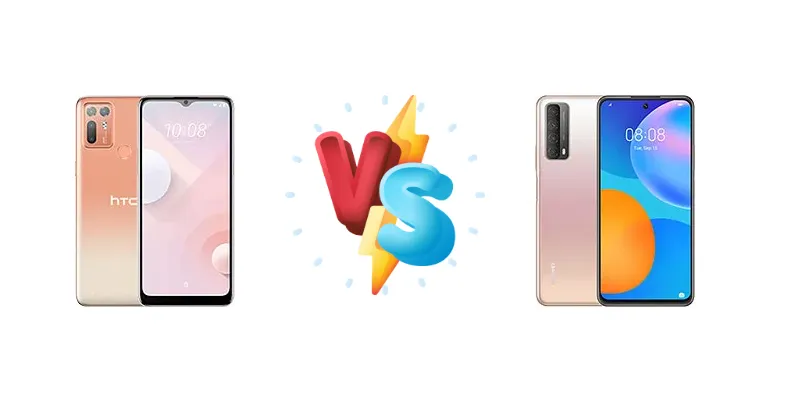
The HTC Desire 20+ and Huawei Y7a represent compelling options in the crowded budget smartphone market. While both aim to deliver essential features at an accessible price point, they diverge significantly in their core hardware. This comparison dissects the key differences, focusing on the impact of their respective chipsets and charging technologies on real-world performance.
🏆 Quick Verdict
For the average user prioritizing sustained performance and future-proofing, the HTC Desire 20+ is the better choice. Its Qualcomm Snapdragon 720G offers a more efficient and capable architecture than the Huawei Y7a’s Kirin 710A, despite the Y7a’s faster charging.
| Network |
|---|
| 2G bands | GSM 850 / 900 / 1800 / 1900 - SIM 1 & SIM 2 | GSM 900 / 1800 / 1900 |
| 3G bands | HSDPA 850 / 900 / 1900 / 2100 | HSDPA 850 / 900 / 1900 / 2100 |
| 4G bands | 1, 3, 5, 7, 8, 20, 28, 38, 40, 41 | 1, 3, 5, 7, 8, 20, 28, 38, 40, 41 |
| Speed | HSPA 42.2/5.76 Mbps, LTE-A, Cat6 300/75 Mbps | HSPA, LTE |
| Technology | GSM / HSPA / LTE | GSM / HSPA / LTE |
| Launch |
|---|
| Announced | 2020, October 19 | 2020, October 21. Released 2020, October 30 |
| Status | Available. Released 2020, October 22 | Discontinued |
| Body |
|---|
| Dimensions | 164.9 x 75.7 x 9 mm (6.49 x 2.98 x 0.35 in) | 165.7 x 76.9 x 9.3 mm (6.52 x 3.03 x 0.37 in) |
| Keyboard | - | QWERTY |
| SIM | Dual SIM (Nano-SIM, dual stand-by) | Nano-SIM + Nano-SIM |
| Weight | 203 g (7.16 oz) | 206 g (7.27 oz) |
| Display |
|---|
| Resolution | 720 x 1600 pixels, 20:9 ratio (~270 ppi density) | 1080 x 2400 pixels, 20:9 ratio (~395 ppi density) |
| Size | 6.5 inches, 102.0 cm2 (~81.7% screen-to-body ratio) | 6.67 inches, 107.4 cm2 (~84.3% screen-to-body ratio) |
| Type | IPS LCD | IPS LCD |
| Platform |
|---|
| CPU | Octa-core (2x2.3 GHz Kryo 465 Gold & 6x1.8 GHz Kryo 465 Silver) | Octa-core (4x2.0 GHz Cortex-A73 & 4x1.7 GHz Cortex-A53) |
| Chipset | Qualcomm SM7125 Snapdragon 720G (8 nm) | Kirin 710A (14 nm) |
| GPU | Adreno 618 | Mali-G51 MP4 |
| OS | Android 10 | Android 10, EMUI 10.1, no Google Play Services |
| Memory |
|---|
| Card slot | microSDXC | microSDXC (dedicated slot) |
| Internal | 128GB 6GB RAM | 64GB 4GB RAM, 128GB 4GB RAM |
| Main Camera |
|---|
| Features | Dual-LED flash, HDR, panorama | LED flash, HDR, panorama |
| Quad | 48 MP, f/1.8, 26mm (wide), 1/2.0", 0.8µm, PDAF
5 MP, f/2.2, 115˚ (ultrawide)
2 MP, f/2.4, (macro)
5 MP, f/2.4, (depth) | 48 MP, f/1.8, 26mm (wide), 1/2.0", 0.8µm, PDAF
8 MP, f/2.4, 120˚ (ultrawide), 1/4.0", 1.12µm
2 MP (macro)
Auxiliary lens |
| Single | - | 5 MP, AF |
| Video | 4K@30fps, 1080p@30fps | 1080p@30/60fps |
| Selfie camera |
|---|
| Features | HDR | HDR |
| Single | 16 MP, f/2.0, (wide) | 8 MP, f/2.0, (wide) |
| Video | 1080p@30fps | 1080p@30fps |
| Sound |
|---|
| 3.5mm jack | Yes | Yes |
| 35mm jack | - | Yes |
| Loudspeaker | Yes | Yes |
| Comms |
|---|
| Bluetooth | 5.0, A2DP, LE | 5.1, A2DP, LE |
| NFC | Yes | No |
| Positioning | GPS, GLONASS, GALILEO, BDS | GPS, GLONASS, BDS |
| Radio | No | FM radio |
| USB | USB Type-C 2.0, OTG | USB Type-C 2.0, OTG |
| WLAN | Wi-Fi 802.11 a/b/g/n/ac, dual-band, Wi-Fi Direct | Wi-Fi 802.11 b/g/n, Wi-Fi Direct |
| Features |
|---|
| Sensors | Fingerprint (rear-mounted), accelerometer, gyro, proximity, compass | Fingerprint (side-mounted), accelerometer, proximity |
| Battery |
|---|
| Charging | 15W wired, QC4 | 22.5W wired, 46% in 30 min |
| Stand-by | - | Up to 144 h (3G) |
| Talk time | - | Up to 15 h (3G) |
| Type | Li-Po 5000 mAh, non-removable | Li-Po 5000 mAh |
| Misc |
|---|
| Colors | Dawn Orange, Twilight Black, Blue | Crush Green, Blush Gold, Midnight Black |
| Models | - | PPA-LX3 |
| Price | About 250 EUR | About 160 EUR |
| SAR | - | 0.37 W/kg (head) 0.90 W/kg (body) |
HTC Desire 20+
- More powerful and efficient Snapdragon 720G chipset
- Potentially better image processing due to advanced ISP
- Likely longer software support due to newer chipset
- Slower charging speed (15W vs 22.5W)
- Limited information on display specifications
Huawei Y7a
- Faster 22.5W wired charging
- Potentially lower price point
- Adequate for basic smartphone tasks
- Less powerful and efficient Kirin 710A chipset
- Older 14nm process technology
- Potentially shorter software support lifecycle
Display Comparison
Display specifications are not provided, so a direct comparison is limited. However, given the price bracket, both likely feature LCD panels. The absence of information regarding refresh rates suggests both are standard 60Hz displays. The user experience will likely be similar in terms of visual fidelity, but the Desire 20+'s potential for future software optimizations with a more powerful chipset could lead to better display calibration over time.
Camera Comparison
Camera details are limited. Without sensor size or aperture information, a definitive comparison is difficult. However, the Snapdragon 720G’s image signal processor (ISP) is generally more advanced than the Kirin 710A’s, potentially leading to better image processing, especially in low-light conditions. The absence of information suggests both phones likely feature a standard camera setup for their price range, with the Desire 20+ potentially offering slightly better image quality due to its superior ISP.
Performance
The core difference lies in the chipsets. The HTC Desire 20+ utilizes the Qualcomm Snapdragon 720G, fabricated on an 8nm process. This translates to greater transistor density and improved power efficiency compared to the Huawei Y7a’s Kirin 710A, built on a less efficient 14nm process. The Snapdragon 720G’s CPU configuration – 2x2.3 GHz Kryo 465 Gold & 6x1.8 GHz Kryo 465 Silver – offers a performance advantage over the Kirin 710A’s 4x2.0 GHz Cortex-A73 & 4x1.7 GHz Cortex-A53. The Kryo cores are architecturally more advanced, leading to better single-core and multi-core performance. This difference will be most noticeable in demanding applications and multitasking scenarios. The Snapdragon 720G also benefits from a more capable Adreno GPU, providing a smoother gaming experience.
Battery Life
Battery capacities are not provided. However, the Huawei Y7a boasts 22.5W wired charging, capable of reaching 46% charge in 30 minutes, while the HTC Desire 20+ is limited to 15W charging with Quick Charge 4 (QC4) support. While the Desire 20+’s QC4 support offers some optimization, the Y7a’s higher wattage provides a significantly faster initial charge. However, the Snapdragon 720G’s superior power efficiency could offset the Y7a’s faster charging in real-world usage, potentially resulting in comparable overall battery life despite a potentially smaller battery capacity.
Buying Guide
Buy the HTC Desire 20+ if you need a phone capable of handling moderate gaming, multitasking, and benefit from a more modern chipset architecture for longer software support. Buy the Huawei Y7a if you prioritize quick top-ups and are primarily focused on basic smartphone tasks like calling, texting, and light social media use, and are comfortable with the limitations of the older Kirin chipset.
Frequently Asked Questions
❓ Will the Kirin 710A in the Huawei Y7a struggle with demanding games like PUBG Mobile?
Yes, the Kirin 710A is likely to struggle with PUBG Mobile at higher settings. While playable at lower graphics settings, users should expect frame drops and potential lag, especially during intense firefights. The Snapdragon 720G in the Desire 20+ offers a significantly smoother gaming experience.
❓ Does the slower 15W charging on the HTC Desire 20+ make it impractical for users who need quick top-ups?
While slower than the Y7a’s 22.5W charging, the Snapdragon 720G’s power efficiency means the Desire 20+ may not require as frequent charging. Furthermore, Quick Charge 4 (QC4) support optimizes the charging process, mitigating some of the speed difference. It's still slower, but not necessarily impractical.
❓ How will the chipset difference affect the long-term performance and software updates of these phones?
The Snapdragon 720G is a more modern chipset, meaning the HTC Desire 20+ is likely to receive software updates for a longer period. The Kirin 710A is an older chipset, and Huawei’s software update track record is less consistent, potentially leading to the Y7a becoming outdated sooner.