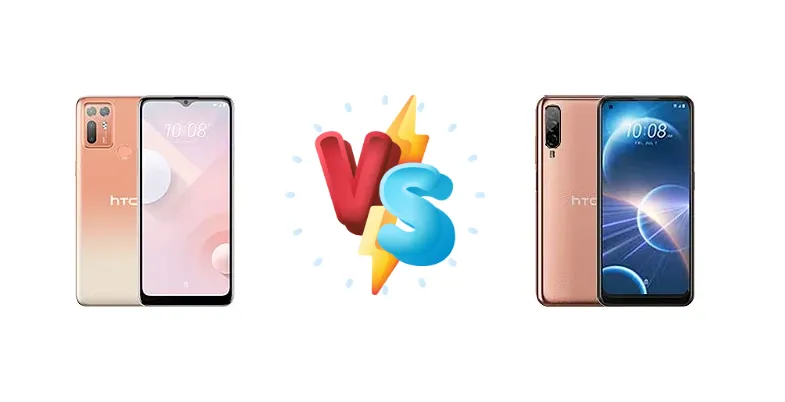
The HTC Desire line continues to offer accessible smartphones, but the jump from the Desire 20+ to the 22 Pro isn't a simple generational upgrade. While both target the budget-conscious consumer, they represent different priorities: the 20+ focuses on a proven, if older, chipset, while the 22 Pro embraces 5G connectivity with a newer, but less powerful, processor. This comparison dissects the key differences to help you determine which device best suits your needs.
🏆 Quick Verdict
For most users, the HTC Desire 22 Pro is the better buy. Its Snapdragon 695 5G offers future-proofing with 5G support, and the inclusion of wireless and reverse-wired charging adds significant convenience. While the 20+'s Snapdragon 720G is still capable, the 22 Pro's added features justify the likely price difference.
| Network |
|---|
| 2G bands | GSM 850 / 900 / 1800 / 1900 - SIM 1 & SIM 2 | GSM 850 / 900 / 1800 / 1900 |
| 3G bands | HSDPA 850 / 900 / 1900 / 2100 | HSDPA 850 / 900 / 1700(AWS) / 1900 / 2100 |
| 4G bands | 1, 3, 5, 7, 8, 20, 28, 38, 40, 41 | 1, 3, 5, 7, 8, 20, 28, 38, 39, 40, 41 |
| 5G bands | - | 1, 3, 7, 20, 28, 41, 78 SA/NSA |
| Speed | HSPA 42.2/5.76 Mbps, LTE-A, Cat6 300/75 Mbps | HSPA, LTE, 5G |
| Technology | GSM / HSPA / LTE | GSM / HSPA / LTE / 5G |
| Launch |
|---|
| Announced | 2020, October 19 | 2022, June 28 |
| Status | Available. Released 2020, October 22 | Available. Released 2022, July 10 |
| Body |
|---|
| Dimensions | 164.9 x 75.7 x 9 mm (6.49 x 2.98 x 0.35 in) | 166.3 x 76.9 x 9.4 mm (6.55 x 3.03 x 0.37 in) |
| SIM | Dual SIM (Nano-SIM, dual stand-by) | Nano-SIM + Nano-SIM |
| Weight | 203 g (7.16 oz) | 205.5 g (7.27 oz) |
| | - | IP67 dust/water resistant (up to 1m for 30 min) |
| Display |
|---|
| Protection | - | Corning Gorilla Glass |
| Resolution | 720 x 1600 pixels, 20:9 ratio (~270 ppi density) | 1080 x 2412 pixels, 20:9 ratio (~400 ppi density) |
| Size | 6.5 inches, 102.0 cm2 (~81.7% screen-to-body ratio) | 6.6 inches, 104.8 cm2 (~82.0% screen-to-body ratio) |
| Type | IPS LCD | IPS LCD, 120Hz |
| Platform |
|---|
| CPU | Octa-core (2x2.3 GHz Kryo 465 Gold & 6x1.8 GHz Kryo 465 Silver) | Octa-core (2x2.2 GHz Kryo 660 Gold & 6x1.7 GHz Kryo 660 Silver) |
| Chipset | Qualcomm SM7125 Snapdragon 720G (8 nm) | Qualcomm SM6375 Snapdragon 695 5G (6 nm) |
| GPU | Adreno 618 | Adreno 619 |
| OS | Android 10 | Android 12 |
| Memory |
|---|
| Card slot | microSDXC | microSDXC (uses shared SIM slot) |
| Internal | 128GB 6GB RAM | 128GB 8GB RAM |
| Main Camera |
|---|
| Features | Dual-LED flash, HDR, panorama | Dual-LED flash, HDR, panorama |
| Quad | 48 MP, f/1.8, 26mm (wide), 1/2.0", 0.8µm, PDAF
5 MP, f/2.2, 115˚ (ultrawide)
2 MP, f/2.4, (macro)
5 MP, f/2.4, (depth) | - |
| Triple | - | 64 MP, f/1.8, (wide), PDAF
13 MP, f/2.4, 118˚ (ultrawide)
Auxiliary lens |
| Video | 4K@30fps, 1080p@30fps | 1080p@30fps |
| Selfie camera |
|---|
| Features | HDR | HDR |
| Single | 16 MP, f/2.0, (wide) | 32 MP, f/2.0, (wide) |
| Video | 1080p@30fps | 1080p@30fps |
| Sound |
|---|
| 3.5mm jack | Yes | Yes |
| 35mm jack | - | Yes |
| Loudspeaker | Yes | Yes |
| Comms |
|---|
| Bluetooth | 5.0, A2DP, LE | 5.1, A2DP, LE |
| NFC | Yes | Yes |
| Positioning | GPS, GLONASS, GALILEO, BDS | GPS, GLONASS, GALILEO, BDS |
| Radio | No | Unspecified |
| USB | USB Type-C 2.0, OTG | USB Type-C 2.0, OTG |
| WLAN | Wi-Fi 802.11 a/b/g/n/ac, dual-band, Wi-Fi Direct | Wi-Fi 802.11 a/b/g/n/ac, dual-band, Wi-Fi Direct |
| Features |
|---|
| Sensors | Fingerprint (rear-mounted), accelerometer, gyro, proximity, compass | Fingerprint (side-mounted), accelerometer, gyro, proximity, compass |
| Battery |
|---|
| Charging | 15W wired, QC4 | 18W wired
Wireless
Reverse wired |
| Type | Li-Po 5000 mAh, non-removable | Li-Po 4520 mAh |
| Misc |
|---|
| Colors | Dawn Orange, Twilight Black, Blue | Wave Gold, Starry Night Black |
| Price | About 250 EUR | About 460 EUR |
HTC Desire 20+
- Potentially higher CPU performance with Snapdragon 720G
- Proven chipset with established reliability
- Likely more affordable price point
- Lacks 5G connectivity
- Limited to 15W wired charging
- No wireless or reverse charging
HTC Desire 22 Pro
- 5G connectivity for future-proofing
- 18W wired charging with wireless and reverse-wired charging
- More power-efficient 6nm Snapdragon 695
- Slightly lower CPU clock speeds
- Potentially lower performance in CPU-intensive tasks
- May be slightly more expensive
Display Comparison
Unfortunately, detailed display specifications are unavailable. However, given the market positioning of both devices, it's reasonable to assume both utilize LCD panels. The Desire 22 Pro's newer chipset *could* potentially support a higher refresh rate, but this is unconfirmed. Bezels are likely comparable, reflecting the budget nature of both phones. Color accuracy will likely be standard for this price range, prioritizing power efficiency over color calibration.
Camera Comparison
Detailed camera specs are lacking, making a direct comparison difficult. However, both phones likely feature multi-camera setups geared towards general photography. The absence of high-resolution sensors or advanced features suggests a focus on affordability. Image processing will likely differ, with the 22 Pro potentially benefiting from Qualcomm's newer ISP for improved noise reduction and dynamic range. Without specific sensor details, it's difficult to declare a clear winner, but the 22 Pro's newer chipset *could* offer slightly better image processing capabilities.
Performance
The core difference lies in the chipsets. The Desire 20+ boasts the Qualcomm Snapdragon 720G (8nm), featuring an octa-core CPU with 2x2.3 GHz Kryo 465 Gold and 6x1.8 GHz Kryo 465 Silver cores. The Desire 22 Pro steps down to the Snapdragon 695 5G (6nm), with a slightly lower clocked octa-core CPU: 2x2.2 GHz Kryo 660 Gold and 6x1.7 GHz Kryo 660 Silver. While the 720G has a clock speed advantage, the 695's 6nm process offers improved power efficiency. The 6nm node translates to less heat generation under sustained load, potentially mitigating throttling. The 695 also integrates a 5G modem, a key advantage for future network compatibility. The 20+ will likely outperform in CPU-intensive tasks, but the 22 Pro will excel in 5G connectivity and sustained performance due to thermal efficiency.
Battery Life
Battery capacity is not specified for either device. However, the Desire 22 Pro gains a significant advantage with its 18W wired charging, wireless charging, and reverse-wired charging capabilities. The Desire 20+ is limited to 15W wired charging with Quick Charge 4.0. The addition of wireless and reverse charging on the 22 Pro provides substantial convenience, allowing for cable-free charging and the ability to top up other devices. While a larger battery capacity on the 20+ could offset the slower charging, the 22 Pro's charging versatility is a compelling feature.
Buying Guide
Buy the HTC Desire 20+ if you prioritize a slightly more powerful processor for demanding tasks and don't require 5G connectivity. It's a solid choice for users who primarily use their phone for everyday tasks and occasional gaming. Buy the HTC Desire 22 Pro if you want 5G capabilities, the convenience of wireless charging, and the flexibility of reverse-wired charging, even if it means a slight performance trade-off. This phone is ideal for users who want a modern feature set without breaking the bank.
Frequently Asked Questions
❓ Does the Snapdragon 695 in the Desire 22 Pro struggle with graphically demanding games like Genshin Impact?
While the Snapdragon 695 isn't a gaming powerhouse, it can handle many popular titles at medium settings. Genshin Impact will likely require lower graphics settings and may experience occasional frame drops. The 6nm process helps with thermal throttling, but sustained gaming will still generate heat.
❓ Is the reverse-wired charging on the Desire 22 Pro fast enough to meaningfully charge other devices?
The reverse-wired charging on the Desire 22 Pro is relatively slow, offering around 5-10W of output. It's best suited for topping up accessories like wireless earbuds or smartwatches, rather than fully charging another smartphone. It's a convenience feature, not a replacement for a dedicated charger.
❓ How much faster is 5G on the Desire 22 Pro compared to 4G on the Desire 20+ in real-world scenarios?
5G speeds on the Desire 22 Pro will vary significantly depending on network coverage and carrier. In areas with strong 5G signal, you can expect download speeds several times faster than 4G. However, in areas with limited 5G coverage, the difference may be minimal.