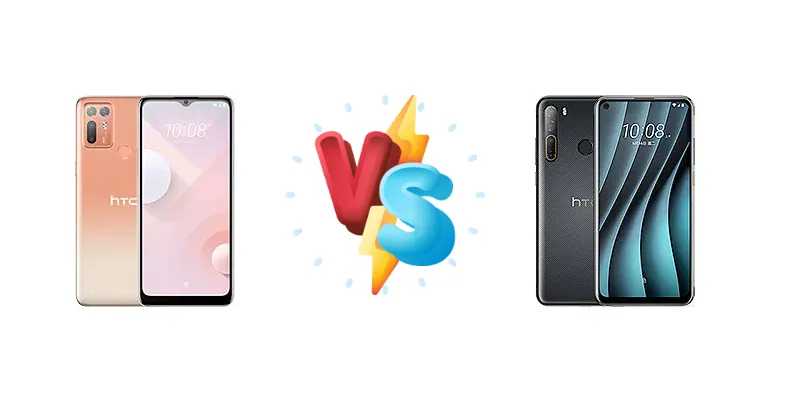
The HTC Desire 20+ and 20 Pro represent HTC's attempts to deliver competitive smartphones in the mid-range segment. While visually similar, the core difference lies under the hood: the Desire 20+ boasts the more modern Snapdragon 720G, while the 20 Pro relies on the older Snapdragon 665. This comparison will dissect these chipset differences and their impact on real-world performance, battery life, and overall user experience.
🏆 Quick Verdict
For the average user prioritizing performance and future-proofing, the HTC Desire 20+ is the clear winner. The Snapdragon 720G offers a significant performance uplift over the 665, translating to smoother multitasking, faster app loading, and a better gaming experience. While both phones share the same 15W charging, the 20+'s efficiency gains make it the more sensible choice.
| Network |
|---|
| 2G bands | GSM 850 / 900 / 1800 / 1900 - SIM 1 & SIM 2 | GSM 850 / 900 / 1800 / 1900 |
| 3G bands | HSDPA 850 / 900 / 1900 / 2100 | HSDPA 850 / 900 / 1900 / 2100 |
| 4G bands | 1, 3, 5, 7, 8, 20, 28, 38, 40, 41 | 1, 2, 3, 5, 7, 8, 20, 28, 38, 39, 40, 41 |
| EDGE | - | No |
| GPRS | - | No |
| Speed | HSPA 42.2/5.76 Mbps, LTE-A, Cat6 300/75 Mbps | HSPA 42.2/5.76 Mbps, LTE (2CA) Cat13 400/150 Mbps |
| Technology | GSM / HSPA / LTE | GSM / HSPA / LTE |
| Launch |
|---|
| Announced | 2020, October 19 | 2020, June 16. Released 2020, July 18 |
| Status | Available. Released 2020, October 22 | Discontinued |
| Body |
|---|
| Dimensions | 164.9 x 75.7 x 9 mm (6.49 x 2.98 x 0.35 in) | 162 x 77 x 9.4 mm (6.38 x 3.03 x 0.37 in) |
| SIM | Dual SIM (Nano-SIM, dual stand-by) | Nano-SIM + Nano-SIM |
| Weight | 203 g (7.16 oz) | 201 g (7.09 oz) |
| Display |
|---|
| Resolution | 720 x 1600 pixels, 20:9 ratio (~270 ppi density) | 1080 x 2340 pixels, 19.5:9 ratio (~396 ppi density) |
| Size | 6.5 inches, 102.0 cm2 (~81.7% screen-to-body ratio) | 6.5 inches, 103.7 cm2 (~83.1% screen-to-body ratio) |
| Type | IPS LCD | IPS LCD |
| Platform |
|---|
| CPU | Octa-core (2x2.3 GHz Kryo 465 Gold & 6x1.8 GHz Kryo 465 Silver) | Octa-core (4x2.0 GHz Kryo 260 Gold & 4x1.8 GHz Kryo 260 Silver) |
| Chipset | Qualcomm SM7125 Snapdragon 720G (8 nm) | Qualcomm SM6125 Snapdragon 665 (11 nm) |
| GPU | Adreno 618 | Adreno 610 |
| OS | Android 10 | Android 10 |
| Memory |
|---|
| Call records | - | 20 dialed, 20 received, 20 missed calls |
| Card slot | microSDXC | microSDXC |
| Internal | 128GB 6GB RAM | 128GB 6GB RAM |
| Phonebook | - | 1000 entries |
| Main Camera |
|---|
| Features | Dual-LED flash, HDR, panorama | Dual-LED flash, HDR, panorama |
| Quad | 48 MP, f/1.8, 26mm (wide), 1/2.0", 0.8µm, PDAF
5 MP, f/2.2, 115˚ (ultrawide)
2 MP, f/2.4, (macro)
5 MP, f/2.4, (depth) | 48 MP, f/1.8, 26mm (wide), 1/2.0", 0.8µm, PDAF
8 MP, f/2.2, 118˚ (ultrawide), 1/4.0", 1.12µm
2 MP (macro)
Auxiliary lens |
| Video | 4K@30fps, 1080p@30fps | 4K@30fps, 1080p@30fps |
| Selfie camera |
|---|
| Features | HDR | HDR |
| Single | 16 MP, f/2.0, (wide) | 25 MP, f/2.0, (wide) |
| Video | 1080p@30fps | 1080p@30fps |
| Sound |
|---|
| 3.5mm jack | Yes | Yes |
| 35mm jack | - | Yes |
| Loudspeaker | Yes | Yes |
| Comms |
|---|
| Bluetooth | 5.0, A2DP, LE | 5.0, A2DP, LE |
| NFC | Yes | Yes |
| Positioning | GPS, GLONASS, GALILEO, BDS | GPS, GLONASS, GALILEO, BDS |
| Radio | No | FM radio |
| USB | USB Type-C 2.0, OTG | USB Type-C 2.0, OTG |
| WLAN | Wi-Fi 802.11 a/b/g/n/ac, dual-band, Wi-Fi Direct | Wi-Fi 802.11 a/b/g/n/ac, dual-band, Wi-Fi Direct |
| Features |
|---|
| Games | - | Yes |
| Java | - | Yes |
| Messaging | - | SMS |
| Sensors | Fingerprint (rear-mounted), accelerometer, gyro, proximity, compass | Fingerprint (rear-mounted), accelerometer, gyro, proximity, compass |
| Battery |
|---|
| Charging | 15W wired, QC4 | 15W wired, QC3 |
| Stand-by | - | Up to 570 h |
| Talk time | - | Up to 8 h 40 min |
| Type | Li-Po 5000 mAh, non-removable | Li-Po 5000 mAh |
| Misc |
|---|
| Colors | Dawn Orange, Twilight Black, Blue | Smoky Black, Pretty Blue, Crystal Green |
| Price | About 250 EUR | About 660 EUR |
| SAR EU | - | 0.56 W/kg (head) |
HTC Desire 20+
- Significantly faster processor (Snapdragon 720G)
- Improved power efficiency for longer battery life
- Better image processing capabilities
- More responsive user experience
- Potentially higher price point
- May not offer a drastically different visual experience
HTC Desire 20 Pro
- Potentially lower price
- Sufficient for basic smartphone tasks
- Acceptable battery life for light usage
- Familiar Android experience
- Noticeably slower processor (Snapdragon 665)
- Limited gaming performance
- Less efficient power consumption
- Slower app loading times
Display Comparison
Both devices likely feature similar LCD panels, given their market positioning. However, the chipset differences don't directly impact display quality. We can infer that both will offer adequate viewing angles and color reproduction for everyday use. Without specific display specs, it's difficult to determine differences in brightness or color accuracy. Bezels are likely comparable, reflecting the budget-conscious design.
Camera Comparison
Without detailed camera specifications beyond the chipsets, a direct comparison is limited. However, the Snapdragon 720G includes a more capable Image Signal Processor (ISP) than the 665. This means the 20+ will likely offer better image processing, resulting in sharper images, improved dynamic range, and more accurate colors, even if both phones share the same sensor. The 720G’s ISP also supports features like slow-motion video recording at higher frame rates and improved low-light performance. The presence of a more powerful ISP is more impactful than any marginal sensor differences at this price point.
Performance
The core differentiator is the chipset. The HTC Desire 20+’s Qualcomm SM7125 Snapdragon 720G, built on an 8nm process, represents a substantial upgrade over the Desire 20 Pro’s Snapdragon 665 (11nm). The 720G’s Kryo 465 Gold cores, clocked at 2.3 GHz, provide a noticeable performance boost compared to the 665’s 2.0 GHz Kryo 260 Gold cores. The 8nm process also contributes to improved power efficiency, meaning the 20+ will likely run cooler and consume less battery during intensive tasks. This translates to a smoother experience when multitasking, launching apps, and playing graphically demanding games. The 720G’s Adreno 618 GPU also significantly outperforms the 665’s Adreno 610.
Battery Life
Both phones feature 15W wired charging with Quick Charge (QC) support – QC4 for the 20+ and QC3 for the 20 Pro. While the charging wattage is identical, the Snapdragon 720G’s 8nm process is more power-efficient. This means the Desire 20+ will likely achieve a longer battery life on a single charge and potentially reach 100% charge slightly faster due to reduced heat generation during charging. The actual 0-100% charge time will depend on battery capacity (not specified), but the 20+ has an inherent advantage in power management.
Buying Guide
Buy the HTC Desire 20+ if you need a phone capable of handling demanding apps, enjoy mobile gaming, and want a device that will remain responsive for longer. Buy the HTC Desire 20 Pro if you prioritize a potentially lower price point and your usage is limited to basic tasks like calling, texting, and light social media browsing. The 20 Pro is best suited for users who don't push their smartphones to their limits.
Frequently Asked Questions
❓ Will the Snapdragon 665 in the Desire 20 Pro struggle with modern mobile games like PUBG or Call of Duty?
Yes, the Snapdragon 665 is likely to struggle with graphically demanding games like PUBG or Call of Duty, even at lower settings. Expect noticeable frame drops and lag, making the experience less enjoyable. The Snapdragon 720G in the Desire 20+ offers a much smoother gaming experience.
❓ Does the Desire 20+’s Quick Charge 4 support offer a significant charging speed advantage over the Desire 20 Pro’s Quick Charge 3?
While both support Quick Charge, QC4 is generally more efficient and can negotiate higher voltages and currents. However, since both phones are limited to 15W charging, the real-world difference in charging speed will be minimal. The 20+'s efficiency gains will be more noticeable in battery life than charging time.
❓ Is the difference in performance between the two chipsets noticeable for everyday tasks like browsing and social media?
Yes, the difference is noticeable. The Snapdragon 720G in the Desire 20+ will result in snappier app launches, smoother scrolling, and a more responsive overall experience, even with everyday tasks. The 665 in the 20 Pro may exhibit slight lag or delays when multitasking.