
HTC Desire 20 Pro vs Xiaomi Redmi Note 12 Pro: A Detailed Comparison
| Phones Images | |||||
|---|---|---|---|---|---|
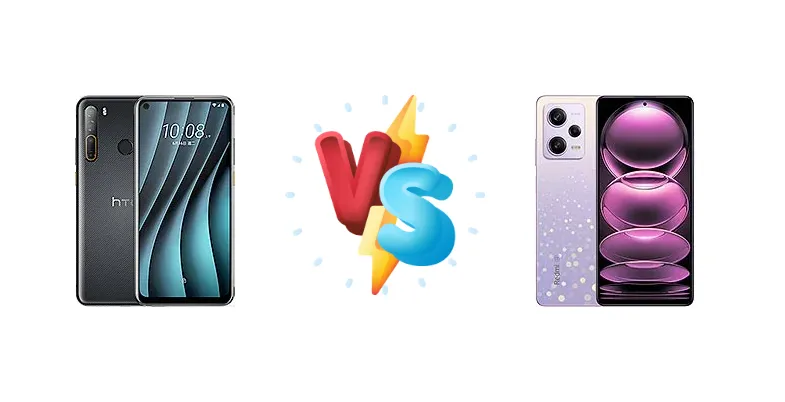
|
🏆 Quick Verdict
For most users, the Xiaomi Redmi Note 12 Pro is the superior choice. Its Mediatek Dimensity 1080 chipset delivers significantly better performance than the Snapdragon 665 in the Desire 20 Pro, and the 67W charging is a game-changer, fully charging the device in just 46 minutes compared to the Desire 20 Pro's slower 15W charging.
| PHONES | ||
|---|---|---|
| Phone Names | HTC Desire 20 Pro | Xiaomi Redmi Note 12 Pro |
| Network | ||
|---|---|---|
| 2G bands | GSM 850 / 900 / 1800 / 1900 | GSM 850 / 900 / 1800 / 1900 |
| 3G bands | HSDPA 850 / 900 / 1900 / 2100 | HSDPA 800 / 850 / 900 / 1900 / 2100 |
| 4G bands | 1, 2, 3, 5, 7, 8, 20, 28, 38, 39, 40, 41 | 1, 2, 3, 4, 5, 7, 8, 12, 13, 17, 18, 19, 20, 26, 28, 32, 38, 40, 41, 66 - International |
| 5G bands | - | 1, 3, 5, 7, 8, 20, 28, 38, 40, 41, 66, 77, 78 SA/NSA - International |
| EDGE | No | - |
| GPRS | No | - |
| Speed | HSPA 42.2/5.76 Mbps, LTE (2CA) Cat13 400/150 Mbps | HSPA, LTE, 5G |
| Technology | GSM / HSPA / LTE | GSM / CDMA / HSPA / EVDO / LTE / 5G |
| - | 1, 3, 5, 8, 28, 38, 41, 77, 78 SA/NSA - China | |
| Launch | ||
|---|---|---|
| Announced | 2020, June 16. Released 2020, July 18 | 2022, October 27 |
| Status | Discontinued | Available. Released 2022, November 01 |
| Body | ||
|---|---|---|
| Build | - | Glass front (Gorilla Glass 5), glass back, plastic frame |
| Dimensions | 162 x 77 x 9.4 mm (6.38 x 3.03 x 0.37 in) | 163 x 76 x 8 mm (6.42 x 2.99 x 0.31 in) |
| SIM | Nano-SIM + Nano-SIM | Nano-SIM + Nano-SIM |
| Weight | 201 g (7.09 oz) | 187 g (6.60 oz) |
| - | IP53, dust and splash resistant | |
| Display | ||
|---|---|---|
| Protection | - | Corning Gorilla Glass 5 |
| Resolution | 1080 x 2340 pixels, 19.5:9 ratio (~396 ppi density) | 1080 x 2400 pixels, 20:9 ratio (~395 ppi density) |
| Size | 6.5 inches, 103.7 cm2 (~83.1% screen-to-body ratio) | 6.67 inches, 107.4 cm2 (~86.7% screen-to-body ratio) |
| Type | IPS LCD | AMOLED, 1B colors, 120Hz, Dolby Vision, HDR10+, 500 nits (typ), 900 nits (HBM) |
| Platform | ||
|---|---|---|
| CPU | Octa-core (4x2.0 GHz Kryo 260 Gold & 4x1.8 GHz Kryo 260 Silver) | Octa-core (2x2.6 GHz Cortex-A78 & 6x2.0 GHz Cortex-A55) |
| Chipset | Qualcomm SM6125 Snapdragon 665 (11 nm) | Mediatek Dimensity 1080 (6 nm) |
| GPU | Adreno 610 | Mali-G68 MC4 |
| OS | Android 10 | Android 12, MIUI 13 |
| Memory | ||
|---|---|---|
| Call records | 20 dialed, 20 received, 20 missed calls | - |
| Card slot | microSDXC | No |
| Internal | 128GB 6GB RAM | 128GB 6GB RAM, 128GB 8GB RAM, 256GB 8GB RAM, 256GB 12GB RAM |
| Phonebook | 1000 entries | - |
| - | UFS 2.2 | |
| Main Camera | ||
|---|---|---|
| Features | Dual-LED flash, HDR, panorama | Dual-LED dual-tone flash, HDR, panorama |
| Quad | 48 MP, f/1.8, 26mm (wide), 1/2.0", 0.8µm, PDAF 8 MP, f/2.2, 118˚ (ultrawide), 1/4.0", 1.12µm 2 MP (macro) Auxiliary lens | - |
| Triple | - | 50 MP, f/1.9, 24mm (wide), 1/1.56", 1.0µm, PDAF, OIS 8 MP, f/2.2, 120˚ (ultrawide), 1/4.0", 1.12µm 2 MP (macro) |
| Video | 4K@30fps, 1080p@30fps | 4K@30fps, 1080p@30/60/120fps, 720p@960fps |
| Selfie camera | ||
|---|---|---|
| Features | HDR | HDR |
| Single | 25 MP, f/2.0, (wide) | 16 MP, f/2.5, (wide), 1/3.06", 1.0µm |
| Video | 1080p@30fps | 1080p@30/60fps |
| Sound | ||
|---|---|---|
| 3.5mm jack | Yes | Yes |
| 35mm jack | Yes | Yes |
| Loudspeaker | Yes | Yes, with stereo speakers |
| - | 24-bit/192kHz audio | |
| Comms | ||
|---|---|---|
| Bluetooth | 5.0, A2DP, LE | 5.2, A2DP, LE |
| Infrared port | - | Yes |
| NFC | Yes | Yes (market/region dependent) |
| Positioning | GPS, GLONASS, GALILEO, BDS | GPS (L1), GLONASS (G1), BDS (B1I+B1c), GALILEO (E1), QZSS (L1) |
| Radio | FM radio | No |
| USB | USB Type-C 2.0, OTG | USB Type-C 2.0, OTG |
| WLAN | Wi-Fi 802.11 a/b/g/n/ac, dual-band, Wi-Fi Direct | Wi-Fi 802.11 a/b/g/n/ac/6, dual-band, Wi-Fi Direct |
| Features | ||
|---|---|---|
| Games | Yes | - |
| Java | Yes | - |
| Messaging | SMS | - |
| Sensors | Fingerprint (rear-mounted), accelerometer, gyro, proximity, compass | Fingerprint (side-mounted), accelerometer, gyro, proximity, compass |
| Battery | ||
|---|---|---|
| Charging | 15W wired, QC3 | 67W wired, PD3.0, 50% in 15 min, 100% in 46 min |
| Stand-by | Up to 570 h | - |
| Talk time | Up to 8 h 40 min | - |
| Type | Li-Po 5000 mAh | Li-Po 5000 mAh |
| Misc | ||
|---|---|---|
| Colors | Smoky Black, Pretty Blue, Crystal Green | Frosted Blue (Sky Blue), Onyx Black (Midnight Black), Polar White, Stardust Purple |
| Models | - | 22101316C, 22101316I, 23013RK75C, 22101316G |
| Price | About 660 EUR | € 148.54 / $ 142.17 / £ 149.99 / ₹ 19,999 |
| SAR | - | 1.09 W/kg (head) 1.06 W/kg (body) |
| SAR EU | 0.56 W/kg (head) | 0.99 W/kg (head) 0.99 W/kg (body) |
| Tests | ||
|---|---|---|
| Battery life | - | Endurance rating 97h |
| Camera | - | Photo / Video |
| Display | - | Contrast ratio: Infinite (nominal) |
| Loudspeaker | - | -26.6 LUFS (Good) |
| Performance | - | AnTuTu: 490526 (v9) GeekBench: 2209 (v5.1), 2372 (v6) GFXBench: 22fps (ES 3.1 onscreen) |
HTC Desire 20 Pro
- Lower price point
- Simple and straightforward user experience
- Acceptable for basic tasks
- Outdated Snapdragon 665 chipset
- Slow 15W charging
- Less detailed display specifications
Xiaomi Redmi Note 12 Pro
- Powerful Mediatek Dimensity 1080 chipset
- Ultra-fast 67W charging
- Bright and vibrant display (890 nits)
- Higher price compared to Desire 20 Pro
- May have more bloatware (typical of Xiaomi)
- Software update support may be limited
Display Comparison
The Xiaomi Redmi Note 12 Pro boasts a significantly brighter display, reaching a measured peak brightness of 890 nits, compared to the HTC Desire 20 Pro’s unspecified brightness. This difference is crucial for outdoor visibility. While both displays have an 'infinite' contrast ratio (typical for modern LCD/OLED panels), the Redmi Note 12 Pro’s higher brightness translates to a more vivid and enjoyable viewing experience, especially in direct sunlight. The Desire 20 Pro’s display specifications are less detailed, suggesting a more basic panel.
Camera Comparison
Both phones feature photo and video capabilities, but detailed camera specifications beyond this are lacking for the Desire 20 Pro. The Redmi Note 12 Pro likely benefits from more advanced image processing algorithms and potentially a larger sensor, though specific details are unavailable. The absence of information regarding the Desire 20 Pro’s sensor size and aperture makes a direct comparison difficult, but it’s reasonable to assume the Redmi Note 12 Pro offers a more refined camera experience.
Performance
The performance gap between these two devices is substantial. The Redmi Note 12 Pro’s Mediatek Dimensity 1080, built on a 6nm process, features a more modern CPU architecture (2x2.6 GHz Cortex-A78 & 6x2.0 GHz Cortex-A55) compared to the HTC Desire 20 Pro’s Qualcomm Snapdragon 665 (4x2.0 GHz Kryo 260 Gold & 4x1.8 GHz Kryo 260 Silver) fabricated on an 11nm node. The Dimensity 1080’s Cortex-A78 cores provide a significant uplift in single-core performance, while the 6nm process contributes to better power efficiency and reduced thermal throttling during sustained workloads. This means the Redmi Note 12 Pro will handle demanding apps and games with greater ease.
Battery Life
While both phones achieve an endurance rating of 97 hours, the Redmi Note 12 Pro’s 67W charging capability is a major advantage. It can reach 50% charge in just 15 minutes and a full charge in 46 minutes, drastically reducing downtime. The HTC Desire 20 Pro’s 15W charging is considerably slower, making it less convenient for users who need to quickly top up their battery. The Redmi Note 12 Pro’s active use score of 12:08h further demonstrates its efficient power management.
Buying Guide
Buy the HTC Desire 20 Pro if you prioritize a lower upfront cost and are comfortable with a more basic user experience. It's suitable for light users who primarily need a phone for calls, texts, and occasional social media browsing. Buy the Xiaomi Redmi Note 12 Pro if you value performance, fast charging, and a brighter, more vibrant display. This phone is ideal for gamers, content creators, and anyone who demands a more responsive and feature-rich smartphone.