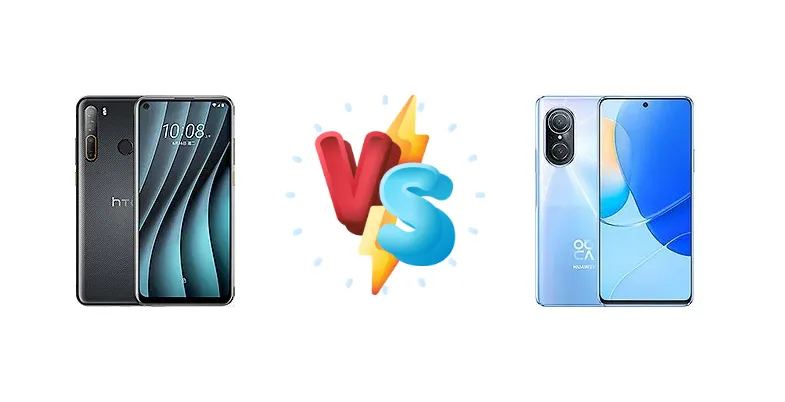
The HTC Desire 20 Pro and Huawei nova 9 SE represent different approaches to the budget smartphone market. The Desire 20 Pro, released earlier, aims for affordability, while the nova 9 SE leverages a newer chipset and significantly faster charging. This comparison dissects their key differences to determine which device delivers the best value for your money.
🏆 Quick Verdict
For most users, the Huawei nova 9 SE is the superior choice. Its Snapdragon 680, built on a more efficient 6nm process, offers a performance uplift over the Desire 20 Pro’s Snapdragon 665. Crucially, the nova 9 SE’s 66W charging is a game-changer, drastically reducing recharge times compared to the Desire 20 Pro’s 15W charging.
| Network |
|---|
| 2G bands | GSM 850 / 900 / 1800 / 1900 | GSM 850 / 900 / 1800 / 1900 |
| 3G bands | HSDPA 850 / 900 / 1900 / 2100 | HSDPA 850 / 900 / 1900 / 2100 - JLN-LX1 |
| 4G bands | 1, 2, 3, 5, 7, 8, 20, 28, 38, 39, 40, 41 | 1, 3, 5, 7, 8, 20, 28, 34, 38, 39, 40, 41 - JLN-LX1 |
| EDGE | No | - |
| GPRS | No | - |
| Speed | HSPA 42.2/5.76 Mbps, LTE (2CA) Cat13 400/150 Mbps | HSPA, LTE |
| Technology | GSM / HSPA / LTE | GSM / HSPA / LTE |
| | - | 1, 2, 3, 4, 5, 7, 8, 12, 13, 17, 26, 28, 38, 40, 41, 66 - JLN-LX3 |
| Launch |
|---|
| Announced | 2020, June 16. Released 2020, July 18 | 2022, March 08 |
| Status | Discontinued | Available. Released 2022, March 20 |
| Body |
|---|
| Dimensions | 162 x 77 x 9.4 mm (6.38 x 3.03 x 0.37 in) | 164.6 x 75.6 x 7.9 mm (6.48 x 2.98 x 0.31 in) |
| SIM | Nano-SIM + Nano-SIM | Nano-SIM + Nano-SIM |
| Weight | 201 g (7.09 oz) | 191 g (6.74 oz) |
| Display |
|---|
| Resolution | 1080 x 2340 pixels, 19.5:9 ratio (~396 ppi density) | 1080 x 2388 pixels (~387 ppi density) |
| Size | 6.5 inches, 103.7 cm2 (~83.1% screen-to-body ratio) | 6.78 inches, 111.4 cm2 (~89.5% screen-to-body ratio) |
| Type | IPS LCD | IPS LCD, 90Hz |
| Platform |
|---|
| CPU | Octa-core (4x2.0 GHz Kryo 260 Gold & 4x1.8 GHz Kryo 260 Silver) | Octa-core (4x2.4 GHz Kryo 265 Gold & 4x1.9 GHz Kryo 265 Silver) |
| Chipset | Qualcomm SM6125 Snapdragon 665 (11 nm) | Qualcomm SM6225 Snapdragon 680 4G (6 nm) |
| GPU | Adreno 610 | Adreno 610 |
| OS | Android 10 | Android 11, EMUI 12, no Google Play Services |
| Memory |
|---|
| Call records | 20 dialed, 20 received, 20 missed calls | - |
| Card slot | microSDXC | microSDXC (uses shared SIM slot) |
| Internal | 128GB 6GB RAM | 128GB 6GB RAM, 128GB 8GB RAM, 256GB 8GB RAM, 512GB 8GB RAM |
| Phonebook | 1000 entries | - |
| Main Camera |
|---|
| Features | Dual-LED flash, HDR, panorama | LED flash, HDR, panorama |
| Quad | 48 MP, f/1.8, 26mm (wide), 1/2.0", 0.8µm, PDAF
8 MP, f/2.2, 118˚ (ultrawide), 1/4.0", 1.12µm
2 MP (macro)
Auxiliary lens | 108 MP, f/1.9, (wide), 1/1.52", 0.7µm, PDAF
8 MP, f/2.2, 112˚ (ultrawide)
2 MP (macro)
Auxiliary lens |
| Single | - | 16 MP, f/2.2, 22mm (wide) |
| Video | 4K@30fps, 1080p@30fps | 1080p@30fps, gyro-EIS |
| Selfie camera |
|---|
| Features | HDR | - |
| Single | 25 MP, f/2.0, (wide) | 16 MP, f/2.2, 22mm (wide) |
| Video | 1080p@30fps | 1080p@30fps |
| Sound |
|---|
| 3.5mm jack | Yes | No |
| 35mm jack | Yes | No |
| Loudspeaker | Yes | Yes |
| Comms |
|---|
| Bluetooth | 5.0, A2DP, LE | 5.0, A2DP, LE |
| NFC | Yes | Yes (JLN-XL1 only) |
| Positioning | GPS, GLONASS, GALILEO, BDS | GPS, GLONASS, GALILEO, BDS, QZSS |
| Radio | FM radio | No |
| USB | USB Type-C 2.0, OTG | USB Type-C 2.0, OTG |
| WLAN | Wi-Fi 802.11 a/b/g/n/ac, dual-band, Wi-Fi Direct | Wi-Fi 802.11 a/b/g/n/ac, dual-band, Wi-Fi Direct |
| Features |
|---|
| Games | Yes | - |
| Java | Yes | - |
| Messaging | SMS | - |
| Sensors | Fingerprint (rear-mounted), accelerometer, gyro, proximity, compass | Fingerprint (side-mounted), accelerometer, gyro, compass |
| | - | Virtual proximity sensing |
| Battery |
|---|
| Charging | 15W wired, QC3 | 66W wired, 75% in 20 min |
| Stand-by | Up to 570 h | - |
| Talk time | Up to 8 h 40 min | - |
| Type | Li-Po 5000 mAh | Li-Po 4000 mAh |
| Misc |
|---|
| Colors | Smoky Black, Pretty Blue, Crystal Green | Midnight Black, Pearl White, Crystal Blue |
| Models | - | JLN-LX1, JLN-LX3, JuliaQN-L01B, JuliaQN-L21B, JuliaQN-L23A, RMX2190, FIO-BD00, JLN-AL00 |
| Price | About 660 EUR | About 150 EUR |
| SAR EU | 0.56 W/kg (head) | - |
HTC Desire 20 Pro
- Potentially lower initial cost
- Familiar Qualcomm Snapdragon platform
- QC3 fast charging support (though slower than nova 9 SE)
- Older Snapdragon 665 chipset
- Slower 15W charging
- Likely to receive fewer software updates
Huawei nova 9 SE
- More efficient Snapdragon 680 chipset (6nm)
- Ultra-fast 66W charging (75% in 20 min)
- Likely better image processing capabilities
- Potentially higher initial cost
- Reliance on Huawei's ecosystem (potential software limitations)
- May lack Google Mobile Services (GMS) depending on region
Display Comparison
Neither device boasts a standout display. While specific display specs (resolution, panel type) are not provided, both likely utilize LCD panels common in this price bracket. The focus here is on the underlying performance. The difference in chipsets won't directly impact display quality, but a smoother user experience on the nova 9 SE could *feel* like a better display due to reduced lag.
Camera Comparison
Without detailed camera specifications, a direct comparison is limited. However, the chipset plays a role in image processing. The Snapdragon 680’s improved ISP (Image Signal Processor) in the nova 9 SE will likely result in better image quality, particularly in low-light conditions. The Desire 20 Pro’s older chipset may struggle with noise reduction and dynamic range. It's reasonable to assume both phones include standard features like HDR, but the nova 9 SE will likely execute these algorithms more effectively.
Performance
The core difference lies in the chipsets. The Huawei nova 9 SE’s Snapdragon 680 (6nm) is a clear upgrade over the HTC Desire 20 Pro’s Snapdragon 665 (11nm). The 6nm process allows for greater transistor density and improved power efficiency, translating to better sustained performance and reduced thermal throttling. The nova 9 SE’s CPU, with 4x2.4 GHz Kryo 265 Gold cores, also boasts a higher clock speed than the Desire 20 Pro’s 4x2.0 GHz Kryo 260 Gold cores, resulting in snappier app launches and smoother multitasking. While both use an octa-core configuration, the architectural improvements in the 680 give it a distinct advantage.
Battery Life
The battery capacity isn't specified for either device, but the charging capabilities are a major differentiator. The Huawei nova 9 SE’s 66W wired charging is a significant advantage, capable of reaching 75% charge in just 20 minutes. The HTC Desire 20 Pro’s 15W charging is comparatively slow, requiring considerably longer to fully recharge. Even if the Desire 20 Pro has a slightly larger battery capacity, the nova 9 SE’s fast charging mitigates any potential endurance concerns for most users.
Buying Guide
Buy the HTC Desire 20 Pro if you prioritize a potentially lower upfront cost and are comfortable with slower charging speeds and a less powerful processor. Buy the Huawei nova 9 SE if you value faster performance, significantly quicker charging, and a more modern chipset that will likely receive software updates for a longer period. The nova 9 SE is ideal for users who frequently use their phone throughout the day and need to top up quickly.
Frequently Asked Questions
❓ Does the Huawei nova 9 SE's Snapdragon 680 handle demanding games like PUBG Mobile smoothly?
The Snapdragon 680 is capable of running PUBG Mobile, but likely at medium settings for a consistently smooth experience. While not a gaming powerhouse, the 680’s improvements over the 665 will result in fewer frame drops and more stable performance, especially during extended gaming sessions. The 6nm process helps manage heat, reducing throttling.
❓ Is the lack of Google Mobile Services (GMS) on some Huawei nova 9 SE models a significant issue?
The absence of GMS means you won't have direct access to the Google Play Store and core Google apps like Gmail and YouTube. However, Huawei's AppGallery offers a growing selection of apps, and workarounds exist to sideload Google apps. This is a significant consideration for users heavily reliant on the Google ecosystem.
❓ How much faster is the 66W charging on the nova 9 SE compared to the 15W charging on the Desire 20 Pro in real-world use?
The difference is substantial. The nova 9 SE can gain a significant charge – 75% – in just 20 minutes. The Desire 20 Pro’s 15W charging will take well over an hour to achieve the same level of charge, making the nova 9 SE far more convenient for users who need a quick power boost.