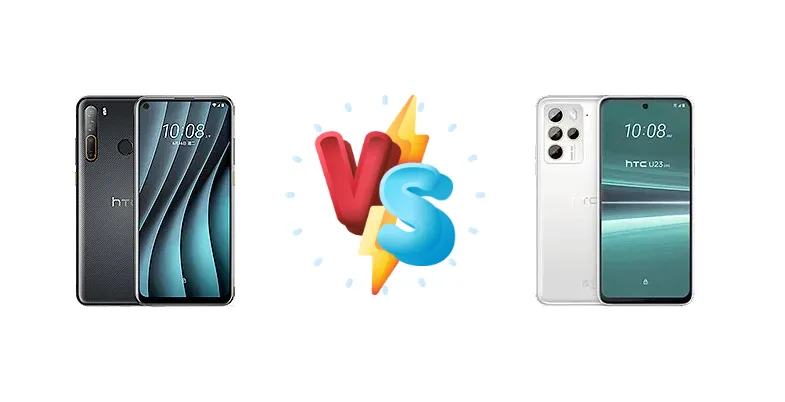
The HTC Desire 20 Pro represented a solid budget offering in its time, but the newer HTC U23 Pro aims to deliver a more modern experience with a significantly upgraded chipset and features. This comparison dissects the key differences between these two HTC devices, focusing on where the U23 Pro justifies its higher price tag and who might still find value in the older Desire 20 Pro.
🏆 Quick Verdict
For most users, the HTC U23 Pro is the clear winner. Its Snapdragon 7 Gen 1 chipset provides a substantial performance boost over the Desire 20 Pro’s Snapdragon 665, alongside faster charging and a brighter display. While the Desire 20 Pro remains a functional device, the U23 Pro offers a far more future-proof and enjoyable user experience.
| Network |
|---|
| 2G bands | GSM 850 / 900 / 1800 / 1900 | GSM 850 / 900 / 1800 / 1900 |
| 3G bands | HSDPA 850 / 900 / 1900 / 2100 | HSDPA 850 / 900 / 1700(AWS) / 1900 / 2100 |
| 4G bands | 1, 2, 3, 5, 7, 8, 20, 28, 38, 39, 40, 41 | 1, 3, 5, 7, 8, 12, 17, 20, 28, 38, 39, 40, 41 |
| 5G bands | - | 1, 3, 7, 20, 28, 41, 78 SA/NSA |
| EDGE | No | - |
| GPRS | No | - |
| Speed | HSPA 42.2/5.76 Mbps, LTE (2CA) Cat13 400/150 Mbps | HSPA, LTE, 5G |
| Technology | GSM / HSPA / LTE | GSM / HSPA / LTE / 5G |
| Launch |
|---|
| Announced | 2020, June 16. Released 2020, July 18 | 2023, May 18 |
| Status | Discontinued | Available. Released 2023, May 18 |
| Body |
|---|
| Build | - | Glass front (Gorilla Glass Victus), plastic frame, plastic back |
| Dimensions | 162 x 77 x 9.4 mm (6.38 x 3.03 x 0.37 in) | 166.6 x 77.1 x 8.9 mm (6.56 x 3.04 x 0.35 in) |
| SIM | Nano-SIM + Nano-SIM | Nano-SIM + Nano-SIM |
| Weight | 201 g (7.09 oz) | 205 g (7.23 oz) |
| | - | IP67 dust/water resistant (up to 1m for 30 min) |
| Display |
|---|
| Protection | - | Corning Gorilla Glass Victus |
| Resolution | 1080 x 2340 pixels, 19.5:9 ratio (~396 ppi density) | 1080 x 2400 pixels, 20:9 ratio (~393 ppi density) |
| Size | 6.5 inches, 103.7 cm2 (~83.1% screen-to-body ratio) | 6.7 inches, 108.4 cm2 (~84.4% screen-to-body ratio) |
| Type | IPS LCD | OLED, 120Hz |
| Platform |
|---|
| CPU | Octa-core (4x2.0 GHz Kryo 260 Gold & 4x1.8 GHz Kryo 260 Silver) | Octa-core (1x2.4 GHz Cortex-A710 & 3x2.36 GHz Cortex-A710 & 4x1.8 GHz Cortex-A510) |
| Chipset | Qualcomm SM6125 Snapdragon 665 (11 nm) | Qualcomm SM7450-AB Snapdragon 7 Gen 1 (4 nm) |
| GPU | Adreno 610 | Adreno 644 |
| OS | Android 10 | Android 13 |
| Memory |
|---|
| Call records | 20 dialed, 20 received, 20 missed calls | - |
| Card slot | microSDXC | microSDXC |
| Internal | 128GB 6GB RAM | 256GB 8GB RAM, 256GB 12GB RAM |
| Phonebook | 1000 entries | - |
| Main Camera |
|---|
| Features | Dual-LED flash, HDR, panorama | Dual-LED flash, HDR, panorama |
| Quad | 48 MP, f/1.8, 26mm (wide), 1/2.0", 0.8µm, PDAF
8 MP, f/2.2, 118˚ (ultrawide), 1/4.0", 1.12µm
2 MP (macro)
Auxiliary lens | 108 MP, f/1.7, (wide), 1/1.67", 0.64μm, PDAF, OIS
8 MP, f/2.4, 120˚ (ultrawide), 1/4.0", 1.12µm
5 MP (macro)
Auxiliary lens |
| Video | 4K@30fps, 1080p@30fps | 4K@30fps, 1080p@30fps, gyro-EIS |
| Selfie camera |
|---|
| Features | HDR | HDR |
| Single | 25 MP, f/2.0, (wide) | 32 MP, f/2.5, (wide), 1/3.2", 0.7µm |
| Video | 1080p@30fps | 1080p@30fps |
| Sound |
|---|
| 3.5mm jack | Yes | Yes |
| 35mm jack | Yes | Yes |
| Loudspeaker | Yes | Yes |
| Comms |
|---|
| Bluetooth | 5.0, A2DP, LE | 5.2, A2DP, LE |
| NFC | Yes | Yes |
| Positioning | GPS, GLONASS, GALILEO, BDS | GPS, GLONASS, GALILEO, BDS |
| Radio | FM radio | No |
| USB | USB Type-C 2.0, OTG | USB Type-C 3.0 |
| WLAN | Wi-Fi 802.11 a/b/g/n/ac, dual-band, Wi-Fi Direct | Wi-Fi 802.11 a/b/g/n/ac/6, dual-band |
| Features |
|---|
| Games | Yes | - |
| Java | Yes | - |
| Messaging | SMS | - |
| Sensors | Fingerprint (rear-mounted), accelerometer, gyro, proximity, compass | Fingerprint (side-mounted), accelerometer, gyro, proximity, compass |
| Battery |
|---|
| Charging | 15W wired, QC3 | 30W wired
15W wireless
5W reverse wireless
Reverse wired |
| Stand-by | Up to 570 h | - |
| Talk time | Up to 8 h 40 min | - |
| Type | Li-Po 5000 mAh | Li-Ion 4600 mAh |
| Misc |
|---|
| Colors | Smoky Black, Pretty Blue, Crystal Green | Snow White, Coffee Black |
| Models | - | 2QC9200, 2QC9100, 2QCB100 |
| Price | About 660 EUR | About 220 EUR |
| SAR EU | 0.56 W/kg (head) | - |
HTC Desire 20 Pro
- More affordable price point
- Functional for basic smartphone tasks
- Quick Charge 3.0 support
- Outdated Snapdragon 665 chipset
- Slower charging speeds
- Likely lower display brightness
HTC U23 Pro
- Significantly faster Snapdragon 7 Gen 1 chipset
- Faster 30W wired and 15W wireless charging
- Brighter display for better outdoor visibility
- Reverse wireless charging capability
- Higher price tag
- Limited information on camera sensor details
- May not be significantly better for extremely basic tasks
Display Comparison
The HTC U23 Pro boasts a significantly brighter display, reaching a measured 727 nits, compared to an unspecified brightness on the Desire 20 Pro. This higher peak brightness translates to better visibility outdoors under direct sunlight. While panel technology details for the Desire 20 Pro are unavailable, the U23 Pro’s brightness alone represents a substantial improvement. The absence of refresh rate information for the Desire 20 Pro suggests a standard 60Hz panel, while the U23 Pro’s display is likely to offer a smoother visual experience, though the exact refresh rate is not specified.
Camera Comparison
While both phones feature cameras, the U23 Pro is expected to offer a superior imaging experience due to its more modern image signal processor (ISP) within the Snapdragon 7 Gen 1. Details on the U23 Pro’s camera sensors are limited, but the chipset’s capabilities suggest improved image processing, better low-light performance, and more advanced features. The Desire 20 Pro’s camera performance is likely to be limited by its older chipset and potentially smaller sensor size. The presence of a 2MP macro camera on the Desire 20 Pro is unlikely to provide significant value, as these sensors typically lack detail and dynamic range.
Performance
The core difference between these two phones lies in their chipsets. The HTC U23 Pro’s Snapdragon 7 Gen 1 (4nm) is a generational leap over the Desire 20 Pro’s Snapdragon 665 (11nm). The 7 Gen 1 utilizes a more efficient 4nm process, resulting in better thermal management and sustained performance. Its CPU configuration – 1x2.4 GHz Cortex-A710 & 3x2.36 GHz Cortex-A710 & 4x1.8 GHz Cortex-A510 – offers significantly improved single-core and multi-core performance compared to the Desire 20 Pro’s Octa-core (4x2.0 GHz Kryo 260 Gold & 4x1.8 GHz Kryo 260 Silver). This translates to faster app loading times, smoother multitasking, and a more responsive user interface on the U23 Pro. The U23 Pro is also likely to support more advanced gaming features and higher graphical settings.
Battery Life
The HTC U23 Pro offers a more versatile charging solution with 30W wired charging, 15W wireless charging, and even 5W reverse wireless charging. The Desire 20 Pro is limited to 15W wired charging with Quick Charge 3.0. While the U23 Pro’s battery capacity isn’t explicitly stated, its 83-hour endurance rating suggests efficient power management. The U23 Pro’s faster charging speeds will significantly reduce downtime, allowing users to quickly top up their battery when needed. The addition of wireless and reverse wireless charging adds convenience and functionality not found on the Desire 20 Pro.
Buying Guide
Buy the HTC Desire 20 Pro if you need a basic, functional smartphone for essential tasks and prioritize affordability above all else. It's suitable for users who primarily make calls, text, and browse the web. Buy the HTC U23 Pro if you prefer a smoother, more responsive experience for gaming, photography, and multitasking, and value features like faster charging and a brighter, more vibrant display. It’s the better choice for users who want a phone that will remain capable for years to come.
Frequently Asked Questions
❓ Does the Snapdragon 7 Gen 1 in the U23 Pro handle demanding games like Genshin Impact or Call of Duty Mobile?
Yes, the Snapdragon 7 Gen 1 is capable of running demanding games like Genshin Impact and Call of Duty Mobile at medium to high settings. While it won't match the performance of flagship Snapdragon 8 Gen series chips, it provides a smooth and enjoyable gaming experience, especially considering the phone's price point. The 4nm process also helps with thermal throttling during extended gaming sessions.
❓ Is the 15W wireless charging on the U23 Pro fast enough for practical daily use?
15W wireless charging on the U23 Pro is a reasonable speed for overnight charging or topping up throughout the day. It's slower than the 30W wired charging, but it offers the convenience of simply placing the phone on a wireless charging pad. Expect a full charge from 0% to take around 2-3 hours with wireless charging.
❓ How does the camera on the U23 Pro perform in low-light conditions compared to the Desire 20 Pro?
The U23 Pro is expected to significantly outperform the Desire 20 Pro in low-light conditions. The Snapdragon 7 Gen 1’s advanced ISP and likely larger sensor size allow for better light gathering and noise reduction, resulting in clearer and more detailed photos in dimly lit environments. The Desire 20 Pro’s older chipset will struggle to produce comparable results.