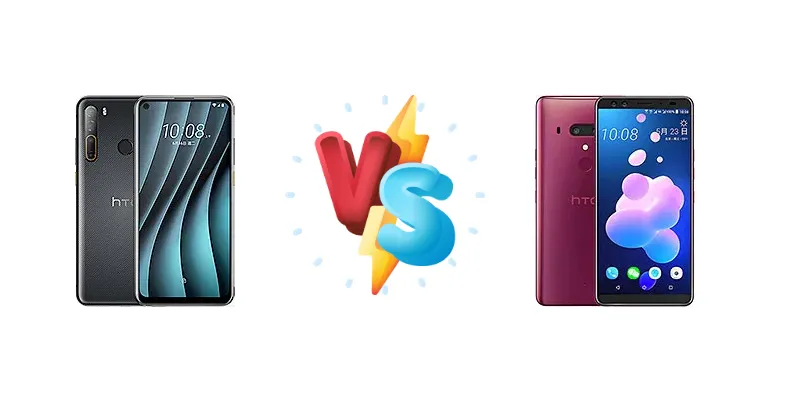
The HTC U12+ represented a high-water mark for HTC's flagship ambitions, boasting a Snapdragon 845 and a premium build. The Desire 20 Pro, released later, targets a more budget-conscious market with a Snapdragon 665. This comparison dissects the trade-offs between these two devices, examining whether the U12+'s older, more powerful hardware still justifies its potential price premium.
🏆 Quick Verdict
For most users, the HTC U12+ remains the superior choice. While the Desire 20 Pro offers a newer device at a lower price, the U12+'s significantly faster Snapdragon 845 delivers a smoother experience for demanding tasks and gaming. The U12+'s superior display and endurance rating further solidify its position as the better overall phone.
| Network |
|---|
| 2G bands | GSM 850 / 900 / 1800 / 1900 | GSM 850 / 900 / 1800 / 1900 - SIM 1 & SIM 2 (dual-SIM model only) |
| 3G bands | HSDPA 850 / 900 / 1900 / 2100 | HSDPA 850 / 900 / 1700(AWS) / 1900 / 2100 |
| 4G bands | 1, 2, 3, 5, 7, 8, 20, 28, 38, 39, 40, 41 | 1, 2, 3, 4, 5, 7, 8, 12, 13, 17, 20, 28, 32, 38, 39, 49, 41, 66 |
| EDGE | No | - |
| GPRS | No | - |
| Speed | HSPA 42.2/5.76 Mbps, LTE (2CA) Cat13 400/150 Mbps | HSPA 42.2/5.76 Mbps, LTE-A (5CA) Cat18 1200/150 Mbps |
| Technology | GSM / HSPA / LTE | GSM / HSPA / LTE |
| Launch |
|---|
| Announced | 2020, June 16. Released 2020, July 18 | 2018, May 23 |
| Status | Discontinued | Available. Released 2018, June 29 |
| Body |
|---|
| Build | - | Glass front (Gorilla Glass 3), glass back, aluminum frame |
| Dimensions | 162 x 77 x 9.4 mm (6.38 x 3.03 x 0.37 in) | 156.6 x 73.9 x 8.7 mm (6.17 x 2.91 x 0.34 in) |
| SIM | Nano-SIM + Nano-SIM | Single SIM (Nano-SIM) or Hybrid Dual SIM (Nano-SIM, dual stand-by) |
| Weight | 201 g (7.09 oz) | 188 g (6.63 oz) |
| | - | IP68 dust/water resistant (up to 1.5m for 30 mins)
Pressure-sensitive buttons |
| Display |
|---|
| Protection | - | Corning Gorilla Glass 3 |
| Resolution | 1080 x 2340 pixels, 19.5:9 ratio (~396 ppi density) | 1440 x 2880 pixels, 18:9 ratio (~537 ppi density) |
| Size | 6.5 inches, 103.7 cm2 (~83.1% screen-to-body ratio) | 6.0 inches, 92.9 cm2 (~80.3% screen-to-body ratio) |
| Type | IPS LCD | Super LCD6, HDR10 |
| Platform |
|---|
| CPU | Octa-core (4x2.0 GHz Kryo 260 Gold & 4x1.8 GHz Kryo 260 Silver) | Octa-core (4x2.8 GHz Kryo 385 Gold & 4x1.7 GHz Kryo 385 Silver) |
| Chipset | Qualcomm SM6125 Snapdragon 665 (11 nm) | Qualcomm SDM845 Snapdragon 845 (10 nm) |
| GPU | Adreno 610 | Adreno 630 |
| OS | Android 10 | Android 8.0 (Oreo), upgradable to Android 9.0 (Pie), Sense UI |
| Memory |
|---|
| Call records | 20 dialed, 20 received, 20 missed calls | - |
| Card slot | microSDXC | microSDXC (uses shared SIM slot) |
| Internal | 128GB 6GB RAM | 64GB 6GB RAM, 128GB 6GB RAM |
| Phonebook | 1000 entries | - |
| Main Camera |
|---|
| Dual | - | 12 MP, f/1.8, 1/2.55", 1.4µm, dual pixel PDAF, Laser AF, OIS
16 MP (12 MP effective), f/2.6, 1/3.1", 1.0µm, 2x optical zoom, AF |
| Features | Dual-LED flash, HDR, panorama | Dual-LED dual-tone flash, HDR |
| Quad | 48 MP, f/1.8, 26mm (wide), 1/2.0", 0.8µm, PDAF
8 MP, f/2.2, 118˚ (ultrawide), 1/4.0", 1.12µm
2 MP (macro)
Auxiliary lens | - |
| Video | 4K@30fps, 1080p@30fps | 4K@60fps, 1080p@60/240fps, 1080p@30fps (gyro-EIS), HDR, 24-bit/96kHz stereo sound rec. |
| Selfie camera |
|---|
| Dual | - | 8 MP, f/2.0, 1/4", 1.12µm
8 MP, f/2.0, 1/4", 1.12µm |
| Features | HDR | HDR, panorama |
| Single | 25 MP, f/2.0, (wide) | - |
| Video | 1080p@30fps | 1080p@30fps |
| Sound |
|---|
| 3.5mm jack | Yes | No |
| 35mm jack | Yes | - |
| Loudspeaker | Yes | Yes, with stereo speakers |
| | - | 32-bit/384kHz audio
|
| Comms |
|---|
| Bluetooth | 5.0, A2DP, LE | 5.0, A2DP, aptX HD, LE |
| NFC | Yes | Yes |
| Positioning | GPS, GLONASS, GALILEO, BDS | GPS, GLONASS, GALILEO, BDS |
| Radio | FM radio | No |
| USB | USB Type-C 2.0, OTG | USB Type-C 3.1 |
| WLAN | Wi-Fi 802.11 a/b/g/n/ac, dual-band, Wi-Fi Direct | Wi-Fi 802.11 a/b/g/n/ac, dual-band, Wi-Fi Direct, DLNA |
| Features |
|---|
| Games | Yes | - |
| Java | Yes | - |
| Messaging | SMS | - |
| Sensors | Fingerprint (rear-mounted), accelerometer, gyro, proximity, compass | Fingerprint (rear-mounted), accelerometer, gyro, proximity, compass |
| Battery |
|---|
| Charging | 15W wired, QC3 | 18W wired, QC3, 50% in 35 min (advertised) |
| Stand-by | Up to 570 h | - |
| Talk time | Up to 8 h 40 min | Up to 24 h (3G) |
| Type | Li-Po 5000 mAh | Li-Ion 3500 mAh, non-removable |
| Misc |
|---|
| Colors | Smoky Black, Pretty Blue, Crystal Green | Translucent Blue, Ceramic Black, Flame Red |
| Models | - | U12, 2Q55100 |
| Price | About 660 EUR | About 450 EUR |
| SAR EU | 0.56 W/kg (head) | - |
| Tests |
|---|
| Audio quality | - |
Noise -93.7dB / Crosstalk -52.7dB |
| Battery life | - |
Endurance rating 64h
|
| Camera | - |
Photo / Video |
| Display | - |
Contrast ratio: 1818:1 (nominal), 3.085 (sunlight) |
| Loudspeaker | - |
Voice 77dB / Noise 73dB / Ring 99dB
|
| Performance | - |
AnTuTu: 263696 (v7)
GeekBench: 9001 (v4.4)
GFXBench: 20fps (ES 3.1 onscreen) |
HTC Desire 20 Pro
- Newer device with potential for (limited) software updates
- More affordable price point
- Potentially lighter and more compact design (speculation)
- Significantly weaker performance due to Snapdragon 665
- Likely inferior display quality
- Slower charging speed
HTC U12+
- Flagship-level performance with Snapdragon 845
- Superior display quality (contrast ratio suggests)
- Faster charging and potentially better battery endurance
- Older device with limited software update support
- Potentially higher price
- Larger and heavier design (likely)
Display Comparison
The HTC U12+ boasts a superior display experience, though specific details beyond contrast ratios (1818:1 nominal, 3.085 in sunlight) are lacking. These contrast ratios suggest excellent visibility even in bright conditions. The Desire 20 Pro’s display specifications are absent, implying a standard LCD panel likely lacking the U12+'s color accuracy and brightness. The U12+'s display technology likely provides a more vibrant and immersive viewing experience, particularly for media consumption.
Camera Comparison
Detailed camera specs are missing for both devices, making a direct comparison difficult. However, the U12+ likely benefits from a more sophisticated image signal processor (ISP) integrated within the Snapdragon 845. This would result in better dynamic range, noise reduction, and overall image quality. The Desire 20 Pro, relying on the 665’s ISP, will likely produce acceptable images in good lighting conditions but struggle in low-light scenarios. Without sensor size information, it's difficult to assess low-light performance definitively, but the U12+'s flagship status suggests a higher-quality camera system.
Performance
The core difference lies in the chipsets. The HTC U12+’s Snapdragon 845 (10nm) is a flagship-class processor with a CPU clocked up to 2.8 GHz, significantly outperforming the Desire 20 Pro’s Snapdragon 665 (11nm) which peaks at 2.0 GHz. This translates to a noticeable difference in app loading times, multitasking, and gaming performance. The 845’s Adreno 630 GPU is also far more capable than the 665’s Adreno 610. While both utilize Kryo cores, the 385 Gold cores in the 845 are architecturally more advanced, offering greater performance per clock cycle. The 10nm process of the 845 also contributes to better thermal efficiency, potentially mitigating throttling during sustained workloads.
Battery Life
The HTC U12+ has an endurance rating of 64 hours, indicating excellent battery life. While the Desire 20 Pro’s battery capacity is unknown, the U12+'s more efficient chipset and optimized software likely contribute to its longer runtime. The U12+ also supports 18W charging with a claimed 50% charge in 35 minutes, while the Desire 20 Pro is limited to 15W charging. This means the U12+ can be topped up more quickly, minimizing downtime.
Buying Guide
Buy the HTC Desire 20 Pro if you prioritize a newer device with guaranteed software updates (though HTC's update track record is spotty) and are primarily focused on basic smartphone tasks like calling, texting, and light social media use. Buy the HTC U12+ if you value performance, a better display experience, and longer battery life, and are willing to accept an older device with potentially limited software support.
Frequently Asked Questions
❓ Will the Snapdragon 665 in the Desire 20 Pro struggle with demanding games like PUBG or Call of Duty?
Yes, the Snapdragon 665 is a mid-range chipset and will likely require significant graphics settings reductions to achieve playable frame rates in demanding games. Expect noticeable lag and stuttering compared to the smoother experience offered by the Snapdragon 845 in the U12+.
❓ Given the age of the HTC U12+, is the battery still in good condition if purchasing a used model?
Battery health degrades over time. If considering a used U12+, inquire about the battery's condition and usage history. A significant drop in battery life is a common issue with older smartphones, and replacing the battery can be costly.
❓ Does the HTC Desire 20 Pro support Quick Charge 3.0 effectively, or is the 15W charging significantly slower in real-world use?
While the Desire 20 Pro supports QC3, the 15W charging is considerably slower than the U12+'s 18W implementation. Expect a longer charging time from 0-100%, potentially exceeding 2 hours depending on the charger and battery level.