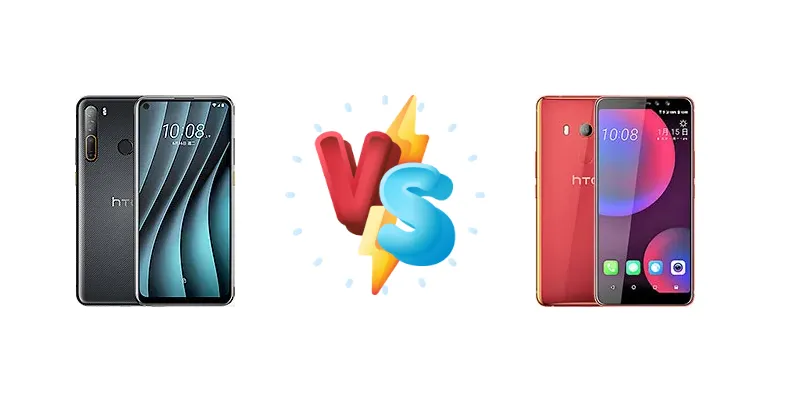
HTC, once a dominant force in the smartphone market, continues to release devices catering to different budgets. The Desire 20 Pro and the U11 Eyes represent different eras of HTC's journey. Let's dive into a comprehensive comparison to see which phone offers the best value today.
🏆 Quick Verdict
The HTC Desire 20 Pro generally wins due to its newer chipset, improved processing power, and more modern features. However, the U11 Eyes might appeal to those seeking a slightly more compact design and potentially a better camera experience depending on usage, especially considering its age and price.
| Network |
|---|
| 2G bands | GSM 850 / 900 / 1800 / 1900 | GSM 850 / 900 / 1800 / 1900 - SIM 1 & SIM 2 |
| 3G bands | HSDPA 850 / 900 / 1900 / 2100 | HSDPA 850 / 900 / 1900 / 2100 |
| 4G bands | 1, 2, 3, 5, 7, 8, 20, 28, 38, 39, 40, 41 | 1, 2, 3, 4, 5, 7, 8, 12, 17, 20, 28, 32 |
| EDGE | No | - |
| GPRS | No | - |
| Speed | HSPA 42.2/5.76 Mbps, LTE (2CA) Cat13 400/150 Mbps | HSPA 42.2/5.76 Mbps, LTE (2CA) Cat6 300/50 Mbps |
| Technology | GSM / HSPA / LTE | GSM / HSPA / LTE |
| Launch |
|---|
| Announced | 2020, June 16. Released 2020, July 18 | 2018, January. Released 2018, January |
| Status | Discontinued | Discontinued |
| Body |
|---|
| Dimensions | 162 x 77 x 9.4 mm (6.38 x 3.03 x 0.37 in) | 157.9 x 75 x 8.5 mm (6.22 x 2.95 x 0.33 in) |
| SIM | Nano-SIM + Nano-SIM | Nano-SIM + Nano-SIM |
| Weight | 201 g (7.09 oz) | 185 g (6.53 oz) |
| | - | IP67 dust/water resistant (up to 1m for 30 mins) |
| Display |
|---|
| Protection | - | Corning Gorilla Glass 3 |
| Resolution | 1080 x 2340 pixels, 19.5:9 ratio (~396 ppi density) | 1080 x 2160 pixels, 18:9 ratio (~402 ppi density) |
| Size | 6.5 inches, 103.7 cm2 (~83.1% screen-to-body ratio) | 6.0 inches, 92.9 cm2 (~78.4% screen-to-body ratio) |
| Type | IPS LCD | Super LCD3 |
| Platform |
|---|
| CPU | Octa-core (4x2.0 GHz Kryo 260 Gold & 4x1.8 GHz Kryo 260 Silver) | Octa-core |
| Chipset | Qualcomm SM6125 Snapdragon 665 (11 nm) | Qualcomm MSM8976 Snapdragon 652 (28 nm) |
| GPU | Adreno 610 | Adreno 510 |
| OS | Android 10 | Android 8.0 (Oreo), Sense UI |
| Memory |
|---|
| Call records | 20 dialed, 20 received, 20 missed calls | - |
| Card slot | microSDXC | microSDXC (uses shared SIM slot) |
| Internal | 128GB 6GB RAM | 64GB 4GB RAM |
| Phonebook | 1000 entries | - |
| | - | eMMC 5.1 |
| Main Camera |
|---|
| Features | Dual-LED flash, HDR, panorama | Dual-LED dual-tone flash, HDR, panorama |
| Quad | 48 MP, f/1.8, 26mm (wide), 1/2.0", 0.8µm, PDAF
8 MP, f/2.2, 118˚ (ultrawide), 1/4.0", 1.12µm
2 MP (macro)
Auxiliary lens | - |
| Single | - | 12 MP, f/1.7, 1.4 μm, PDAF, OIS |
| Video | 4K@30fps, 1080p@30fps | 4K@30fps, 1080p@120fps |
| Selfie camera |
|---|
| Dual | - | 5 MP, f/2.2
5 MP |
| Features | HDR | - |
| Single | 25 MP, f/2.0, (wide) | - |
| Video | 1080p@30fps | 1080p@30fps |
| Sound |
|---|
| 3.5mm jack | Yes | No |
| 35mm jack | Yes | No |
| Loudspeaker | Yes | Yes |
| | - | 24-bit/192kHz audio
|
| Comms |
|---|
| Bluetooth | 5.0, A2DP, LE | 4.2, A2DP, LE |
| NFC | Yes | Yes |
| Positioning | GPS, GLONASS, GALILEO, BDS | GPS, GLONASS, BDS |
| Radio | FM radio | No |
| USB | USB Type-C 2.0, OTG | USB Type-C 2.0 |
| WLAN | Wi-Fi 802.11 a/b/g/n/ac, dual-band, Wi-Fi Direct | Wi-Fi 802.11 a/b/g/n/ac, dual-band, Wi-Fi Direct, DLNA |
| Features |
|---|
| Games | Yes | - |
| Java | Yes | - |
| Messaging | SMS | - |
| Sensors | Fingerprint (rear-mounted), accelerometer, gyro, proximity, compass | Fingerprint (rear-mounted), accelerometer, gyro, proximity, compass |
| Battery |
|---|
| Charging | 15W wired, QC3 | 18W wired, QC3 |
| Stand-by | Up to 570 h | - |
| Talk time | Up to 8 h 40 min | - |
| Type | Li-Po 5000 mAh | Li-Ion 3930 mAh, non-removable |
| Misc |
|---|
| Colors | Smoky Black, Pretty Blue, Crystal Green | Black, Red, Blue |
| Models | - | 2Q4R100 |
| Price | About 660 EUR | About 300 EUR |
| SAR EU | 0.56 W/kg (head) | - |
HTC Desire 20 Pro
- More powerful processor
- Larger display
- Versatile quad-camera system
- Longer battery life
- Modern design
- Potentially less refined software experience compared to older HTC models
- 15W charging is relatively slow
HTC U11 Eyes
- Compact size
- Potentially better camera in specific scenarios (due to older processing)
- QC3 charging
- Older chipset and slower performance
- Smaller display
- Shorter battery life
- Outdated design
Display Comparison
The HTC Desire 20 Pro boasts a 6.5-inch FHD+ display, offering a larger and more immersive viewing experience compared to the U11 Eyes' 5.5-inch FHD display. While both offer good resolution, the Desire 20 Pro's larger size provides a noticeable advantage for media consumption and gaming.
Camera Comparison
The Desire 20 Pro features a quad-camera setup (48MP main, 8MP ultrawide, 2MP depth, 2MP macro), offering more versatility. The U11 Eyes has a dual-camera setup (12MP main, 8MP front). While the U11 Eyes' camera was well-regarded in its time, the Desire 20 Pro's newer sensor and processing should generally produce better results, especially in low light.
Performance
The Snapdragon 665 in the Desire 20 Pro is significantly more powerful than the Snapdragon 652 in the U11 Eyes. The 11nm process of the 665 offers better efficiency and performance, resulting in smoother multitasking and faster app loading times. The U11 Eyes, while still capable, will show its age in demanding tasks.
Battery Life
The Desire 20 Pro typically has a larger battery capacity (around 5000mAh) compared to the U11 Eyes (around 3000mAh). This translates to significantly longer battery life on the Desire 20 Pro, easily lasting a full day with moderate usage, while the U11 Eyes might require a midday top-up.
Buying Guide
The HTC Desire 20 Pro is ideal for users seeking a budget-friendly phone with decent performance for everyday tasks and occasional gaming. The HTC U11 Eyes is a good option for those looking for a compact, affordable phone with a familiar Android experience, and who prioritize a potentially better camera in certain lighting conditions.
Frequently Asked Questions
❓ Is the HTC Desire 20 Pro worth buying in 2024?
Yes, if you're looking for a budget-friendly phone with decent performance and a large display, the Desire 20 Pro remains a viable option. However, consider newer budget phones from other brands as well.
❓ How does the U11 Eyes compare to other phones from its era?
The U11 Eyes was a strong contender in its time, known for its good camera and compact design. However, newer phones offer significantly better performance and features.