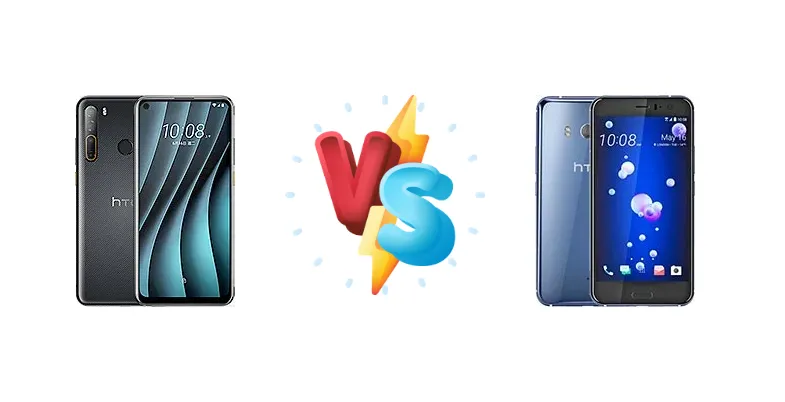
The HTC U11, a 2017 flagship, represents a peak in HTC's design and engineering. The Desire 20 Pro, released years later, targets a more budget-conscious market. This comparison examines how these two devices stack up, considering the significant advancements in mobile technology and the differing priorities of their respective launches.
🏆 Quick Verdict
For the average user in 2024, the HTC U11 remains the superior choice. While the Desire 20 Pro offers newer features, the U11’s significantly more powerful Snapdragon 835 chipset delivers a smoother, more responsive experience, especially for demanding tasks. The similar battery endurance ratings further solidify the U11’s value.
| Network |
|---|
| 2G bands | GSM 850 / 900 / 1800 / 1900 | GSM 850 / 900 / 1800 / 1900 - SIM 1 & SIM 2 (dual-SIM model only) |
| 3G bands | HSDPA 850 / 900 / 1900 / 2100 | HSDPA 850 / 900 / 1900 / 2100 |
| 4G bands | 1, 2, 3, 5, 7, 8, 20, 28, 38, 39, 40, 41 | 1, 3, 4, 5, 7, 8, 12, 17, 20, 28, 32, 38, 39, 40, 41 |
| EDGE | No | - |
| GPRS | No | - |
| Speed | HSPA 42.2/5.76 Mbps, LTE (2CA) Cat13 400/150 Mbps | HSPA 42.2/5.76 Mbps, LTE (4CA) Cat16 1024/75 Mbps |
| Technology | GSM / HSPA / LTE | GSM / HSPA / LTE |
| Launch |
|---|
| Announced | 2020, June 16. Released 2020, July 18 | 2017, May 16. Released 2017, June 10 |
| Status | Discontinued | Discontinued |
| Body |
|---|
| Build | - | Glass front (Gorilla Glass 5), glass back, aluminum frame |
| Dimensions | 162 x 77 x 9.4 mm (6.38 x 3.03 x 0.37 in) | 153.9 x 75.9 x 7.9 mm (6.06 x 2.99 x 0.31 in) |
| SIM | Nano-SIM + Nano-SIM | · Nano-SIM· Nano-SIM + Nano-SIM |
| Weight | 201 g (7.09 oz) | 169 g (5.96 oz) |
| | - | IP67 dust/water resistant (up to 1m for 30 mins) |
| Display |
|---|
| Protection | - | Corning Gorilla Glass 5 |
| Resolution | 1080 x 2340 pixels, 19.5:9 ratio (~396 ppi density) | 1440 x 2560 pixels, 16:9 ratio (~534 ppi density) |
| Size | 6.5 inches, 103.7 cm2 (~83.1% screen-to-body ratio) | 5.5 inches, 83.4 cm2 (~71.4% screen-to-body ratio) |
| Type | IPS LCD | Super LCD5 |
| Platform |
|---|
| CPU | Octa-core (4x2.0 GHz Kryo 260 Gold & 4x1.8 GHz Kryo 260 Silver) | Octa-core (4x2.45 GHz Kryo & 4x1.9 GHz Kryo) |
| Chipset | Qualcomm SM6125 Snapdragon 665 (11 nm) | Qualcomm MSM8998 Snapdragon 835 (10 nm) |
| GPU | Adreno 610 | Adreno 540 |
| OS | Android 10 | Android 7.1 (Nougat), upgradable to Android 9.0 (Pie), Sense UI |
| Memory |
|---|
| Call records | 20 dialed, 20 received, 20 missed calls | - |
| Card slot | microSDXC | microSDXC (uses shared SIM slot) - dual SIM model only |
| Internal | 128GB 6GB RAM | 64GB 4GB RAM, 128GB 6GB RAM |
| Phonebook | 1000 entries | - |
| Main Camera |
|---|
| Features | Dual-LED flash, HDR, panorama | Dual-LED dual-tone flash, HDR, panorama |
| Quad | 48 MP, f/1.8, 26mm (wide), 1/2.0", 0.8µm, PDAF
8 MP, f/2.2, 118˚ (ultrawide), 1/4.0", 1.12µm
2 MP (macro)
Auxiliary lens | - |
| Single | - | 12 MP, f/1.7, 1/2.55", 1.4µm, dual pixel PDAF, 5-axis OIS |
| Video | 4K@30fps, 1080p@30fps | 4K@30fps, 1080p@30/60/120fps, HDR, 24-bit/192kHz stereo sound rec. |
| Selfie camera |
|---|
| Features | HDR | - |
| Single | 25 MP, f/2.0, (wide) | 16 MP, f/2.0, 27mm (wide), 1/3.06", 1.0µm |
| Video | 1080p@30fps | 1080p@30fps |
| Sound |
|---|
| 3.5mm jack | Yes | No |
| 35mm jack | Yes | No |
| Loudspeaker | Yes | Yes, with stereo speakers |
| | - | 24-bit/192kHz audio
|
| Comms |
|---|
| Bluetooth | 5.0, A2DP, LE | 4.2, A2DP, LE (5.0 after SW update) |
| NFC | Yes | Yes |
| Positioning | GPS, GLONASS, GALILEO, BDS | GPS, GLONASS, BDS |
| Radio | FM radio | No |
| USB | USB Type-C 2.0, OTG | USB Type-C 3.1 |
| WLAN | Wi-Fi 802.11 a/b/g/n/ac, dual-band, Wi-Fi Direct | Wi-Fi 802.11 a/b/g/n/ac, dual-band, Wi-Fi Direct, DLNA |
| Features |
|---|
| Games | Yes | - |
| Java | Yes | - |
| Messaging | SMS | - |
| Sensors | Fingerprint (rear-mounted), accelerometer, gyro, proximity, compass | Fingerprint (front-mounted), accelerometer, gyro, proximity, compass |
| Battery |
|---|
| Charging | 15W wired, QC3 | 18W wired, QC3 |
| Stand-by | Up to 570 h | Up to 336 h (3G) |
| Talk time | Up to 8 h 40 min | Up to 24 h 30 min (3G) |
| Type | Li-Po 5000 mAh | Li-Ion 3000 mAh, non-removable |
| Misc |
|---|
| Colors | Smoky Black, Pretty Blue, Crystal Green | Amazing Silver, Sapphire Blue, Brilliant Black, Ice White, Solar Red |
| Models | - | U11, HTV33, 2PZC100, 2PZC5, 601HT |
| Price | About 660 EUR | About 300 EUR |
| SAR EU | 0.56 W/kg (head) | - |
| Tests |
|---|
| Audio quality | - |
Noise -94.1 / Crosstalk -94.5 |
| Battery life | - |
Endurance rating 73h
|
| Camera | - |
Photo / Video |
| Loudspeaker | - |
Voice 68dB / Noise 73dB / Ring 79dB
|
| Performance | - |
GeekBench: 6393 (v4.4)
GFXBench: 13fps (ES 3.1 onscreen) |
HTC Desire 20 Pro
- More powerful Snapdragon 835 processor
- Likely superior display quality
- Faster charging (18W vs 15W)
- Older software (potentially fewer updates)
- May be harder to find in good condition
HTC U11
- More modern software base
- Potentially lower price
- More readily available
- Significantly weaker Snapdragon 665 processor
- Likely inferior display quality
- Slower charging
Display Comparison
Neither device's display specifications are provided, but given the U11's flagship status, it likely features a higher-quality panel with better color accuracy and brightness. The Desire 20 Pro, being a budget device, likely utilizes a less expensive LCD. The U11’s likely smaller bezels, typical of 2017 flagships, would offer a more immersive viewing experience compared to the potentially larger bezels on the Desire 20 Pro.
Camera Comparison
Both phones are listed as having Photo/Video capabilities, but without specific sensor details, a direct comparison is difficult. However, flagship phones like the U11 typically feature larger sensors and more advanced image processing algorithms. The U11 likely benefits from superior low-light performance and dynamic range. The Desire 20 Pro may offer more camera modes due to its later release date, but image quality will likely be inferior to the U11’s.
Performance
The core difference lies in the chipsets. The HTC U11’s Snapdragon 835 (10nm) is a substantial upgrade over the Desire 20 Pro’s Snapdragon 665 (11nm). The 835’s Kryo cores, clocked at up to 2.45 GHz, provide significantly more processing power than the 665’s Kryo 260 cores (2.0 GHz). This translates to faster app loading times, smoother multitasking, and a more enjoyable gaming experience on the U11. The 10nm process node of the 835 also contributes to better thermal efficiency, reducing throttling during sustained workloads. While the 665 is more power efficient, the performance gap is considerable.
Battery Life
Interestingly, both devices share an endurance rating of 73 hours. This suggests similar real-world battery life despite the U11’s more powerful processor. The U11 offers 18W wired charging with QC3, while the Desire 20 Pro has 15W wired charging with QC3. The slightly faster charging on the U11 provides a marginal convenience, but the comparable endurance ratings mean neither phone will leave you constantly searching for a power outlet.
Buying Guide
Buy the HTC Desire 20 Pro if you need a phone with a more modern software base and are primarily focused on basic tasks like calling, texting, and light social media use. The lower price point makes it an accessible option. Buy the HTC U11 if you prioritize performance, a more refined user experience, and better long-term usability for demanding applications and occasional gaming. Its superior chipset and build quality offer lasting value.
Frequently Asked Questions
❓ Is the Snapdragon 665 in the Desire 20 Pro capable of running modern games like Genshin Impact?
While the Snapdragon 665 can *run* Genshin Impact, expect significant compromises in graphics settings and frame rates. The experience will likely be choppy and not enjoyable for extended periods. The Snapdragon 835 in the U11 offers a much smoother and more playable experience, even on medium settings.
❓ Given the age of the HTC U11, are software updates still available?
Official software updates from HTC for the U11 have ceased. However, the U11 has a vibrant custom ROM community, allowing users to install newer versions of Android and benefit from security patches and new features. This extends the lifespan and usability of the device.
❓ How does the build quality of the U11 compare to the Desire 20 Pro?
The HTC U11 featured a unibody glass design, considered premium for its time, offering a more solid and refined feel. The Desire 20 Pro, being a budget device, likely utilizes a plastic build, which is less durable and feels less premium in hand.