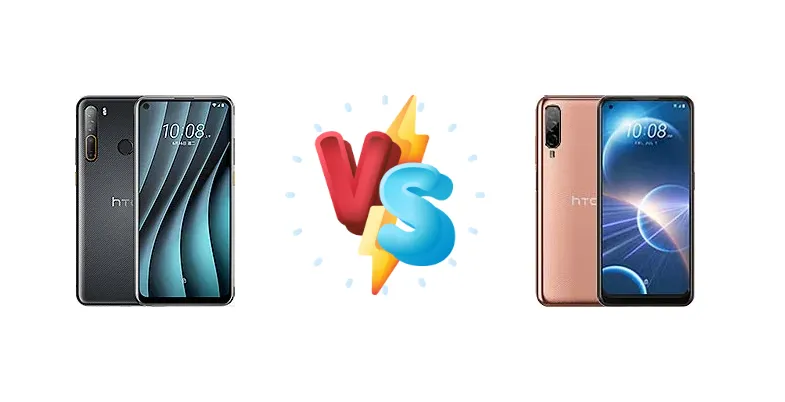
HTC continues to navigate the competitive smartphone landscape with its Desire series. The Desire 20 Pro, released in 2020, offered a solid mid-range experience. The Desire 22 Pro, arriving later, introduces 5G connectivity and a newer chipset. This comparison dissects the key differences between these two devices, helping you determine if the upgrade is justified.
🏆 Quick Verdict
For most users, the HTC Desire 22 Pro is the superior choice. The Snapdragon 695 offers a noticeable performance boost over the 665, alongside the added benefit of 5G connectivity. While the 20 Pro remains a viable option at a potentially lower price, the 22 Pro’s improved efficiency and charging capabilities make it the more future-proof investment.
| Network |
|---|
| 2G bands | GSM 850 / 900 / 1800 / 1900 | GSM 850 / 900 / 1800 / 1900 |
| 3G bands | HSDPA 850 / 900 / 1900 / 2100 | HSDPA 850 / 900 / 1700(AWS) / 1900 / 2100 |
| 4G bands | 1, 2, 3, 5, 7, 8, 20, 28, 38, 39, 40, 41 | 1, 3, 5, 7, 8, 20, 28, 38, 39, 40, 41 |
| 5G bands | - | 1, 3, 7, 20, 28, 41, 78 SA/NSA |
| EDGE | No | - |
| GPRS | No | - |
| Speed | HSPA 42.2/5.76 Mbps, LTE (2CA) Cat13 400/150 Mbps | HSPA, LTE, 5G |
| Technology | GSM / HSPA / LTE | GSM / HSPA / LTE / 5G |
| Launch |
|---|
| Announced | 2020, June 16. Released 2020, July 18 | 2022, June 28 |
| Status | Discontinued | Available. Released 2022, July 10 |
| Body |
|---|
| Dimensions | 162 x 77 x 9.4 mm (6.38 x 3.03 x 0.37 in) | 166.3 x 76.9 x 9.4 mm (6.55 x 3.03 x 0.37 in) |
| SIM | Nano-SIM + Nano-SIM | Nano-SIM + Nano-SIM |
| Weight | 201 g (7.09 oz) | 205.5 g (7.27 oz) |
| | - | IP67 dust/water resistant (up to 1m for 30 min) |
| Display |
|---|
| Protection | - | Corning Gorilla Glass |
| Resolution | 1080 x 2340 pixels, 19.5:9 ratio (~396 ppi density) | 1080 x 2412 pixels, 20:9 ratio (~400 ppi density) |
| Size | 6.5 inches, 103.7 cm2 (~83.1% screen-to-body ratio) | 6.6 inches, 104.8 cm2 (~82.0% screen-to-body ratio) |
| Type | IPS LCD | IPS LCD, 120Hz |
| Platform |
|---|
| CPU | Octa-core (4x2.0 GHz Kryo 260 Gold & 4x1.8 GHz Kryo 260 Silver) | Octa-core (2x2.2 GHz Kryo 660 Gold & 6x1.7 GHz Kryo 660 Silver) |
| Chipset | Qualcomm SM6125 Snapdragon 665 (11 nm) | Qualcomm SM6375 Snapdragon 695 5G (6 nm) |
| GPU | Adreno 610 | Adreno 619 |
| OS | Android 10 | Android 12 |
| Memory |
|---|
| Call records | 20 dialed, 20 received, 20 missed calls | - |
| Card slot | microSDXC | microSDXC (uses shared SIM slot) |
| Internal | 128GB 6GB RAM | 128GB 8GB RAM |
| Phonebook | 1000 entries | - |
| Main Camera |
|---|
| Features | Dual-LED flash, HDR, panorama | Dual-LED flash, HDR, panorama |
| Quad | 48 MP, f/1.8, 26mm (wide), 1/2.0", 0.8µm, PDAF
8 MP, f/2.2, 118˚ (ultrawide), 1/4.0", 1.12µm
2 MP (macro)
Auxiliary lens | - |
| Triple | - | 64 MP, f/1.8, (wide), PDAF
13 MP, f/2.4, 118˚ (ultrawide)
Auxiliary lens |
| Video | 4K@30fps, 1080p@30fps | 1080p@30fps |
| Selfie camera |
|---|
| Features | HDR | HDR |
| Single | 25 MP, f/2.0, (wide) | 32 MP, f/2.0, (wide) |
| Video | 1080p@30fps | 1080p@30fps |
| Sound |
|---|
| 3.5mm jack | Yes | Yes |
| 35mm jack | Yes | Yes |
| Loudspeaker | Yes | Yes |
| Comms |
|---|
| Bluetooth | 5.0, A2DP, LE | 5.1, A2DP, LE |
| NFC | Yes | Yes |
| Positioning | GPS, GLONASS, GALILEO, BDS | GPS, GLONASS, GALILEO, BDS |
| Radio | FM radio | Unspecified |
| USB | USB Type-C 2.0, OTG | USB Type-C 2.0, OTG |
| WLAN | Wi-Fi 802.11 a/b/g/n/ac, dual-band, Wi-Fi Direct | Wi-Fi 802.11 a/b/g/n/ac, dual-band, Wi-Fi Direct |
| Features |
|---|
| Games | Yes | - |
| Java | Yes | - |
| Messaging | SMS | - |
| Sensors | Fingerprint (rear-mounted), accelerometer, gyro, proximity, compass | Fingerprint (side-mounted), accelerometer, gyro, proximity, compass |
| Battery |
|---|
| Charging | 15W wired, QC3 | 18W wired
Wireless
Reverse wired |
| Stand-by | Up to 570 h | - |
| Talk time | Up to 8 h 40 min | - |
| Type | Li-Po 5000 mAh | Li-Po 4520 mAh |
| Misc |
|---|
| Colors | Smoky Black, Pretty Blue, Crystal Green | Wave Gold, Starry Night Black |
| Price | About 660 EUR | About 460 EUR |
| SAR EU | 0.56 W/kg (head) | - |
HTC Desire 20 Pro
- Potentially lower price point
- Reliable performance for basic tasks
- QC3 fast charging support
- Older Snapdragon 665 chipset
- No 5G connectivity
- Limited charging options (wired only)
HTC Desire 22 Pro
- Faster Snapdragon 695 5G chipset
- 5G connectivity for faster data speeds
- Wireless and reverse wired charging
- Likely higher price point
- May not offer a dramatically different camera experience without detailed specs
- Potential for slightly higher thermal output under sustained load
Display Comparison
Neither HTC provides detailed display specifications beyond resolution. However, the core difference lies in the processing power driving the display. The Snapdragon 695 in the Desire 22 Pro will likely deliver smoother animations and faster app loading times, impacting the perceived visual experience. While both likely utilize LCD panels given the price bracket, the 6nm process of the 695 allows for more efficient power delivery to the display, potentially extending battery life during media consumption.
Camera Comparison
Detailed camera specs are unavailable, making a direct comparison challenging. However, the processing capabilities of the Snapdragon 695 in the Desire 22 Pro will undoubtedly contribute to improved image processing. Expect better noise reduction, dynamic range, and overall image quality, particularly in low-light conditions. While both phones likely feature similar sensor configurations (avoiding analysis of 2MP macro lenses), the 695’s ISP (Image Signal Processor) will be more advanced, leading to superior results. The 20 Pro's image processing will be limited by the older chipset.
Performance
The core distinction here is the chipset. The Desire 20 Pro’s Snapdragon 665 (11nm) is a capable processor for everyday tasks, featuring an octa-core configuration with Kryo 260 cores. However, the Desire 22 Pro’s Snapdragon 695 (6nm) represents a significant leap forward. The 6nm process is more efficient, leading to lower temperatures and sustained performance. The CPU configuration – 2x2.2 GHz Kryo 660 Gold and 6x1.7 GHz Kryo 660 Silver – offers a higher peak clock speed and a more balanced core arrangement, resulting in faster app launches and smoother multitasking. The 695 also includes an integrated 5G modem, a feature absent in the 20 Pro.
Battery Life
Battery capacity is not specified in the provided data. However, the Snapdragon 695’s 6nm process offers significantly improved power efficiency compared to the 665’s 11nm process. This translates to longer battery life on the Desire 22 Pro, even with similar battery capacity. Furthermore, the Desire 22 Pro supports 18W wired charging, wireless charging, and reverse wired charging – features completely absent in the Desire 20 Pro’s 15W QC3 implementation. The addition of wireless and reverse charging adds considerable convenience for users.
Buying Guide
Buy the HTC Desire 20 Pro if you prioritize affordability and don't require 5G connectivity. It's a suitable option for basic smartphone tasks like calling, texting, and light social media use. Buy the HTC Desire 22 Pro if you want a smoother, more responsive experience, faster download speeds with 5G, and the convenience of wireless and reverse-wired charging. It’s ideal for users who stream video, play mobile games, or frequently download large files.
Frequently Asked Questions
❓ Does the Snapdragon 695 in the Desire 22 Pro offer a noticeable gaming improvement over the 665?
Yes, the Snapdragon 695 provides a significant performance uplift, particularly in graphics processing. While neither phone is a dedicated gaming device, the 695 will deliver smoother frame rates and a more responsive experience in popular mobile games. The 6nm process also helps mitigate thermal throttling during extended gaming sessions.
❓ Is the 5G connectivity on the Desire 22 Pro worth the extra cost if I don't have 5G coverage in my area?
Currently, if 5G coverage is unavailable, the benefit is minimal. However, the 695 also includes improvements to 4G LTE connectivity, potentially offering faster and more reliable 4G speeds. Furthermore, investing in a 5G-enabled device future-proofs your purchase as 5G networks continue to expand.
❓ How much faster is the 18W charging on the Desire 22 Pro compared to the 15W charging on the Desire 20 Pro?
While a 3W difference may not seem substantial, the 18W charging on the Desire 22 Pro, combined with the more efficient chipset, will likely result in a noticeably faster 0-100% charge time. The addition of wireless charging is a significant convenience factor not available on the 20 Pro.