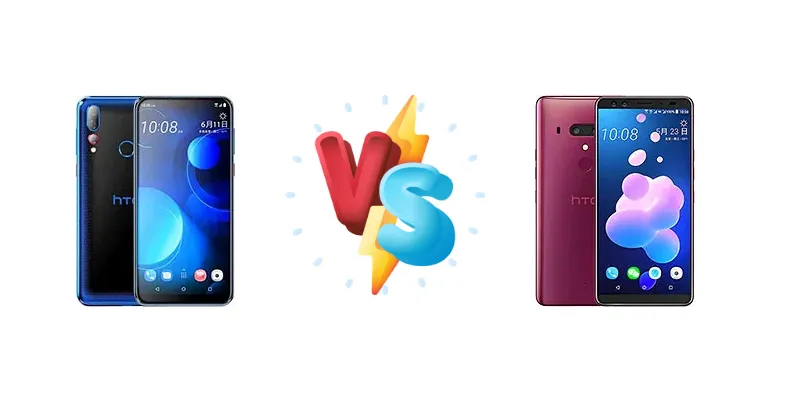
The HTC U12+ represented a flagship ambition in 2018, boasting a high-end Snapdragon processor and advanced features. The Desire 19+, released later, targets a significantly lower price point. This comparison examines whether the U12+'s older, premium hardware still justifies its potential cost over the more accessible Desire 19+.
🏆 Quick Verdict
For most users, the HTC U12+ remains the superior choice, offering a dramatically faster Snapdragon 845 processor and significantly improved charging speeds. However, the Desire 19+ provides a functional smartphone experience at a much lower price, making it suitable for basic users.
| Network |
|---|
| 2G bands | GSM 850 / 900 / 1800 / 1900 | GSM 850 / 900 / 1800 / 1900 - SIM 1 & SIM 2 (dual-SIM model only) |
| 3G bands | HSDPA 850 / 900 / 1900 / 2100 | HSDPA 850 / 900 / 1700(AWS) / 1900 / 2100 |
| 4G bands | 1, 2, 3, 5, 7, 8, 20, 28, 38, 40, 41 | 1, 2, 3, 4, 5, 7, 8, 12, 13, 17, 20, 28, 32, 38, 39, 49, 41, 66 |
| Speed | HSPA 42.2/5.76 Mbps, LTE (2CA) Cat6 300/50 Mbps | HSPA 42.2/5.76 Mbps, LTE-A (5CA) Cat18 1200/150 Mbps |
| Technology | GSM / HSPA / LTE | GSM / HSPA / LTE |
| Launch |
|---|
| Announced | 2019, June 11. Released 2019, August 07 | 2018, May 23 |
| Status | Discontinued | Available. Released 2018, June 29 |
| Body |
|---|
| Build | - | Glass front (Gorilla Glass 3), glass back, aluminum frame |
| Dimensions | 156.2 x 74.8 x 8.5 mm (6.15 x 2.94 x 0.33 in) | 156.6 x 73.9 x 8.7 mm (6.17 x 2.91 x 0.34 in) |
| SIM | Nano-SIM + Nano-SIM | Single SIM (Nano-SIM) or Hybrid Dual SIM (Nano-SIM, dual stand-by) |
| Weight | 170 g (6.00 oz) | 188 g (6.63 oz) |
| | - | IP68 dust/water resistant (up to 1.5m for 30 mins)
Pressure-sensitive buttons |
| Display |
|---|
| Protection | - | Corning Gorilla Glass 3 |
| Resolution | 720 x 1520 pixels, 19:9 ratio (~271 ppi density) | 1440 x 2880 pixels, 18:9 ratio (~537 ppi density) |
| Size | 6.2 inches, 95.9 cm2 (~82.1% screen-to-body ratio) | 6.0 inches, 92.9 cm2 (~80.3% screen-to-body ratio) |
| Type | IPS LCD | Super LCD6, HDR10 |
| Platform |
|---|
| CPU | Octa-core (4x2.3 GHz Cortex-A53 & 4x1.8 GHz Cortex-A53) | Octa-core (4x2.8 GHz Kryo 385 Gold & 4x1.7 GHz Kryo 385 Silver) |
| Chipset | Mediatek MT6765 Helio P35 (12 nm) | Qualcomm SDM845 Snapdragon 845 (10 nm) |
| GPU | PowerVR GE8320 | Adreno 630 |
| OS | Android 9 (Pie) | Android 8.0 (Oreo), upgradable to Android 9.0 (Pie), Sense UI |
| Memory |
|---|
| Card slot | microSDXC (dedicated slot) | microSDXC (uses shared SIM slot) |
| Internal | 64GB 4GB RAM, 128GB 6GB RAM | 64GB 6GB RAM, 128GB 6GB RAM |
| Main Camera |
|---|
| Dual | - | 12 MP, f/1.8, 1/2.55", 1.4µm, dual pixel PDAF, Laser AF, OIS
16 MP (12 MP effective), f/2.6, 1/3.1", 1.0µm, 2x optical zoom, AF |
| Features | Dual-LED dual-tone flash, HDR, panorama | Dual-LED dual-tone flash, HDR |
| Triple | 13 MP, f/1.9, 26mm (wide), PDAF
8 MP, f/2.2, 13mm (ultrawide), 1/4.0", 1.12µm
Auxiliary lens | - |
| Video | 1080p@30fps | 4K@60fps, 1080p@60/240fps, 1080p@30fps (gyro-EIS), HDR, 24-bit/96kHz stereo sound rec. |
| Selfie camera |
|---|
| Dual | - | 8 MP, f/2.0, 1/4", 1.12µm
8 MP, f/2.0, 1/4", 1.12µm |
| Features | HDR | HDR, panorama |
| Single | 16 MP, f/2.0, 27mm (wide), 1/3.06", 1.0µm | - |
| Video | 1080p@30fps | 1080p@30fps |
| Sound |
|---|
| 3.5mm jack | - | No |
| 35mm jack | Yes | - |
| Loudspeaker | Yes | Yes, with stereo speakers |
| | - | 32-bit/384kHz audio
|
| Comms |
|---|
| Bluetooth | 5.0, A2DP, LE | 5.0, A2DP, aptX HD, LE |
| NFC | Yes | Yes |
| Positioning | GPS, GLONASS, GALILEO, BDS | GPS, GLONASS, GALILEO, BDS |
| Radio | FM radio | No |
| USB | USB Type-C 2.0, OTG | USB Type-C 3.1 |
| WLAN | Wi-Fi 802.11 a/b/g/n/ac, dual-band, Wi-Fi Direct | Wi-Fi 802.11 a/b/g/n/ac, dual-band, Wi-Fi Direct, DLNA |
| Features |
|---|
| Sensors | Fingerprint (rear-mounted), accelerometer, proximity, compass | Fingerprint (rear-mounted), accelerometer, gyro, proximity, compass |
| Battery |
|---|
| Charging | 10W wired | 18W wired, QC3, 50% in 35 min (advertised) |
| Talk time | - | Up to 24 h (3G) |
| Type | Li-Ion 3850 mAh, non-removable | Li-Ion 3500 mAh, non-removable |
| Misc |
|---|
| Colors | Star Can Blue, Jasmine White | Translucent Blue, Ceramic Black, Flame Red |
| Models | - | U12, 2Q55100 |
| Price | About 280 EUR | About 450 EUR |
| Tests |
|---|
| Audio quality | - |
Noise -93.7dB / Crosstalk -52.7dB |
| Battery life | - |
Endurance rating 64h
|
| Camera | - |
Photo / Video |
| Display | - |
Contrast ratio: 1818:1 (nominal), 3.085 (sunlight) |
| Loudspeaker | - |
Voice 77dB / Noise 73dB / Ring 99dB
|
| Performance | - |
AnTuTu: 263696 (v7)
GeekBench: 9001 (v4.4)
GFXBench: 20fps (ES 3.1 onscreen) |
HTC Desire 19+
- Significantly lower price point
- Functional for basic smartphone tasks
- Acceptable battery life for light usage
- Slow processor limits performance
- Slow 10W charging
- Inferior display quality
HTC U12+
- Powerful Snapdragon 845 processor
- Fast 18W Quick Charge 3.0 charging
- Superior display contrast and brightness
- Longer software support potential
- Higher price point
- Older device, potentially limited software updates
- May be harder to find new
Display Comparison
The HTC U12+ boasts a superior display experience, though specific details beyond contrast ratios are limited. The reported contrast ratio of 1818:1 (nominal) and 3.085 (sunlight) suggests excellent visibility even in bright conditions. The Desire 19+ lacks these specifications, implying a standard LCD panel likely with lower peak brightness and contrast. This difference translates to a more vibrant and readable screen on the U12+ in all lighting scenarios.
Camera Comparison
Without detailed camera specs for both devices, a direct comparison is challenging. However, the U12+'s flagship positioning suggests a more sophisticated camera system with potentially larger sensors and better image processing. The Desire 19+ likely features a more basic camera setup focused on affordability. While both phones likely offer standard photo and video capabilities, the U12+ is expected to deliver superior image quality, especially in low-light conditions, and potentially offer features like optical image stabilization (OIS) which is common in flagship devices.
Performance
The core difference lies in the chipsets. The HTC U12+'s Snapdragon 845 (10nm) is a flagship-class processor with a Kryo 385 architecture, featuring 4x2.8 GHz Gold cores and 4x1.7 GHz Silver cores. This contrasts sharply with the Desire 19+'s Mediatek MT6765 Helio P35 (12nm) which utilizes four 2.3 GHz Cortex-A53 cores and four 1.8 GHz Cortex-A53 cores. The Snapdragon 845’s smaller 10nm process node and more powerful core design deliver significantly higher CPU and GPU performance, resulting in smoother multitasking, faster app loading times, and a far superior gaming experience. The U12+ will handle demanding games with higher frame rates and graphical settings, while the Desire 19+ will struggle with anything beyond casual titles.
Battery Life
The HTC U12+ offers a clear advantage in charging speed with 18W wired charging and Quick Charge 3.0 support, advertised to reach 50% charge in 35 minutes. The Desire 19+ is limited to 10W wired charging, resulting in a significantly slower charging experience. While battery capacity isn't specified for either device, the U12+'s 64-hour endurance rating suggests efficient power management combined with a reasonable battery size. The slower charging of the Desire 19+ means longer downtime between uses.
Buying Guide
Buy the HTC Desire 19+ if you prioritize affordability and only need a smartphone for essential tasks like calling, texting, and light social media use. You'll accept slower performance and limited gaming capabilities. Buy the HTC U12+ if you value smooth multitasking, responsive gaming, and faster charging, and are willing to pay a premium for a more refined experience. The U12+ is ideal for users who demand performance and longevity from their device.
Frequently Asked Questions
❓ Is the Snapdragon 845 in the U12+ still capable of running modern apps and games?
Yes, the Snapdragon 845 remains a very capable processor. While not the latest, it can comfortably handle most current apps and games at reasonable settings. You may encounter some limitations with the most graphically demanding titles, but it will provide a significantly smoother experience than the Helio P35 in the Desire 19+.
❓ How much of a difference will the charging speed make in daily use?
The difference is substantial. The U12+'s 18W Quick Charge 3.0 can add a significant amount of charge in a short time, minimizing downtime. The Desire 19+'s 10W charging will require considerably longer to reach a full charge, potentially being inconvenient for users who need to quickly top up their battery.
❓ Given the age of the U12+, are software updates still available?
Software update support for the U12+ is likely limited at this point. HTC's update track record isn't the strongest, and the device is several years old. However, it should still be running a relatively recent version of Android, and security patches may still be available.