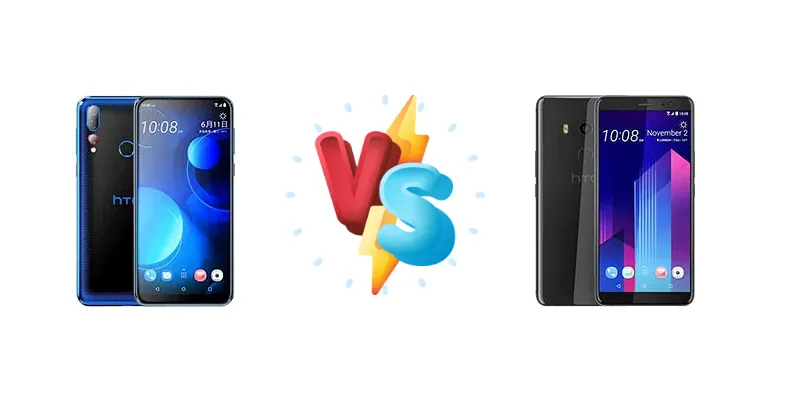
The HTC U11+ represented a flagship peak for HTC, boasting a premium build and powerful Snapdragon 835 processor. The Desire 19+ arrived years later as a budget-focused offering. This comparison dissects the key differences between these two devices, examining where the U11+ still holds an advantage and where the Desire 19+ offers a compelling value proposition in today’s market.
🏆 Quick Verdict
For most users, the HTC U11+ remains the superior choice. Its Snapdragon 835 chipset delivers significantly faster performance and smoother multitasking compared to the Desire 19+'s Helio P35. While the Desire 19+ is more affordable, the U11+'s superior processing power, faster charging, and comparable battery endurance justify the price premium.
| Network |
|---|
| 2G bands | GSM 850 / 900 / 1800 / 1900 - SIM 1 & SIM 2 | GSM 850 / 900 / 1800 / 1900 - SIM 1 & SIM 2 (dual-SIM model only) |
| 3G bands | HSDPA 850 / 900 / 1900 / 2100 | HSDPA 850 / 900 / 1900 / 2100 |
| 4G bands | 1, 2, 3, 5, 7, 8, 20, 28, 38, 40, 41 | 1, 3, 4, 5, 7, 8, 12, 17, 20, 28, 32, 38, 39, 40, 41 |
| Speed | HSPA 42.2/5.76 Mbps, LTE-A (2CA) Cat6 300/50 Mbps | HSPA 42.2/5.76 Mbps, LTE (4CA) Cat15 800/150 Mbps |
| Technology | GSM / HSPA / LTE | GSM / HSPA / LTE |
| Launch |
|---|
| Announced | 2019, June 11 | 2017, November 02. Released 2017, November 22 |
| Status | Available. Released 2019, August 07 | Discontinued |
| Body |
|---|
| Build | - | Glass front (Gorilla Glass 5), glass back, aluminum frame |
| Dimensions | 156.2 x 74.8 x 8.5 mm (6.15 x 2.94 x 0.33 in) | 158.5 x 74.9 x 8.5 mm (6.24 x 2.95 x 0.33 in) |
| SIM | Dual SIM (Nano-SIM, dual stand-by) | · Nano-SIM· Nano-SIM + Nano-SIM |
| Weight | 170 g (6.00 oz) | 188 g (6.63 oz) |
| | - | IP68 dust/water resistant (up to 1.5m for 30 mins) |
| Display |
|---|
| Protection | - | Corning Gorilla Glass 5 |
| Resolution | 720 x 1520 pixels, 19:9 ratio (~271 ppi density) | 1440 x 2880 pixels, 18:9 ratio (~537 ppi density) |
| Size | 6.2 inches, 95.9 cm2 (~82.1% screen-to-body ratio) | 6.0 inches, 92.9 cm2 (~78.3% screen-to-body ratio) |
| Type | IPS LCD | Super LCD6 |
| Platform |
|---|
| CPU | Octa-core (4x2.3 GHz Cortex-A53 & 4x1.8 GHz Cortex-A53) | Octa-core (4x2.45 GHz Kryo & 4x1.9 GHz Kryo) |
| Chipset | Mediatek MT6765 Helio P35 (12nm) | Qualcomm MSM8998 Snapdragon 835 (10 nm) |
| GPU | PowerVR GE8320 | Adreno 540 |
| OS | Android 9 (Pie) | Android 8.0 (Oreo), upgradable to Android 9.0 (Pie), Sense UI |
| Memory |
|---|
| Card slot | microSDXC (dedicated slot) | microSDXC (uses shared SIM slot) - dual SIM model only |
| Internal | 64GB 4GB RAM, 128GB 6GB RAM | 64GB 4GB RAM, 128GB 6GB RAM |
| | eMMC 5.1 | - |
| Main Camera |
|---|
| Features | Dual-LED dual-tone flash, HDR, panorama | Dual-LED dual-tone flash, HDR, panorama |
| Single | - | 12 MP, f/1.7, 1/2.55", 1.4µm, dual pixel PDAF, OIS |
| Triple | 13 MP, f/1.9, 26mm (wide), PDAF
8 MP, f/2.2, 13mm (ultrawide), 1/4.0", 1.12µm
5 MP, f/2.2, (depth) | - |
| Video | 1080p@30fps | 4K@30fps, 1080p@30/60/120fps, HDR, 24-bit/192kHz stereo sound rec. |
| Selfie camera |
|---|
| Features | HDR | HDR, panorama |
| Single | 16 MP, f/2.0, 27mm (wide), 1/3.06", 1.0µm | 8 MP, f/2.0 |
| Video | 1080p@30fps | 1080p@30fps |
| Sound |
|---|
| 3.5mm jack | Yes | No |
| 35mm jack | - | No |
| Loudspeaker | Yes | Yes, with stereo speakers |
| | - | 24-bit/192kHz audio
|
| Comms |
|---|
| Bluetooth | 5.0, A2DP, LE | 5.0, A2DP, aptX HD, LE |
| NFC | Yes | Yes |
| Positioning | GPS, GLONASS, GALILEO, BDS | GPS, GLONASS, BDS |
| Radio | FM radio | No |
| USB | USB Type-C 2.0, OTG | USB Type-C 3.1 |
| WLAN | Wi-Fi 802.11 a/b/g/n/ac, dual-band, Wi-Fi Direct | Wi-Fi 802.11 a/b/g/n/ac, dual-band, Wi-Fi Direct, DLNA |
| Features |
|---|
| Sensors | Fingerprint (rear-mounted), accelerometer, proximity, compass | Fingerprint (rear-mounted), accelerometer, gyro, proximity, compass |
| Battery |
|---|
| Charging | 10W wired | 18W wired, QC3 |
| Talk time | - | Up to 25 h (3G) |
| Type | Li-Ion 3850 mAh, non-removable | Li-Ion 3930 mAh, non-removable |
| Misc |
|---|
| Colors | Star Can Blue, Jasmine White | Translucent Black, Ceramic Black, Amazing Silver |
| Models | - | U11 plus, htc_2q4d100 |
| Price | About 280 EUR | About 450 EUR |
| Tests |
|---|
| Audio quality | - |
Noise -93.9dB / Crosstalk -94.0dB |
| Battery life | - | Endurance rating 73h |
| Camera | - |
Photo / Video |
| Display | - |
Contrast ratio: 1626:1 (nominal), 2.556 (sunlight) |
| Loudspeaker | - |
Voice 91dB / Noise 75dB / Ring 90dB |
| Performance | - |
GeekBench: 6654 (v4.4)
GFXBench: 13fps (ES 3.1 onscreen) |
HTC Desire 19+
- Significantly lower price point
- Acceptable battery endurance
- Functional for basic smartphone tasks
- Slow processor and limited performance
- Slow 10W charging
- Limited camera capabilities (assumed)
HTC U11+
- Powerful Snapdragon 835 processor
- Fast 18W Quick Charge 3.0 charging
- Comparable battery endurance to Desire 19+
- Higher price point
- Older device, potentially limited software updates
- Battery has aged over time
Display Comparison
Both the HTC U11+ and Desire 19+ share a similar contrast ratio of 1626:1 (nominal) and 2.556 (sunlight), suggesting comparable outdoor visibility. However, detailed display specs for the Desire 19+ are unavailable, making a direct comparison of resolution and panel technology impossible. The U11+’s flagship status likely afforded it a higher quality panel with better color accuracy and viewing angles. The lack of information on the Desire 19+'s display suggests a cost-cutting measure in this area.
Camera Comparison
Both phones feature photo and video capabilities, but specifics are limited for the Desire 19+. The U11+’s camera was well-regarded in its time, though details on sensor size and aperture are needed for a complete assessment. The absence of detailed camera specs for the Desire 19+ suggests a more basic camera system focused on everyday snapshots. Without further information, it’s safe to assume the U11+ offers superior image quality and features.
Performance
The performance gap between these devices is substantial. The HTC U11+ utilizes the Qualcomm MSM8998 Snapdragon 835 (10nm), an octa-core processor with Kryo cores clocked up to 2.45 GHz. This is a significant leap over the Desire 19+'s Mediatek MT6765 Helio P35 (12nm) and its Cortex-A53 cores peaking at 2.3 GHz. The Snapdragon 835’s 10nm process node is more efficient, leading to better thermal management and sustained performance. The U11+ will handle demanding applications and games with ease, while the Desire 19+ will struggle with graphically intensive tasks.
Battery Life
Interestingly, both phones boast an endurance rating of 73 hours, suggesting similar real-world battery life despite the U11+'s more powerful processor. This is likely due to the U11+'s more efficient power management and optimized software. However, the U11+ has a significant charging advantage with 18W wired charging and Quick Charge 3.0 support, allowing for much faster top-ups compared to the Desire 19+'s slow 10W charging. A full charge on the Desire 19+ will take considerably longer.
Buying Guide
Buy the HTC Desire 19+ if you prioritize extreme affordability and basic smartphone functionality, primarily for calls, texts, and light social media use. You'll accept slower performance and limited gaming capabilities. Buy the HTC U11+ if you value a responsive user experience, capable gaming, and faster charging, even if it means spending more. The U11+ is ideal for users who want a phone that can handle demanding tasks without significant slowdown.
Frequently Asked Questions
❓ Is the Snapdragon 835 in the U11+ still capable of running modern apps and games?
Yes, the Snapdragon 835 remains a capable processor even today. While it won't match the performance of the latest flagship chips, it can comfortably handle most apps and games at medium to high settings. It offers a far smoother experience than the Helio P35 in the Desire 19+.
❓ How much does the battery age affect the U11+'s real-world battery life compared to a new Desire 19+?
The U11+ is an older device, so its battery capacity has likely degraded over time. While the initial endurance rating was 73 hours, expect slightly less runtime now. However, the U11+'s more efficient processor and power management may still result in comparable or even better battery life than the Desire 19+ in certain usage scenarios.
❓ Does the Desire 19+ support software updates, and will it receive security patches?
Software update support for the Desire 19+ is likely limited. As a budget device released several years ago, it may no longer receive regular security patches or major Android version updates. This is a significant security risk compared to the U11+, which may have a more extended support lifecycle.