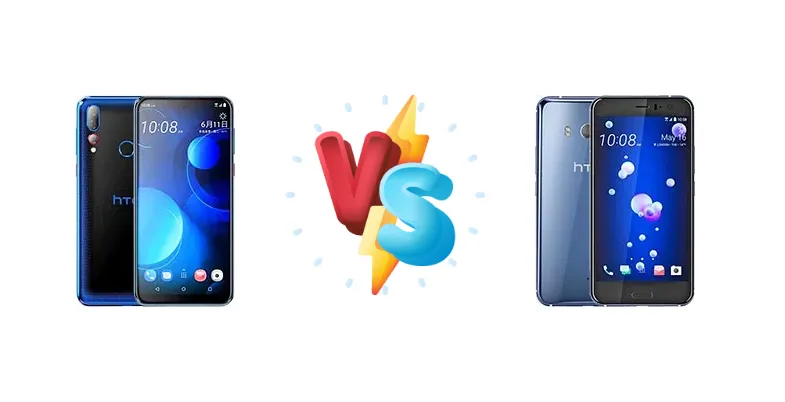
The HTC U11 represented a peak in HTC's flagship ambitions, boasting a powerful Snapdragon 835 processor and a focus on audio quality. The Desire 19+, released years later, targets a drastically different market segment – budget-conscious users. This comparison dissects the core differences between these two devices, revealing where the U11’s premium hardware still shines and where the Desire 19+ offers acceptable compromises.
🏆 Quick Verdict
For the average user prioritizing performance and a more refined experience, the HTC U11 remains the superior choice despite its age. Its Snapdragon 835 chipset delivers significantly faster processing and graphics capabilities. However, the Desire 19+ is a viable option for those on a tight budget who need basic smartphone functionality.
| Network |
|---|
| 2G bands | GSM 850 / 900 / 1800 / 1900 - SIM 1 & SIM 2 | GSM 850 / 900 / 1800 / 1900 - SIM 1 & SIM 2 (dual-SIM model only) |
| 3G bands | HSDPA 850 / 900 / 1900 / 2100 | HSDPA 850 / 900 / 1900 / 2100 |
| 4G bands | 1, 2, 3, 5, 7, 8, 20, 28, 38, 40, 41 | 1, 3, 4, 5, 7, 8, 12, 17, 20, 28, 32, 38, 39, 40, 41 |
| Speed | HSPA 42.2/5.76 Mbps, LTE-A (2CA) Cat6 300/50 Mbps | HSPA 42.2/5.76 Mbps, LTE (4CA) Cat16 1024/75 Mbps |
| Technology | GSM / HSPA / LTE | GSM / HSPA / LTE |
| Launch |
|---|
| Announced | 2019, June 11 | 2017, May 16. Released 2017, June 10 |
| Status | Available. Released 2019, August 07 | Discontinued |
| Body |
|---|
| Build | - | Glass front (Gorilla Glass 5), glass back, aluminum frame |
| Dimensions | 156.2 x 74.8 x 8.5 mm (6.15 x 2.94 x 0.33 in) | 153.9 x 75.9 x 7.9 mm (6.06 x 2.99 x 0.31 in) |
| SIM | Dual SIM (Nano-SIM, dual stand-by) | · Nano-SIM· Nano-SIM + Nano-SIM |
| Weight | 170 g (6.00 oz) | 169 g (5.96 oz) |
| | - | IP67 dust/water resistant (up to 1m for 30 mins) |
| Display |
|---|
| Protection | - | Corning Gorilla Glass 5 |
| Resolution | 720 x 1520 pixels, 19:9 ratio (~271 ppi density) | 1440 x 2560 pixels, 16:9 ratio (~534 ppi density) |
| Size | 6.2 inches, 95.9 cm2 (~82.1% screen-to-body ratio) | 5.5 inches, 83.4 cm2 (~71.4% screen-to-body ratio) |
| Type | IPS LCD | Super LCD5 |
| Platform |
|---|
| CPU | Octa-core (4x2.3 GHz Cortex-A53 & 4x1.8 GHz Cortex-A53) | Octa-core (4x2.45 GHz Kryo & 4x1.9 GHz Kryo) |
| Chipset | Mediatek MT6765 Helio P35 (12nm) | Qualcomm MSM8998 Snapdragon 835 (10 nm) |
| GPU | PowerVR GE8320 | Adreno 540 |
| OS | Android 9 (Pie) | Android 7.1 (Nougat), upgradable to Android 9.0 (Pie), Sense UI |
| Memory |
|---|
| Card slot | microSDXC (dedicated slot) | microSDXC (uses shared SIM slot) - dual SIM model only |
| Internal | 64GB 4GB RAM, 128GB 6GB RAM | 64GB 4GB RAM, 128GB 6GB RAM |
| | eMMC 5.1 | - |
| Main Camera |
|---|
| Features | Dual-LED dual-tone flash, HDR, panorama | Dual-LED dual-tone flash, HDR, panorama |
| Single | - | 12 MP, f/1.7, 1/2.55", 1.4µm, dual pixel PDAF, 5-axis OIS |
| Triple | 13 MP, f/1.9, 26mm (wide), PDAF
8 MP, f/2.2, 13mm (ultrawide), 1/4.0", 1.12µm
5 MP, f/2.2, (depth) | - |
| Video | 1080p@30fps | 4K@30fps, 1080p@30/60/120fps, HDR, 24-bit/192kHz stereo sound rec. |
| Selfie camera |
|---|
| Features | HDR | - |
| Single | 16 MP, f/2.0, 27mm (wide), 1/3.06", 1.0µm | 16 MP, f/2.0, 27mm (wide), 1/3.06", 1.0µm |
| Video | 1080p@30fps | 1080p@30fps |
| Sound |
|---|
| 3.5mm jack | Yes | No |
| 35mm jack | - | No |
| Loudspeaker | Yes | Yes, with stereo speakers |
| | - | 24-bit/192kHz audio
|
| Comms |
|---|
| Bluetooth | 5.0, A2DP, LE | 4.2, A2DP, LE (5.0 after SW update) |
| NFC | Yes | Yes |
| Positioning | GPS, GLONASS, GALILEO, BDS | GPS, GLONASS, BDS |
| Radio | FM radio | No |
| USB | USB Type-C 2.0, OTG | USB Type-C 3.1 |
| WLAN | Wi-Fi 802.11 a/b/g/n/ac, dual-band, Wi-Fi Direct | Wi-Fi 802.11 a/b/g/n/ac, dual-band, Wi-Fi Direct, DLNA |
| Features |
|---|
| Sensors | Fingerprint (rear-mounted), accelerometer, proximity, compass | Fingerprint (front-mounted), accelerometer, gyro, proximity, compass |
| Battery |
|---|
| Charging | 10W wired | 18W wired, QC3 |
| Stand-by | - | Up to 336 h (3G) |
| Talk time | - | Up to 24 h 30 min (3G) |
| Type | Li-Ion 3850 mAh, non-removable | Li-Ion 3000 mAh, non-removable |
| Misc |
|---|
| Colors | Star Can Blue, Jasmine White | Amazing Silver, Sapphire Blue, Brilliant Black, Ice White, Solar Red |
| Models | - | U11, HTV33, 2PZC100, 2PZC5, 601HT |
| Price | About 280 EUR | About 300 EUR |
| Tests |
|---|
| Audio quality | - |
Noise -94.1 / Crosstalk -94.5 |
| Battery life | - |
Endurance rating 73h
|
| Camera | - |
Photo / Video |
| Loudspeaker | - |
Voice 68dB / Noise 73dB / Ring 79dB
|
| Performance | - |
GeekBench: 6393 (v4.4)
GFXBench: 13fps (ES 3.1 onscreen) |
HTC Desire 19+
- More affordable price point
- Acceptable battery life for basic use
- Functional for everyday tasks
- Significantly slower performance
- Less capable camera system
- Slower charging speeds
HTC U11
- Powerful Snapdragon 835 processor
- Faster 18W Quick Charge 3.0 charging
- Likely superior camera quality
- Higher price (even used)
- Older device with potentially limited software support
- Battery may have degraded over time
Display Comparison
Neither device's display specifications are detailed in the provided data. However, given the U11's flagship status, it likely featured a higher-quality panel with better color accuracy and brightness compared to the Desire 19+. The U11 likely employed an AMOLED display, offering superior contrast ratios, while the Desire 19+ likely used an IPS LCD. Bezels on the U11 were also likely slimmer, reflecting design trends at the time of its release.
Camera Comparison
Both devices are listed as having Photo/Video capabilities, but specifics are lacking. The U11, as a flagship, likely featured a more advanced camera system with a larger sensor, optical image stabilization (OIS), and superior image processing algorithms. The Desire 19+ likely utilizes a more basic camera setup focused on affordability. Without sensor size or aperture data, it’s difficult to make a precise comparison, but the U11’s camera would almost certainly deliver better image quality, especially in low-light conditions.
Performance
The core difference lies in the chipsets. The HTC U11’s Qualcomm MSM8998 Snapdragon 835 (10nm) is a significant leap ahead of the Desire 19+'s Mediatek MT6765 Helio P35 (12nm). The Snapdragon 835’s Kryo cores, clocked up to 2.45 GHz, offer substantially more processing power than the Cortex-A53 cores in the Helio P35, peaking at 2.3 GHz. The 10nm fabrication process of the Snapdragon 835 also contributes to better thermal efficiency, reducing throttling during sustained workloads. This translates to smoother gaming, faster app loading times, and a more responsive user experience on the U11.
Battery Life
Interestingly, both phones share an endurance rating of 73 hours, suggesting similar real-world battery life despite the vastly different chipsets. However, this doesn't tell the whole story. The U11’s 18W charging with Quick Charge 3.0 support allows for significantly faster charging speeds compared to the Desire 19+'s 10W wired charging. This means the U11 can replenish its battery much quicker, minimizing downtime. While both may last a full day, the U11 offers greater convenience in topping up the battery.
Buying Guide
Buy the HTC Desire 19+ if you need a functional smartphone for essential tasks like calling, texting, and light social media use, and your budget is extremely limited. You'll accept slower performance and a less capable camera. Buy the HTC U11 if you prioritize smooth multitasking, gaming, photography, and faster charging, and are willing to pay a premium (even on the used market) for a flagship-level experience.
Frequently Asked Questions
❓ Is the Snapdragon 835 in the HTC U11 still capable of handling modern apps and games?
Yes, the Snapdragon 835 remains a capable processor even in 2024. While it won't match the performance of the latest flagship chips, it can comfortably run most popular apps and games at reasonable settings. Expect smooth multitasking and a generally responsive experience.
❓ Given the age of the HTC U11, is battery degradation a significant concern?
Battery degradation is a valid concern with any older smartphone. The U11's battery, having aged, will likely have reduced capacity compared to its original specification. However, the faster charging capabilities of the U11 can mitigate this somewhat, allowing for quicker top-ups throughout the day.
❓ Does the HTC Desire 19+ support common streaming services like Netflix and YouTube?
Yes, the HTC Desire 19+ should support popular streaming services like Netflix and YouTube. However, the Helio P35 processor may result in longer loading times and potentially lower video quality compared to the U11, especially for high-resolution content.
❓ What kind of software updates can I expect on the HTC Desire 19+?
Given its budget nature and age, the HTC Desire 19+ likely has limited or no further software updates. It may be running an older version of Android, and security patches may be infrequent or non-existent. This is a trade-off for the lower price point.