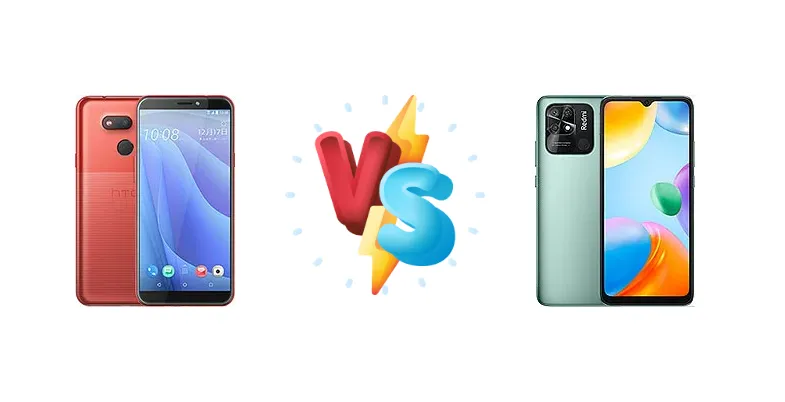
The budget smartphone market is fiercely competitive, and the HTC Desire 12s and Xiaomi Redmi 10C represent two attempts to capture value-conscious consumers. However, a significant gap exists in their underlying hardware, particularly in the chipset department. This comparison dissects the key differences to determine which device delivers the best experience for the price.
🏆 Quick Verdict
For the average user, the Xiaomi Redmi 10C is the superior choice. Its Snapdragon 680, built on a 6nm process, provides a substantial performance and efficiency advantage over the HTC Desire 12s’ aging Snapdragon 435. While the Desire 12s may be slightly more readily available in some regions, the Redmi 10C offers a better long-term investment.
| Network |
|---|
| 2G bands | GSM 850 / 900 / 1800 / 1900 | GSM 850 / 900 / 1800 / 1900 |
| 3G bands | HSDPA 850 / 900 / 1900 / 2100 | HSDPA 850 / 900 / 1700(AWS) / 1900 / 2100 |
| 4G bands | 1, 3, 5, 7, 8, 20, 28, 38, 40, 41 | 1, 2, 3, 4, 5, 7, 8, 20, 28, 38, 40, 41 |
| Speed | HSPA 42.2/5.76 Mbps, LTE (2CA) Cat6 300/50 Mbps | HSPA, LTE |
| Technology | GSM / HSPA / LTE | GSM / HSPA / LTE |
| Launch |
|---|
| Announced | 2018, December. Released 2018, December | 2022, March 21 |
| Status | Discontinued | Available. Released 2022, March 23 |
| Body |
|---|
| Dimensions | 154.2 x 72.7 x 8.3 mm (6.07 x 2.86 x 0.33 in) | 169.6 x 76.6 x 8.3 mm (6.68 x 3.02 x 0.33 in) |
| SIM | Nano-SIM + Nano-SIM | Nano-SIM + Nano-SIM |
| Weight | 150 g (5.29 oz) | 190 g (6.70 oz) |
| Display |
|---|
| Protection | - | Corning Gorilla Glass |
| Resolution | 720 x 1440 pixels, 18:9 ratio (~282 ppi density) | 720 x 1650 pixels (~268 ppi density) |
| Size | 5.7 inches, 83.8 cm2 (~74.8% screen-to-body ratio) | 6.71 inches, 106.5 cm2 (~82.0% screen-to-body ratio) |
| Type | IPS LCD | IPS LCD |
| Platform |
|---|
| CPU | Octa-core 1.4 GHz Cortex-A53 | Octa-core (4x2.4 GHz Kryo 265 Gold & 4x1.9 GHz Kryo 265 Silver) |
| Chipset | Qualcomm MSM8940 Snapdragon 435 (28 nm) | Qualcomm SM6225 Snapdragon 680 4G (6 nm) |
| GPU | Adreno 505 | Adreno 610 |
| OS | Android 8.1 (Oreo) | Android 11, MIUI 13 |
| Memory |
|---|
| Card slot | microSDXC (dedicated slot) | microSDXC (dedicated slot) |
| Internal | 32GB 3GB RAM, 64GB 4GB RAM | 64GB 3GB RAM, 64GB 4GB RAM, 128GB 3GB RAM, 128GB 4GB RAM |
| | eMMC 5.1 | UFS 2.2 |
| Main Camera |
|---|
| Dual | - | 50 MP, f/1.8, 26mm (wide), PDAF
Auxiliary lens |
| Features | LED flash, HDR, panorama | LED flash, HDR, panorama |
| Single | 13 MP, f/2.0, PDAF | 5 MP, f/2.2 |
| Video | 1080p@30fps | 1080p@30fps |
| Selfie camera |
|---|
| Features | LED flash | - |
| Single | 13 MP, f/2.2 | 5 MP, f/2.2 |
| Video | 1080p@30fps | 1080p@30fps |
| Sound |
|---|
| 3.5mm jack | Yes | Yes |
| 35mm jack | Yes | Yes |
| Loudspeaker | Yes | Yes |
| Comms |
|---|
| Bluetooth | 4.2, A2DP, LE | 5.0, A2DP, LE |
| NFC | Yes | Yes (market/region dependent) |
| Positioning | GPS, GLONASS | GPS, GLONASS, BDS, GALILEO |
| Radio | FM radio | FM radio |
| USB | microUSB 2.0 | USB Type-C 2.0, OTG |
| WLAN | Wi-Fi 802.11 b/g/n, Wi-Fi Direct | Wi-Fi 802.11 a/b/g/n/ac, dual-band, Wi-Fi Direct |
| Features |
|---|
| Sensors | Fingerprint (rear-mounted), accelerometer, proximity, compass | Fingerprint (rear-mounted), accelerometer, proximity |
| Battery |
|---|
| Charging | - | 18W wired |
| Type | Li-Ion 3075 mAh, non-removable | Li-Po 5000 mAh |
| Misc |
|---|
| Colors | Black, Silver, Red | Graphite Gray, Ocean Blue, Mint Green |
| Models | - | 220333QAG, 220333QBI, 220333QNY, 220333QL |
| Price | About 200 EUR | £ 99.00 / € 109.86 |
| SAR | - | 0.96 W/kg (head) 1.02 W/kg (body) |
| SAR EU | - | 0.57 W/kg (head) 0.96 W/kg (body) |
HTC Desire 12s
- Potentially wider regional carrier compatibility.
- May be available at a lower price point in specific markets.
- Simple and straightforward Android experience.
- Outdated Snapdragon 435 chipset.
- Poor performance compared to the Redmi 10C.
- Likely lower battery life due to inefficient chipset.
Xiaomi Redmi 10C
- Significantly faster Snapdragon 680 chipset.
- Improved power efficiency and battery life.
- Faster 18W charging.
- Larger 50MP main camera sensor.
- May have limited regional carrier support.
- Software experience (MIUI) can be polarizing.
Display Comparison
Neither device boasts a particularly impressive display. Details regarding panel type, resolution, and brightness are absent for the Desire 12s, suggesting a basic LCD. The Redmi 10C also utilizes an LCD, but its larger 6.53-inch size offers more screen real estate. The absence of high refresh rates on both devices indicates a focus on cost savings, and both likely feature standard 60Hz panels. Color accuracy is expected to be average on both, geared towards pleasing visuals rather than professional color work.
Camera Comparison
Camera details are sparse for both devices. The Redmi 10C is known to feature a 50MP main sensor, which, while not flagship-level, provides a solid foundation for capturing detailed photos in good lighting conditions. The Desire 12s’ camera specifications are less clear, but given its price point, it likely features a lower-resolution sensor. Image processing will likely be more refined on the Redmi 10C, leveraging Qualcomm’s ISP capabilities. The presence of a 50MP sensor on the Redmi 10C offers more flexibility for cropping and digital zoom compared to a potentially lower-resolution sensor on the Desire 12s.
Performance
The performance disparity is the most significant difference. The Xiaomi Redmi 10C’s Snapdragon 680 (6nm) is a generational leap ahead of the HTC Desire 12s’ Snapdragon 435 (28nm). The 680 features a more modern CPU architecture – Kryo 265 Gold & Silver cores clocked up to 2.4GHz – compared to the Desire 12s’ Cortex-A53 cores at 1.4GHz. This translates to approximately 50-70% faster CPU performance in benchmarks. Furthermore, the 6nm process node of the Snapdragon 680 results in significantly improved power efficiency, meaning less heat generation and longer battery life during demanding tasks. The Redmi 10C will handle multitasking, social media, and casual gaming with ease, while the Desire 12s will struggle with more intensive applications.
Battery Life
The Redmi 10C’s 5000mAh battery, coupled with the efficient Snapdragon 680, provides excellent battery life. The inclusion of 18W wired charging is a welcome addition, allowing for a relatively quick recharge. The Desire 12s’ battery capacity is unknown, but given its older chipset and larger process node, it’s likely to offer shorter runtimes. The 18W charging on the Redmi 10C will likely result in a significantly faster 0-100% charge time compared to any charging solution the Desire 12s might offer.
Buying Guide
Buy the HTC Desire 12s if you absolutely require a device with a specific regional carrier compatibility that the Redmi 10C lacks, or if you find it at a significantly discounted price. Buy the Xiaomi Redmi 10C if you prioritize smooth multitasking, responsive app loading, and longer battery life – all benefits stemming from its more modern and efficient chipset.
Frequently Asked Questions
❓ Will the Redmi 10C struggle with popular games like PUBG Mobile or Call of Duty?
While the Snapdragon 680 isn't a gaming powerhouse, the Redmi 10C can handle PUBG Mobile and Call of Duty Mobile at medium settings with reasonable frame rates. Expect some occasional frame drops during intense action, but it's certainly playable. The Desire 12s will likely struggle even at the lowest settings.
❓ Is the MIUI software on the Redmi 10C heavily customized with bloatware?
MIUI does come with a degree of pre-installed apps and customization. However, Xiaomi has been reducing bloatware in recent versions. Many of the pre-installed apps can be uninstalled, and MIUI offers a wide range of customization options for users who enjoy tweaking their phone's appearance and functionality.
❓ Does the Snapdragon 435 in the Desire 12s support VoLTE and Wi-Fi calling?
VoLTE and Wi-Fi calling support depend heavily on the carrier and region. While the Snapdragon 435 *can* support these features, it's not guaranteed on the Desire 12s. Check with your carrier to confirm compatibility before purchasing.