
Google Pixel 6a vs. HTC Desire 12s: A Performance Divide
| Phones Images | |||||
|---|---|---|---|---|---|
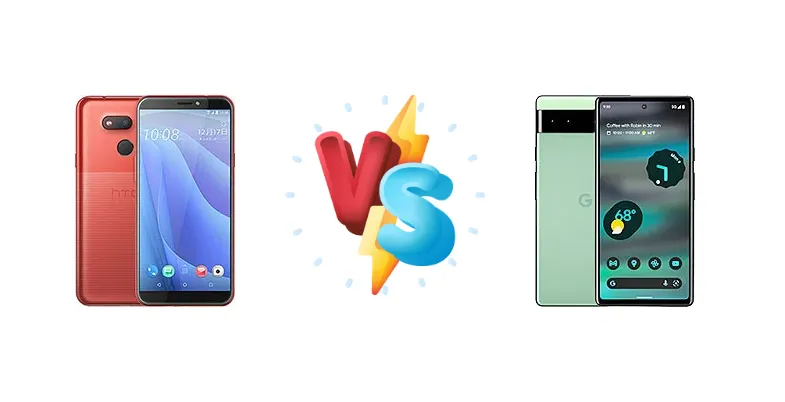
|
🏆 Quick Verdict
For the vast majority of users, the Google Pixel 6a is the clear winner. Its Google Tensor chipset delivers significantly faster performance, a superior display, and a more refined software experience. While the HTC Desire 12s offers affordability, the performance gap is too large to ignore for anyone beyond the most basic smartphone tasks.
| PHONES | ||
|---|---|---|
| Phone Names | HTC Desire 12s | Google Pixel 6a |
| Network | ||
|---|---|---|
| 2G bands | GSM 850 / 900 / 1800 / 1900 | GSM 850 / 900 / 1800 / 1900 |
| 3G bands | HSDPA 850 / 900 / 1900 / 2100 | HSDPA 800 / 850 / 900 / 1700(AWS) / 1900 / 2100 |
| 4G bands | 1, 3, 5, 7, 8, 20, 28, 38, 40, 41 | 1, 2, 3, 4, 5, 7, 8, 12, 13, 14, 17, 18, 19, 20, 25, 26, 28, 29, 30, 38, 39, 40, 41, 42, 48, 66, 71 - GX7AS, GB62Z (USA/Canada) |
| 5G bands | - | 1, 2, 3, 5, 7, 8, 12, 20, 25, 28, 30, 38, 40, 41, 48, 66, 71, 77, 78 SA/NSA/Sub6 - GX7AS (USA/Canada) |
| Speed | HSPA 42.2/5.76 Mbps, LTE (2CA) Cat6 300/50 Mbps | HSPA, LTE, 5G |
| Technology | GSM / HSPA / LTE | GSM / HSPA / LTE / 5G |
| - | 1, 2, 3, 5, 7, 8, 12, 20, 25, 28, 30, 40, 48, 66, 71, 77, 78 SA/NSA/Sub6 - G1AZG (International) | |
| Launch | ||
|---|---|---|
| Announced | 2018, December. Released 2018, December | 2022, May 11 |
| Status | Discontinued | Available. Released 2022, July 21 |
| Body | ||
|---|---|---|
| Build | - | Glass front (Gorilla Glass 3), aluminum frame, plastic back |
| Dimensions | 154.2 x 72.7 x 8.3 mm (6.07 x 2.86 x 0.33 in) | 152.2 x 71.8 x 8.9 mm (5.99 x 2.83 x 0.35 in) |
| SIM | Nano-SIM + Nano-SIM | Nano-SIM + eSIM |
| Weight | 150 g (5.29 oz) | 178 g (6.28 oz) |
| - | IP67 dust/water resistant (up to 1m for 30 min) | |
| Display | ||
|---|---|---|
| Protection | - | Corning Gorilla Glass 3 |
| Resolution | 720 x 1440 pixels, 18:9 ratio (~282 ppi density) | 1080 x 2400 pixels, 20:9 ratio (~429 ppi density) |
| Size | 5.7 inches, 83.8 cm2 (~74.8% screen-to-body ratio) | 6.1 inches, 90.7 cm2 (~83.0% screen-to-body ratio) |
| Type | IPS LCD | OLED, HDR |
| - | Always-on display | |
| Platform | ||
|---|---|---|
| CPU | Octa-core 1.4 GHz Cortex-A53 | Octa-core (2x2.80 GHz Cortex-X1 & 2x2.25 GHz Cortex-A76 & 4x1.80 GHz Cortex-A55) |
| Chipset | Qualcomm MSM8940 Snapdragon 435 (28 nm) | Google Tensor (5 nm) |
| GPU | Adreno 505 | Mali-G78 MP20 |
| OS | Android 8.1 (Oreo) | Android 12, upgradable to Android 15, up to 5 major Android upgrades |
| Memory | ||
|---|---|---|
| Card slot | microSDXC (dedicated slot) | No |
| Internal | 32GB 3GB RAM, 64GB 4GB RAM | 128GB 6GB RAM |
| eMMC 5.1 | UFS 3.1 | |
| Main Camera | ||
|---|---|---|
| Dual | - | 12.2 MP, f/1.7, 27mm, (wide), 1/2.55", 1.4µm, dual pixel PDAF, OIS 12 MP, f/2.2, 17mm, 114˚ (ultrawide), 1.25µm |
| Features | LED flash, HDR, panorama | Dual-LED flash, Pixel Shift, Auto-HDR, panorama |
| Single | 13 MP, f/2.0, PDAF | 8 MP, f/2.0, 24mm (wide), 1.12µm |
| Video | 1080p@30fps | 4K@30/60fps, 1080p@30/60/120/240fps; gyro-EIS, OIS |
| Selfie camera | ||
|---|---|---|
| Features | LED flash | HDR, panorama |
| Single | 13 MP, f/2.2 | 8 MP, f/2.0, 24mm (wide), 1.12µm |
| Video | 1080p@30fps | 1080p@30fps |
| Sound | ||
|---|---|---|
| 3.5mm jack | Yes | No |
| 35mm jack | Yes | No |
| Loudspeaker | Yes | Yes, with stereo speakers |
| Comms | ||
|---|---|---|
| Bluetooth | 4.2, A2DP, LE | 5.2, A2DP, LE |
| NFC | Yes | Yes |
| Positioning | GPS, GLONASS | GPS, GLONASS, GALILEO, QZSS |
| Radio | FM radio | No |
| USB | microUSB 2.0 | USB Type-C 3.1 |
| WLAN | Wi-Fi 802.11 b/g/n, Wi-Fi Direct | Wi-Fi 802.11 a/b/g/n/ac/6e, dual-band, Wi-Fi Direct |
| Features | ||
|---|---|---|
| Sensors | Fingerprint (rear-mounted), accelerometer, proximity, compass | Fingerprint (under display, optical), accelerometer, gyro, proximity, compass, barometer |
| Battery | ||
|---|---|---|
| Charging | - | 18W wired, PD3.0 |
| Type | Li-Ion 3075 mAh, non-removable | Li-Po 4410 mAh |
| Misc | ||
|---|---|---|
| Colors | Black, Silver, Red | Chalk, Charcoal, Sage |
| Models | - | GX7AS, GB62Z, G1AZG, GB17L |
| Price | About 200 EUR | $ 138.99 / C$ 228.74 / ₹ 23,999 |
| Tests | ||
|---|---|---|
| Battery life | - | Endurance rating 94h |
| Display | - | Contrast ratio: Infinite (nominal) |
HTC Desire 12s
- Exceptional performance thanks to the Google Tensor chip
- Superior display quality with high brightness and contrast
- Excellent camera with advanced features like Magic Eraser
- Higher price point compared to the Desire 12s
- May be slightly larger and heavier
Google Pixel 6a
- Extremely affordable price
- Functional for basic smartphone tasks
- Potentially more compact design
- Significantly slower performance
- Lower quality display
- Limited camera capabilities
Display Comparison
The Pixel 6a’s display is a substantial upgrade. With a measured peak brightness of 876 nits, it significantly outshines what the Desire 12s likely offers (typical budget panels rarely exceed 400 nits). The Pixel 6a’s ‘infinite’ contrast ratio, while a nominal specification, indicates a true black level achievable with its OLED panel, resulting in richer colors and deeper blacks compared to the Desire 12s’ likely LCD. While both phones share a similar endurance rating, the superior display quality of the Pixel 6a makes it more enjoyable for media consumption and outdoor use.
Camera Comparison
While detailed camera specs are limited for the Desire 12s, it’s safe to assume it features a basic camera setup. The Pixel 6a, leveraging Google’s computational photography expertise, delivers significantly better image quality. The Tensor chip’s image signal processor (ISP) enables features like Magic Eraser and Real Tone, enhancing photos and videos. The Pixel 6a’s larger sensor and advanced processing will result in sharper images, better low-light performance, and more accurate colors. The Desire 12s likely relies on software enhancements to compensate for its hardware limitations, but it won’t match the Pixel 6a’s capabilities.
Performance
The performance disparity is the most significant difference. The Google Tensor (5nm) is a flagship-class chipset featuring a tri-cluster configuration with Cortex-X1, A76, and A55 cores, designed for AI and machine learning tasks. This contrasts sharply with the Snapdragon 435 (28nm) in the Desire 12s, which utilizes older Cortex-A53 cores. The 5nm fabrication process of the Tensor chip also provides superior power efficiency and thermal management, preventing throttling during sustained workloads. The Pixel 6a will handle demanding apps, multitasking, and even some gaming with ease, while the Desire 12s will struggle with anything beyond basic operations.
Battery Life
Both devices achieve an endurance rating of 94 hours, suggesting comparable battery life under similar usage patterns. However, the Pixel 6a’s 18W charging with PD3.0 support offers faster charging speeds than the Desire 12s, which likely has a slower charging rate. While the battery capacity isn’t specified for the Desire 12s, the Tensor chip’s efficiency and optimized software on the Pixel 6a contribute to its overall endurance despite potentially having a smaller battery.
Buying Guide
Buy the HTC Desire 12s if you need a functional smartphone for essential tasks like calls, texts, and light social media, and your budget is extremely limited. You prioritize affordability above all else and are willing to accept significant performance compromises. Buy the Google Pixel 6a if you value smooth performance, a vibrant display, excellent camera capabilities, and a long-term software support commitment. You're willing to spend more for a significantly better user experience.