
HTC Desire 12+ vs. Samsung Galaxy S9+: A Deep Dive into Performance and Value
| Phones Images | |||||
|---|---|---|---|---|---|
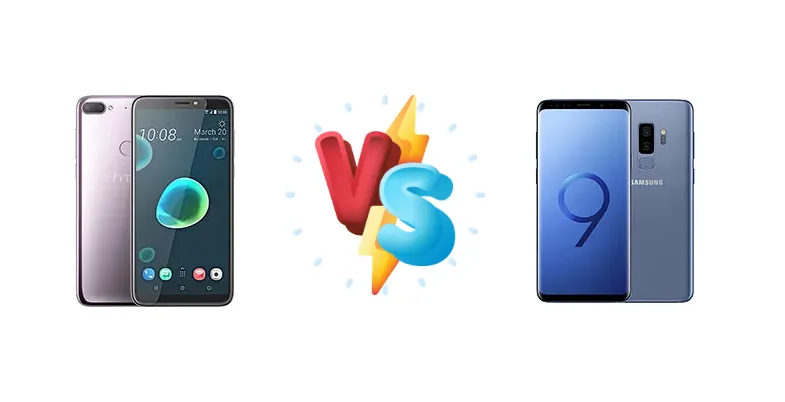
|
🏆 Quick Verdict
For the average user in 2024, the Samsung Galaxy S9+ is the superior choice. While the Desire 12+ offers basic functionality, the S9+'s significantly more powerful Exynos 9810 (or Snapdragon 845) chipset, superior display, and more refined camera system provide a far more enjoyable and capable experience, even considering its age.
| PHONES | ||
|---|---|---|
| Phone Names | HTC Desire 12+ | Samsung Galaxy S9+ |
| Network | ||
|---|---|---|
| 2G bands | GSM 850 / 900 / 1800 / 1900 | GSM 850 / 900 / 1800 / 1900 - SIM 1 & SIM 2 (dual-SIM model only) |
| 3G bands | HSDPA 850 / 900 / 1900 / 2100 | HSDPA 850 / 900 / 1700(AWS) / 1900 / 2100 - Global, USA |
| 4G bands | 1, 3, 5, 7, 8, 20, 40 | 1, 2, 3, 4, 5, 7, 8, 12, 13, 17, 18, 19, 20, 25, 26, 28, 32, 38, 39, 40, 41, 66 - Global |
| Speed | HSPA 42.2/5.76 Mbps, LTE Cat4 150/50 Mbps | HSPA 42.2/5.76 Mbps, LTE (6CA) Cat18 1200/200 Mbps |
| Technology | GSM / HSPA / LTE | GSM / CDMA / HSPA / EVDO / LTE |
| 1, 3, 5, 7, 8, 20, 28, 38, 40 | 1, 2, 3, 4, 5, 7, 8, 12, 13, 14, 17, 18, 19, 20, 25, 26, 28, 29, 30, 38, 39, 40, 41, 46, 66, 71 - USA | |
| Launch | ||
|---|---|---|
| Announced | 2018, March 20. Released 2018, June 07 | 2018, February 25. Released 2018, March |
| Status | Discontinued | Discontinued |
| Body | ||
|---|---|---|
| Build | - | Glass front (Gorilla Glass 5), glass back (Gorilla Glass 5), aluminum frame |
| Dimensions | 158.2 x 76.6 x 8.4 mm (6.23 x 3.02 x 0.33 in) | 158.1 x 73.8 x 8.5 mm (6.22 x 2.91 x 0.33 in) |
| SIM | Nano-SIM + Nano-SIM | · Nano-SIM· Nano-SIM + Nano-SIM |
| Weight | 157.5 g (5.57 oz) | 189 g (6.67 oz) |
| - | IP68 dust/water resistant (up to 1.5m for 30 min) | |
| Display | ||
|---|---|---|
| Protection | - | Corning Gorilla Glass 5 |
| Resolution | 720 x 1440 pixels, 18:9 ratio (~268 ppi density) | 1440 x 2960 pixels, 18.5:9 ratio (~529 ppi density) |
| Size | 6.0 inches, 92.9 cm2 (~76.7% screen-to-body ratio) | 6.2 inches, 98.3 cm2 (~84.2% screen-to-body ratio) |
| Type | IPS LCD | Super AMOLED, HDR10 |
| - | 3D Touch (home button only) Always-on display | |
| Platform | ||
|---|---|---|
| CPU | Octa-core 1.8 GHz Cortex-A53 | Octa-core (4x2.7 GHz Mongoose M3 & 4x1.8 GHz Cortex-A55) - EMEAOcta-core (4x2.8 GHz Kryo 385 Gold & 4x1.7 GHz Kryo 385 Silver) - USA/LATAM, China |
| Chipset | Qualcomm SDM450 Snapdragon 450 (14 nm) | Exynos 9810 (10 nm) - EMEAQualcomm SDM845 Snapdragon 845 (10 nm) - USA/LATAM, China |
| GPU | Adreno 506 | Mali-G72 MP18 - EMEAAdreno 630 - USA/LATAM, China |
| OS | Android 8.0 (Oreo) | Android 8.0 (Oreo), upgradable to Android 10, One UI 2.5 |
| Memory | ||
|---|---|---|
| Card slot | microSDXC (uses shared SIM slot) | microSDXC (uses shared SIM slot) - dual SIM model only |
| Internal | 32GB 3GB RAM | 64GB 4GB RAM, 64GB 6GB RAM, 128GB 6GB RAM, 256GB 6GB RAM |
| eMMC 5.1 | UFS 2.1 | |
| Main Camera | ||
|---|---|---|
| Dual | 13 MP, f/2.2, PDAF Auxiliary lens | 12 MP, f/1.5-2.4, 26mm (wide), 1/2.55", 1.4µm, dual pixel PDAF, OIS 12 MP, f/2.4, 52mm (telephoto), 1/3.6", 1.0µm, AF, OIS, 2x optical zoom |
| Features | LED flash, HDR, panorama | LED flash, auto-HDR, panorama |
| Video | 1080p@30fps | 4K@30/60fps, 1080p@30/60/240fps, 720p@960fps, HDR, stereo sound rec., gyro-EIS & OIS (30fps) |
| Selfie camera | ||
|---|---|---|
| Dual | - | 8 MP, f/1.7, 25mm (wide), 1/3.6", 1.22µm, AF 2 MP (dedicated iris scanner camera) |
| Features | - | HDR |
| Single | 8 MP, f/2.0 | - |
| Video | 1080p@30fps | 1440p@30fps |
| Sound | ||
|---|---|---|
| 3.5mm jack | Yes | Yes |
| 35mm jack | Yes | Yes |
| Loudspeaker | Yes | Yes, with stereo speakers |
| - | 32-bit/384kHz audio Tuned by AKG | |
| Comms | ||
|---|---|---|
| Bluetooth | 4.2, A2DP, LE | 5.0, A2DP, LE, aptX |
| NFC | No | Yes |
| Positioning | GPS, GLONASS | GPS, GLONASS, BDS, GALILEO |
| Radio | FM radio | FM radio (USA & Canada only) |
| USB | microUSB 2.0 | USB Type-C 3.1 |
| WLAN | Wi-Fi 802.11 b/g/n, Wi-Fi Direct | Wi-Fi 802.11 a/b/g/n/ac, dual-band, Wi-Fi Direct |
| Features | ||
|---|---|---|
| Sensors | Fingerprint (rear-mounted), accelerometer, proximity, compass | Iris scanner, fingerprint (rear-mounted), accelerometer, gyro, proximity, compass, barometer, heart rate, SpO2 |
| - | Samsung DeX (desktop experience support) ANT+ Bixby natural language commands and dictation Samsung Pay (Visa, MasterCard certified) | |
| Battery | ||
|---|---|---|
| Charging | - | 15W wired, QC2 Wireless (Qi) (market dependent) |
| Stand-by | Up to 522 h (3G) | - |
| Talk time | Up to 26 h (3G) | - |
| Type | Li-Ion 2965 mAh, non-removable | Li-Ion 3500 mAh, non-removable (13.48 Wh) |
| Misc | ||
|---|---|---|
| Colors | Black, Silver, Gold | Midnight Black, Coral Blue, Titanium Gray, Lilac Purple, Burgundy Red, Sunrise Gold, Ice Blue, Polaris Blue |
| Models | Desire 12 | SM-G965F, SM-G965U, SM-G965W, SM-G9650, SM-G965U1, SM-G965N, SCV39, SM-G965X, SC-03K |
| Price | About 170 EUR | About 200 EUR |
| SAR | - | 0.78 W/kg (head) 0.79 W/kg (body) |
| SAR EU | - | 0.29 W/kg (head) 1.35 W/kg (body) |
| Tests | ||
|---|---|---|
| Audio quality | - | Noise -92.6dB / Crosstalk -93.4dB |
| Battery life | - | Endurance rating 86h |
| Camera | - | Photo / Video |
| Display | - | Contrast ratio: Infinite (nominal), 4.537 (sunlight) |
| Loudspeaker | - | Voice 68dB / Noise 74dB / Ring 80dB |
| Performance | - | AnTuTu: 246660 (v7) GeekBench: 8883 (v4.4) GFXBench: 14fps (ES 3.1 onscreen) |
HTC Desire 12+
- Very affordable price point
- Potentially longer battery life due to less demanding hardware
- Simple and easy-to-use interface
- Significantly slower performance
- Lower-quality display
- Inferior camera system
Samsung Galaxy S9+
- Powerful processor for smooth performance
- High-quality display with vibrant colors
- Excellent camera system with advanced features
- Higher price (though decreasing)
- May require battery replacement due to age
- Software updates may be limited
Display Comparison
The Samsung Galaxy S9+ boasts a significantly more advanced display. While both phones share an 'Infinite' contrast ratio (a marketing term), the S9+'s 4.537 contrast ratio in sunlight indicates superior outdoor visibility. The Desire 12+’s display specifications are not provided, suggesting a lower-quality panel. The S9+'s likely Super AMOLED technology delivers richer colors and deeper blacks compared to the Desire 12+'s probable LCD, enhancing media consumption and gaming. The S9+'s higher resolution (assumed, based on flagship status) also contributes to sharper images.
Camera Comparison
The Samsung Galaxy S9+ offers a far more capable camera system. While both phones are listed as having 'Photo / Video' capabilities, the S9+'s likely inclusion of features like Optical Image Stabilization (OIS) and a larger sensor (specifications not provided, but standard for flagships) results in superior image quality, especially in low-light conditions. The Desire 12+'s camera is likely focused on basic functionality, and any 2MP macro or depth sensors (common in this price range) would offer limited benefit. The S9+'s image processing algorithms are also more sophisticated, producing more detailed and vibrant photos.
Performance
The performance gap between these devices is substantial. The Samsung Galaxy S9+'s Exynos 9810 (EMEA) or Snapdragon 845 (USA/LATAM, China), both built on a 10nm process, dwarfs the HTC Desire 12+'s Qualcomm Snapdragon 450 (14nm). The S9+'s octa-core CPU, with its combination of high-performance Mongoose M3 (Exynos) or Kryo 385 Gold (Snapdragon) cores clocked at 2.7-2.8 GHz, delivers significantly faster processing speeds for demanding applications and multitasking. The Desire 12+'s Cortex-A53 cores, clocked at 1.8 GHz, are designed for efficiency, not raw power. This translates to noticeable lag and slower app loading times on the Desire 12+ compared to the S9+.
Battery Life
Both phones share an endurance rating of 86h, suggesting comparable battery life under similar usage conditions. However, the S9+'s 15W wired charging with Quick Charge 2.0 and Qi wireless charging (market dependent) provide significantly more convenient charging options than the Desire 12+'s likely slower charging speeds. While the mAh capacity isn't specified for either device, the S9+'s more efficient chipset and optimized software likely contribute to its impressive endurance despite potentially having a smaller battery.
Buying Guide
Buy the HTC Desire 12+ if you need a very basic, inexpensive smartphone for essential tasks like calls, texts, and light social media use, and battery life is paramount. Buy the Samsung Galaxy S9+ if you prioritize performance for gaming and multitasking, a high-quality camera for photos and videos, and a premium user experience with features like wireless charging and a vibrant display. The S9+ is ideal for users who want flagship features without paying a flagship price.