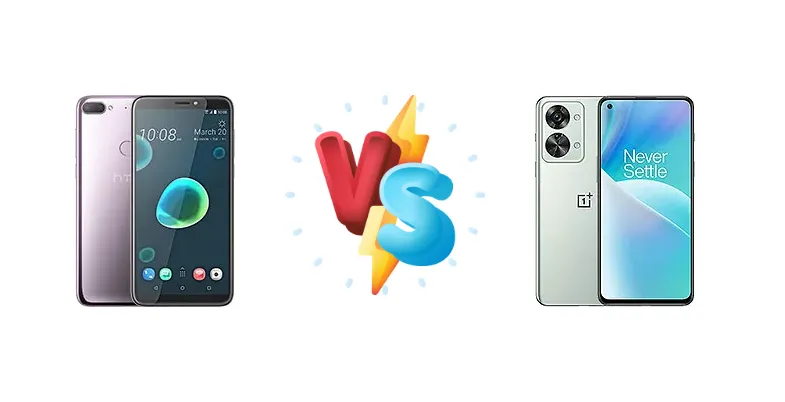
The smartphone market offers a vast spectrum of choices, and these two devices represent opposite ends of the mid-range and budget segments. The HTC Desire 12+ aims for affordability, while the OnePlus Nord 2T attempts to deliver near-flagship performance at a more accessible price point. This comparison dissects their key differences to help you determine which phone best suits your needs.
🏆 Quick Verdict
For most users, the OnePlus Nord 2T is the clear winner. Its Mediatek Dimensity 1300 chipset provides significantly faster performance, and the 80W charging is a game-changer. While the Desire 12+ offers a lower entry price, the Nord 2T’s superior experience justifies the cost for anyone prioritizing speed and convenience.
| Network |
|---|
| 2G bands | GSM 850 / 900 / 1800 / 1900 | GSM 850 / 900 / 1800 / 1900 |
| 3G bands | HSDPA 850 / 900 / 1900 / 2100 | HSDPA 800 / 850 / 900 / 1700(AWS) / 1800 / 1900 / 2100 |
| 4G bands | 1, 3, 5, 7, 8, 20, 40 | 1, 2, 3, 4, 5, 7, 8, 12, 17, 18, 19, 20, 26, 28, 32, 34, 38, 39, 40, 41, 66 |
| 5G bands | - | 1, 3, 7, 8, 20, 28, 38, 41, 78 SA/NSA |
| Speed | HSPA 42.2/5.76 Mbps, LTE Cat4 150/50 Mbps | HSPA 42.2/5.76 Mbps, LTE Cat18 1200/150 Mbps, 5G |
| Technology | GSM / HSPA / LTE | GSM / HSPA / LTE / 5G |
| | 1, 3, 5, 7, 8, 20, 28, 38, 40 | - |
| Launch |
|---|
| Announced | 2018, March 20. Released 2018, June 07 | 2022, May 19 |
| Status | Discontinued | Available. Released 2022, May 21 |
| Body |
|---|
| Build | - | Glass front (Gorilla Glass 5), plastic frame |
| Dimensions | 158.2 x 76.6 x 8.4 mm (6.23 x 3.02 x 0.33 in) | 159.1 x 73.2 x 8.2 mm (6.26 x 2.88 x 0.32 in) |
| SIM | Nano-SIM + Nano-SIM | Nano-SIM + Nano-SIM |
| Weight | 157.5 g (5.57 oz) | 190 g (6.70 oz) |
| Display |
|---|
| Protection | - | Corning Gorilla Glass 5 |
| Resolution | 720 x 1440 pixels, 18:9 ratio (~268 ppi density) | 1080 x 2400 pixels, 20:9 ratio (~409 ppi density) |
| Size | 6.0 inches, 92.9 cm2 (~76.7% screen-to-body ratio) | 6.43 inches, 99.8 cm2 (~85.7% screen-to-body ratio) |
| Type | IPS LCD | AMOLED, 90Hz, HDR10+ |
| Platform |
|---|
| CPU | Octa-core 1.8 GHz Cortex-A53 | Octa-core (1x3.0 GHz Cortex-A78 & 3x2.6 GHz Cortex-A78 & 4x2.0 GHz Cortex-A55) |
| Chipset | Qualcomm SDM450 Snapdragon 450 (14 nm) | Mediatek Dimensity 1300 (6 nm) |
| GPU | Adreno 506 | Mali-G77 MC9 |
| OS | Android 8.0 (Oreo) | Android 12, upgradable to Android 14, OxygenOS 14 |
| Memory |
|---|
| Card slot | microSDXC (uses shared SIM slot) | No |
| Internal | 32GB 3GB RAM | 128GB 8GB RAM, 256GB 12GB RAM |
| | eMMC 5.1 | UFS 3.1 |
| Main Camera |
|---|
| Dual | 13 MP, f/2.2, PDAF
Auxiliary lens | - |
| Features | LED flash, HDR, panorama | Dual-LED flash, HDR, panorama |
| Single | - | 32 MP, f/2.4, (wide), 1/2.8", 0.8µm |
| Triple | - | 50 MP, f/1.9, 24mm (wide), 1/1.56", 1.0µm, PDAF, OIS
8 MP, f/2.2, 120˚ (ultrawide)
Auxiliary lens |
| Video | 1080p@30fps | 4K@30fps, 1080p@30/60/120/480fps, gyro-EIS |
| Selfie camera |
|---|
| Features | - | Auto HDR |
| Single | 8 MP, f/2.0 | 32 MP, f/2.4, (wide), 1/2.8", 0.8µm |
| Video | 1080p@30fps | 1080p@30fps, gyro-EIS |
| Sound |
|---|
| 3.5mm jack | Yes | No |
| 35mm jack | Yes | No |
| Loudspeaker | Yes | Yes, with stereo speakers |
| Comms |
|---|
| Bluetooth | 4.2, A2DP, LE | 5.2, A2DP, LE, aptX HD |
| NFC | No | Yes |
| Positioning | GPS, GLONASS | GPS, GLONASS, GALILEO, BDS, NavIC |
| Radio | FM radio | No |
| USB | microUSB 2.0 | USB Type-C 2.0, OTG |
| WLAN | Wi-Fi 802.11 b/g/n, Wi-Fi Direct | Wi-Fi 802.11 a/b/g/n/ac/6, dual-band, Wi-Fi Direct |
| Features |
|---|
| Sensors | Fingerprint (rear-mounted), accelerometer, proximity, compass | Fingerprint (under display, optical), accelerometer, gyro, proximity, compass |
| Battery |
|---|
| Charging | - | 80W wired, PD |
| Stand-by | Up to 522 h (3G) | - |
| Talk time | Up to 26 h (3G) | - |
| Type | Li-Ion 2965 mAh, non-removable | Li-Po 4500 mAh |
| Misc |
|---|
| Colors | Black, Silver, Gold | Gray Shadow, Jade Fog |
| Models | Desire 12 | CPH2399, CPH2401 |
| Price | About 170 EUR | € 144.39 / $ 169.99 / ₹ 31,490 |
| Tests |
|---|
| Battery life | - |
Endurance rating 100h
|
| Camera | - |
Photo / Video |
| Display | - |
Contrast ratio: Infinite (nominal) |
| Loudspeaker | - |
-25.6 LUFS (Very good)
|
| Performance | - |
AnTuTu: 490545 (v8) | 604467 (v9)
GeekBench: 2790 (v5.1)
GFXBench: 40fps (ES 3.1 onscreen) |
HTC Desire 12+
- Lower price point makes it accessible
- Functional for basic smartphone tasks
- Potentially longer battery life due to less demanding chipset
- Significantly slower performance
- Lower quality display
- Limited camera capabilities
OnePlus Nord 2T
- Much faster performance with Dimensity 1300
- 80W SuperVOOC charging for rapid replenishment
- Brighter and more vibrant display
- Higher price compared to the Desire 12+
- May experience some thermal throttling under heavy load
- Software updates may be less frequent than some competitors
Display Comparison
The OnePlus Nord 2T boasts a significantly brighter display, reaching a measured 636 nits, compared to the likely lower brightness of the Desire 12+. This makes the Nord 2T far more usable outdoors in direct sunlight. While both displays have an 'infinite' contrast ratio (a marketing term), the Nord 2T’s superior brightness contributes to a more vibrant and detailed image. The Desire 12+'s display specifications are not available, suggesting a lower-quality panel geared towards cost savings. The Nord 2T’s display is likely to offer better viewing angles and color accuracy.
Camera Comparison
Both phones offer photo and video capabilities, but the details are sparse. Without specific sensor information for the Desire 12+, it’s safe to assume it utilizes a more basic camera system. The Nord 2T likely features a more advanced sensor and image processing pipeline, resulting in better image quality, especially in low-light conditions. The absence of details regarding OIS (Optical Image Stabilization) on either device suggests neither prioritizes advanced stabilization features. The Nord 2T’s image processing will likely offer more features and better dynamic range.
Performance
The performance gap between these two devices is substantial. The OnePlus Nord 2T’s Mediatek Dimensity 1300, built on a 6nm process, is in a different league than the HTC Desire 12+'s Qualcomm Snapdragon 450 (14nm). The Dimensity 1300 features a tri-cluster configuration with a high-performance Cortex-A78 core clocked at 3.0 GHz, alongside additional A78 cores and efficiency-focused A55 cores. This architecture delivers significantly faster processing speeds and improved multi-tasking capabilities. The Snapdragon 450’s Cortex-A53 cores, while efficient, struggle with demanding applications and will exhibit noticeable lag. The 6nm node of the Dimensity 1300 also translates to better thermal efficiency, reducing the likelihood of performance throttling during extended use.
Battery Life
Both devices share an endurance rating of 100 hours, but this metric doesn't tell the whole story. The OnePlus Nord 2T’s 80W wired charging with Power Delivery (PD) is a massive advantage, allowing for a full charge in a fraction of the time compared to the Desire 12+. While the Desire 12+ may have a comparable battery capacity, the Nord 2T’s faster charging mitigates any potential capacity differences. The convenience of quickly topping up the battery is a significant benefit for users on the go.
Buying Guide
Buy the HTC Desire 12+ if you need a functional smartphone for basic tasks like calls, texts, and light social media, and your budget is extremely limited. You're willing to compromise on performance and features for the lowest possible price. Buy the OnePlus Nord 2T if you prioritize smooth multitasking, gaming, fast charging, and a brighter, more responsive display. You want a phone that can handle demanding apps and provide a premium user experience without breaking the bank.
Frequently Asked Questions
❓ Is the Mediatek Dimensity 1300 in the Nord 2T prone to overheating during extended gaming sessions?
While the Dimensity 1300 is a powerful chip, it can experience some thermal throttling during prolonged, demanding gaming. However, the 6nm process and OnePlus’s thermal management system help mitigate this, preventing significant performance drops. Expect some warmth, but not to the point of unplayability.
❓ How does the Snapdragon 450 in the Desire 12+ handle multitasking and app switching?
The Snapdragon 450 struggles with heavy multitasking. Expect noticeable lag when switching between multiple apps, especially resource-intensive ones. It's best suited for running one app at a time and avoiding demanding background processes.
❓ Does the OnePlus Nord 2T support 5G connectivity?
Yes, the Mediatek Dimensity 1300 supports 5G connectivity, allowing you to take advantage of faster mobile data speeds where available. The HTC Desire 12+ likely only supports 4G LTE.
❓ What type of charging port does each phone use?
The OnePlus Nord 2T uses a USB-C port and supports 80W SuperVOOC charging. The HTC Desire 12+ likely uses a Micro-USB port, which is slower and less convenient.