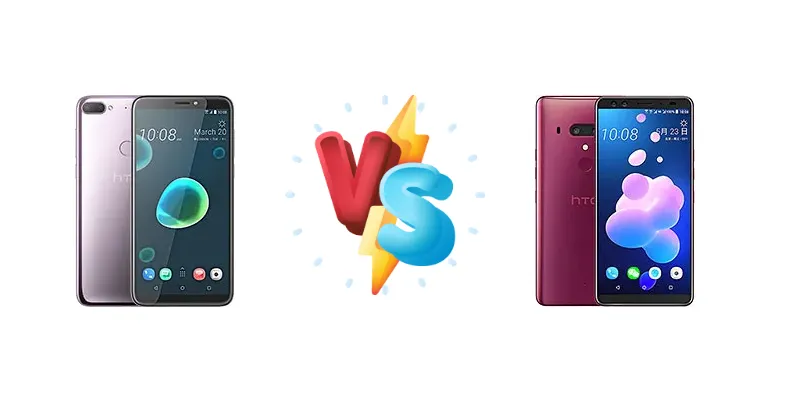
The HTC Desire 12+ and U12+ represent drastically different approaches within HTC's lineup. The Desire 12+ aimed for affordability, while the U12+ was a flagship contender. This comparison dissects the core differences – from the processor to the display – to determine which phone delivers the best experience for your needs and budget.
🏆 Quick Verdict
For the average user prioritizing performance and a premium experience, the HTC U12+ is the clear winner. Its Snapdragon 845 chipset offers significantly faster processing and graphics capabilities. However, the Desire 12+ remains a viable option for those on a tight budget who prioritize basic functionality over speed.
| Network |
|---|
| 2G bands | GSM 850 / 900 / 1800 / 1900 | GSM 850 / 900 / 1800 / 1900 - SIM 1 & SIM 2 (dual-SIM model only) |
| 3G bands | HSDPA 850 / 900 / 1900 / 2100 | HSDPA 850 / 900 / 1700(AWS) / 1900 / 2100 |
| 4G bands | 1, 3, 5, 7, 8, 20, 40 | 1, 2, 3, 4, 5, 7, 8, 12, 13, 17, 20, 28, 32, 38, 39, 49, 41, 66 |
| Speed | HSPA 42.2/5.76 Mbps, LTE Cat4 150/50 Mbps | HSPA 42.2/5.76 Mbps, LTE-A (5CA) Cat18 1200/150 Mbps |
| Technology | GSM / HSPA / LTE | GSM / HSPA / LTE |
| | 1, 3, 5, 7, 8, 20, 28, 38, 40 | - |
| Launch |
|---|
| Announced | 2018, March 20. Released 2018, June 07 | 2018, May 23 |
| Status | Discontinued | Available. Released 2018, June 29 |
| Body |
|---|
| Build | - | Glass front (Gorilla Glass 3), glass back, aluminum frame |
| Dimensions | 158.2 x 76.6 x 8.4 mm (6.23 x 3.02 x 0.33 in) | 156.6 x 73.9 x 8.7 mm (6.17 x 2.91 x 0.34 in) |
| SIM | Nano-SIM + Nano-SIM | Single SIM (Nano-SIM) or Hybrid Dual SIM (Nano-SIM, dual stand-by) |
| Weight | 157.5 g (5.57 oz) | 188 g (6.63 oz) |
| | - | IP68 dust/water resistant (up to 1.5m for 30 mins)
Pressure-sensitive buttons |
| Display |
|---|
| Protection | - | Corning Gorilla Glass 3 |
| Resolution | 720 x 1440 pixels, 18:9 ratio (~268 ppi density) | 1440 x 2880 pixels, 18:9 ratio (~537 ppi density) |
| Size | 6.0 inches, 92.9 cm2 (~76.7% screen-to-body ratio) | 6.0 inches, 92.9 cm2 (~80.3% screen-to-body ratio) |
| Type | IPS LCD | Super LCD6, HDR10 |
| Platform |
|---|
| CPU | Octa-core 1.8 GHz Cortex-A53 | Octa-core (4x2.8 GHz Kryo 385 Gold & 4x1.7 GHz Kryo 385 Silver) |
| Chipset | Qualcomm SDM450 Snapdragon 450 (14 nm) | Qualcomm SDM845 Snapdragon 845 (10 nm) |
| GPU | Adreno 506 | Adreno 630 |
| OS | Android 8.0 (Oreo) | Android 8.0 (Oreo), upgradable to Android 9.0 (Pie), Sense UI |
| Memory |
|---|
| Card slot | microSDXC (uses shared SIM slot) | microSDXC (uses shared SIM slot) |
| Internal | 32GB 3GB RAM | 64GB 6GB RAM, 128GB 6GB RAM |
| | eMMC 5.1 | - |
| Main Camera |
|---|
| Dual | 13 MP, f/2.2, PDAF
Auxiliary lens | 12 MP, f/1.8, 1/2.55", 1.4µm, dual pixel PDAF, Laser AF, OIS
16 MP (12 MP effective), f/2.6, 1/3.1", 1.0µm, 2x optical zoom, AF |
| Features | LED flash, HDR, panorama | Dual-LED dual-tone flash, HDR |
| Video | 1080p@30fps | 4K@60fps, 1080p@60/240fps, 1080p@30fps (gyro-EIS), HDR, 24-bit/96kHz stereo sound rec. |
| Selfie camera |
|---|
| Dual | - | 8 MP, f/2.0, 1/4", 1.12µm
8 MP, f/2.0, 1/4", 1.12µm |
| Features | - | HDR, panorama |
| Single | 8 MP, f/2.0 | - |
| Video | 1080p@30fps | 1080p@30fps |
| Sound |
|---|
| 3.5mm jack | Yes | No |
| 35mm jack | Yes | - |
| Loudspeaker | Yes | Yes, with stereo speakers |
| | - | 32-bit/384kHz audio
|
| Comms |
|---|
| Bluetooth | 4.2, A2DP, LE | 5.0, A2DP, aptX HD, LE |
| NFC | No | Yes |
| Positioning | GPS, GLONASS | GPS, GLONASS, GALILEO, BDS |
| Radio | FM radio | No |
| USB | microUSB 2.0 | USB Type-C 3.1 |
| WLAN | Wi-Fi 802.11 b/g/n, Wi-Fi Direct | Wi-Fi 802.11 a/b/g/n/ac, dual-band, Wi-Fi Direct, DLNA |
| Features |
|---|
| Sensors | Fingerprint (rear-mounted), accelerometer, proximity, compass | Fingerprint (rear-mounted), accelerometer, gyro, proximity, compass |
| Battery |
|---|
| Charging | - | 18W wired, QC3, 50% in 35 min (advertised) |
| Stand-by | Up to 522 h (3G) | - |
| Talk time | Up to 26 h (3G) | Up to 24 h (3G) |
| Type | Li-Ion 2965 mAh, non-removable | Li-Ion 3500 mAh, non-removable |
| Misc |
|---|
| Colors | Black, Silver, Gold | Translucent Blue, Ceramic Black, Flame Red |
| Models | Desire 12 | U12, 2Q55100 |
| Price | About 170 EUR | About 450 EUR |
| Tests |
|---|
| Audio quality | - |
Noise -93.7dB / Crosstalk -52.7dB |
| Battery life | - |
Endurance rating 64h
|
| Camera | - |
Photo / Video |
| Display | - |
Contrast ratio: 1818:1 (nominal), 3.085 (sunlight) |
| Loudspeaker | - |
Voice 77dB / Noise 73dB / Ring 99dB
|
| Performance | - |
AnTuTu: 263696 (v7)
GeekBench: 9001 (v4.4)
GFXBench: 20fps (ES 3.1 onscreen) |
HTC Desire 12+
- More affordable price point
- Potentially longer battery life with light usage
- Functional for basic smartphone tasks
- Significantly slower performance
- Lower quality display
- Inferior camera capabilities
HTC U12+
- Flagship-level performance with Snapdragon 845
- Faster charging with Quick Charge 3.0
- Superior display quality and contrast
- Higher price tag
- Potentially shorter battery life under heavy load
- May be difficult to find new
Display Comparison
The HTC U12+ boasts a superior display experience, though specific details beyond contrast ratios are missing. The advertised contrast ratio of 1818:1 (nominal) and 3.085 (sunlight) suggests good visibility even in bright conditions. The Desire 12+’s display specifications are absent, implying a lower-quality panel likely with lower peak brightness and contrast. This difference impacts outdoor readability and overall visual fidelity, favoring the U12+ for media consumption.
Camera Comparison
While both phones feature cameras, the U12+ is expected to offer a more refined imaging experience. The absence of detailed camera specs for both devices makes a precise comparison difficult. However, given the U12+'s flagship status, it likely incorporates a larger sensor, optical image stabilization (OIS), and more advanced image processing algorithms. The Desire 12+ likely relies on simpler camera hardware and software, resulting in lower image quality, particularly in low-light conditions. We can assume the U12+ will offer better dynamic range and detail.
Performance
The performance gap between these devices is substantial. The HTC U12+’s Snapdragon 845, built on a 10nm process, features a Kryo 385 CPU with a peak clock speed of 2.8 GHz. This is a significant leap over the Desire 12+’s Snapdragon 450 (14nm) and its 1.8 GHz Cortex-A53 cores. The 845’s architecture, with its Gold and Silver core configuration, allows for efficient task allocation, resulting in smoother multitasking and faster app loading times. The smaller 10nm node also contributes to better thermal efficiency, reducing throttling during sustained workloads. Gamers and power users will overwhelmingly benefit from the U12+’s processing power.
Battery Life
The HTC U12+’s 18W charging with Quick Charge 3.0 support is a significant advantage, promising a 50% charge in just 35 minutes. The Desire 12+’s charging specifications are unknown, suggesting a slower charging rate. While the U12+ has an endurance rating of 64 hours, the actual battery life will depend on usage patterns. The Snapdragon 845’s efficiency helps mitigate the power draw of the more powerful processor and display, potentially resulting in comparable real-world battery life despite the lack of specific mAh information for either device.
Buying Guide
Buy the HTC Desire 12+ if you need a functional smartphone for essential tasks like calling, texting, and light social media use, and your budget is under $200. Buy the HTC U12+ if you prioritize smooth multitasking, demanding gaming, high-quality photography, and faster charging, and are willing to spend considerably more for a flagship-level experience.
Frequently Asked Questions
❓ Is the Snapdragon 450 in the Desire 12+ capable of running modern mobile games?
While the Snapdragon 450 can run some mobile games, it will struggle with graphically demanding titles. Expect lower frame rates and reduced graphical settings. It's best suited for casual gaming and older titles.
❓ Does the HTC U12+ suffer from significant thermal throttling during extended gaming sessions?
The Snapdragon 845 in the U12+ is more efficient than previous generations, and the 10nm process helps mitigate throttling. However, prolonged gaming at maximum settings may still result in some performance reduction as the phone heats up. The U12+ is still significantly better than the Desire 12+ in this regard.
❓ Given the age of both phones, are software updates still available?
Software update support for both devices is likely limited. HTC has a history of inconsistent software updates, and these models are several years old. Expect limited or no further major Android version updates.