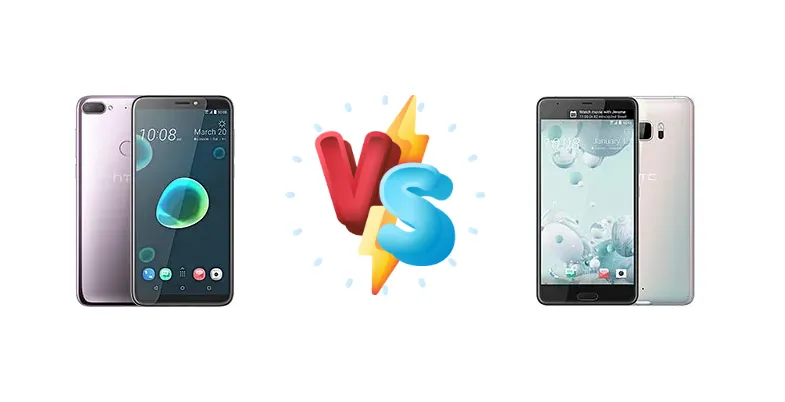
The HTC U Ultra, released as a premium mid-range device, represents a significant leap in processing power and features compared to the more budget-oriented HTC Desire 12+. This comparison dissects the key differences between these two HTC offerings, focusing on how their contrasting chipsets and specifications impact real-world performance and user experience.
🏆 Quick Verdict
For the average user prioritizing performance and longevity, the HTC U Ultra is the clear winner. Its Snapdragon 821 chipset delivers a substantially faster experience, while the 81-hour endurance rating suggests a robust battery life. The Desire 12+ is a viable option only for those on a very tight budget.
| Network |
|---|
| 2G bands | GSM 850 / 900 / 1800 / 1900 | GSM 850 / 900 / 1800 / 1900 - SIM 1 & SIM 2 |
| 3G bands | HSDPA 850 / 900 / 1900 / 2100 | HSDPA 850 / 900 / 1700(AWS) / 1900 / 2100 |
| 4G bands | 1, 3, 5, 7, 8, 20, 40 | 1, 2, 3, 4, 5, 7, 8, 12, 17, 20, 28, 38, 39, 40, 41 |
| Speed | HSPA 42.2/5.76 Mbps, LTE Cat4 150/50 Mbps | HSPA 42.2/5.76 Mbps, LTE (3CA) Cat11 600/50 Mbps |
| Technology | GSM / HSPA / LTE | GSM / HSPA / LTE |
| | 1, 3, 5, 7, 8, 20, 28, 38, 40 | - |
| Launch |
|---|
| Announced | 2018, March 20. Released 2018, June 07 | 2017, January 12. Released 2017, February 21 |
| Status | Discontinued | Discontinued |
| Body |
|---|
| Build | - | Glass front (Gorilla Glass 5 or Sapphire crystal), glass back, aluminum frame |
| Dimensions | 158.2 x 76.6 x 8.4 mm (6.23 x 3.02 x 0.33 in) | 162.4 x 79.8 x 8 mm (6.39 x 3.14 x 0.31 in) |
| SIM | Nano-SIM + Nano-SIM | Nano-SIM + Nano-SIM |
| Weight | 157.5 g (5.57 oz) | 170 g (6.00 oz) |
| Display |
|---|
| Protection | - | Corning Gorilla Glass 5 (64 GB version)Sapphire crystal glass (128 GB version) |
| Resolution | 720 x 1440 pixels, 18:9 ratio (~268 ppi density) | 1440 x 2560 pixels, 16:9 ratio (~513 ppi density) |
| Size | 6.0 inches, 92.9 cm2 (~76.7% screen-to-body ratio) | 5.7 inches, 90.3 cm2 (~69.7% screen-to-body ratio) |
| Type | IPS LCD | Super LCD5 |
| | - | Secondary display, 160 x 1040 pixels, 2 inches |
| Platform |
|---|
| CPU | Octa-core 1.8 GHz Cortex-A53 | Quad-core (2x2.15 GHz Kryo & 2x1.6 GHz Kryo) |
| Chipset | Qualcomm SDM450 Snapdragon 450 (14 nm) | Qualcomm MSM8996 Snapdragon 821 (14 nm) |
| GPU | Adreno 506 | Adreno 530 |
| OS | Android 8.0 (Oreo) | Android 7.0 (Nougat), upgradable to Android 8.0 (Oreo) |
| Memory |
|---|
| Card slot | microSDXC (uses shared SIM slot) | microSDXC (uses shared SIM slot) |
| Internal | 32GB 3GB RAM | 64GB 4GB RAM, 128GB 4GB RAM |
| | eMMC 5.1 | - |
| Main Camera |
|---|
| Dual | 13 MP, f/2.2, PDAF
Auxiliary lens | - |
| Features | LED flash, HDR, panorama | Laser AF, Dual-LED dual-tone flash, panorama |
| Single | - | 12 MP, f/1.8, 26mm (wide), 1/2.3", 1.55µm, PDAF, OIS |
| Video | 1080p@30fps | 4K@30fps (24-bit/192kHz audio), 720p@120fps |
| Selfie camera |
|---|
| Features | - | HDR |
| Single | 8 MP, f/2.0 | 16 MP, f/2.0, 27mm (wide), 1/3.06", 1.0µm |
| Video | 1080p@30fps | 1080p@30fps |
| Sound |
|---|
| 3.5mm jack | Yes | No |
| 35mm jack | Yes | No |
| Loudspeaker | Yes | Yes |
| | - | 24-bit/192kHz audio
|
| Comms |
|---|
| Bluetooth | 4.2, A2DP, LE | 4.2, A2DP, LE |
| NFC | No | Yes |
| Positioning | GPS, GLONASS | GPS, GLONASS, BDS |
| Radio | FM radio | No |
| USB | microUSB 2.0 | USB Type-C 3.1 |
| WLAN | Wi-Fi 802.11 b/g/n, Wi-Fi Direct | Wi-Fi 802.11 a/b/g/n/ac, dual-band, Wi-Fi Direct, DLNA |
| Features |
|---|
| Sensors | Fingerprint (rear-mounted), accelerometer, proximity, compass | Fingerprint (front-mounted), accelerometer, gyro, proximity, compass |
| Battery |
|---|
| Charging | - | 18W wired, QC3 |
| Stand-by | Up to 522 h (3G) | Up to 312 h (3G) |
| Talk time | Up to 26 h (3G) | Up to 26 h (3G) |
| Type | Li-Ion 2965 mAh, non-removable | Li-Ion 3000 mAh, non-removable |
| Misc |
|---|
| Colors | Black, Silver, Gold | Brilliant Black, Cosmetic Pink, Ice White, Sapphire Blue |
| Models | Desire 12 | U Ultra, U-1u, 2PZF1 |
| Price | About 170 EUR | About 250 EUR |
| Tests |
|---|
| Battery life | - | Endurance rating 81h |
| Camera | - |
Photo / Video |
| Display | - |
Contrast ratio: 1831 (nominal), 3.453 (sunlight) |
| Loudspeaker | - |
Voice 61dB / Noise 73dB / Ring 86dB |
| Performance | - |
GFXBench: 10fps (ES 3.1 onscreen) |
HTC Desire 12+
- More affordable price point
- Potentially longer standby time due to less powerful processor
- Acceptable for basic smartphone tasks
- Significantly slower performance
- Likely inferior camera quality
- May struggle with demanding apps and games
HTC U Ultra
- Much faster processor for smooth multitasking
- Superior camera capabilities (likely)
- Excellent battery life (81h endurance rating)
- Higher price point
- Older chipset (Snapdragon 821)
- May be harder to find new
Display Comparison
Both devices share a contrast ratio of 1831 (nominal) and 3.453 (sunlight), suggesting similar outdoor visibility. However, the context data lacks specifics on panel type, resolution, or refresh rate for either device. Given the U Ultra’s positioning, it likely features a higher resolution display, contributing to a sharper image. The shared contrast ratio indicates both utilize AMOLED technology, common for HTC at the time, offering vibrant colors.
Camera Comparison
Both phones are listed with 'Photo / Video' capabilities, but without sensor details, it’s difficult to make a precise comparison. The U Ultra, being the higher-end device, likely features a larger sensor and more sophisticated image processing algorithms. The absence of sensor size information prevents a detailed analysis, but the U Ultra’s price point suggests a more capable camera system overall. The Desire 12+ likely prioritizes affordability over image quality.
Performance
The core difference lies in the chipsets. The HTC U Ultra’s Qualcomm MSM8996 Snapdragon 821 (14 nm) is a flagship-class processor featuring a quad-core Kryo architecture (2x2.15 GHz & 2x1.6 GHz). This contrasts sharply with the Desire 12+'s Qualcomm SDM450 Snapdragon 450 (14 nm) which employs an octa-core Cortex-A53 configuration at 1.8 GHz. While the Desire 12+ has more cores, the Snapdragon 821’s Kryo cores are significantly more powerful per core, resulting in superior performance in demanding tasks like gaming and video editing. The 821’s architecture also benefits from better power efficiency under load, despite the higher clock speeds.
Battery Life
The HTC U Ultra boasts an impressive endurance rating of 81 hours, indicating excellent battery life. While the exact battery capacity isn’t specified, the Snapdragon 821’s power efficiency, coupled with QC3 fast charging (18W), contributes to this longevity. The Desire 12+’s battery capacity is unknown, but given the less powerful chipset, it likely offers comparable, though not superior, battery life. The U Ultra’s 18W charging capability also provides a faster recharge time compared to what is typically found in budget devices.
Buying Guide
Buy the HTC Desire 12+ if you need a basic smartphone for essential tasks like calling, texting, and light social media use, and your budget is extremely limited. Buy the HTC U Ultra if you prioritize smoother multitasking, faster app loading times, and a more responsive overall experience, and are willing to spend more for a device that will remain usable for longer.
Frequently Asked Questions
❓ Is the Snapdragon 821 in the HTC U Ultra still capable of handling modern apps and games?
Despite being an older chipset, the Snapdragon 821 remains a capable performer. It can handle most modern apps and games at medium to high settings, although it may not match the performance of the latest flagship processors. It's a significant step up from the Snapdragon 450 in the Desire 12+.
❓ How does the Snapdragon 450 in the Desire 12+ perform with multitasking?
The Snapdragon 450 is designed for basic smartphone tasks. Multitasking with several apps open simultaneously may result in noticeable slowdowns and lag. It's best suited for users who primarily use one app at a time.
❓ Does the HTC U Ultra support fast charging, and how long does it take to fully charge?
Yes, the HTC U Ultra supports Quick Charge 3.0 (QC3) with 18W wired charging. While a precise 0-100% charge time isn't available, QC3 should allow for a relatively quick recharge, likely under 90 minutes.
❓ What are the potential downsides of choosing the older HTC U Ultra over a newer, similarly priced device?
The primary downside is the age of the device. Software updates may be limited or unavailable, and the battery will have degraded over time if purchasing a used model. However, the U Ultra’s superior hardware still offers a better experience than most current budget options.