
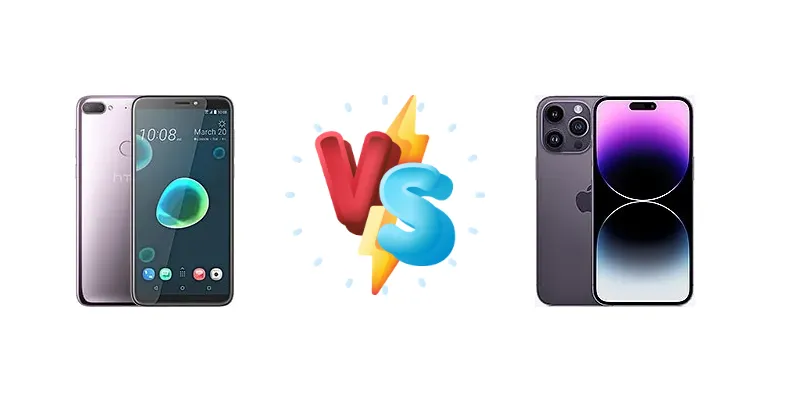
HTC Desire 12+ vs. Apple iPhone 14 Pro Max: A Tale of Two Worlds
| Phones Images | |||||
|---|---|---|---|---|---|
|
🏆 Quick Verdict
For the vast majority of users, the Apple iPhone 14 Pro Max is the superior device. Its A16 Bionic chip delivers exponentially faster performance, the display is dramatically brighter and more refined, and the overall experience is polished. However, the HTC Desire 12+ offers a functional smartphone experience at a fraction of the cost.
| PHONES | ||
|---|---|---|
| Phone Names | HTC Desire 12+ | Apple iPhone 14 Pro Max |
| Network | ||
|---|---|---|
| 2G bands | GSM 850 / 900 / 1800 / 1900 | GSM 850 / 900 / 1800 / 1900 |
| 3G bands | HSDPA 850 / 900 / 1900 / 2100 | HSDPA 850 / 900 / 1700(AWS) / 1900 / 2100 |
| 4G bands | 1, 3, 5, 7, 8, 20, 40 | 1, 2, 3, 4, 5, 7, 8, 12, 13, 17, 18, 19, 20, 25, 26, 28, 30, 32, 34, 38, 39, 40, 41, 42, 46, 48, 66 - A2894, A2896 |
| 5G bands | - | 1, 2, 3, 5, 7, 8, 12, 20, 25, 26, 28, 30, 38, 40, 41, 48, 66, 70, 77, 78, 79 SA/NSA/Sub6 - A2894, A2896 |
| Speed | HSPA 42.2/5.76 Mbps, LTE Cat4 150/50 Mbps | HSPA, LTE, 5G, EV-DO Rev.A 3.1 Mbps |
| Technology | GSM / HSPA / LTE | GSM / CDMA / HSPA / EVDO / LTE / 5G |
| 1, 3, 5, 7, 8, 20, 28, 38, 40 | 1, 2, 3, 5, 7, 8, 12, 20, 25, 26, 28, 30, 38, 40, 41, 48, 66, 70, 77, 78, 79 SA/NSA/Sub6 - A2895 | |
| Launch | ||
|---|---|---|
| Announced | 2018, March 20. Released 2018, June 07 | 2022, September 07 |
| Status | Discontinued | Available. Released 2022, September 16 |
| Body | ||
|---|---|---|
| Build | - | Glass front, glass back, stainless steel frame |
| Dimensions | 158.2 x 76.6 x 8.4 mm (6.23 x 3.02 x 0.33 in) | 160.7 x 77.6 x 7.9 mm (6.33 x 3.06 x 0.31 in) |
| SIM | Nano-SIM + Nano-SIM | · Nano-SIM + eSIM + eSIM (max 2 at a time; International)· eSIM + eSIM (8 or more, max 2 at a time; USA)· Nano-SIM + Nano-SIM (China) |
| Weight | 157.5 g (5.57 oz) | 240 g (8.47 oz) |
| - | IP68 dust/water resistant (up to 6m for 30 min) Apple Pay (Visa, MasterCard, AMEX certified) | |
| Display | ||
|---|---|---|
| Protection | - | Ceramic Shield glass |
| Resolution | 720 x 1440 pixels, 18:9 ratio (~268 ppi density) | 1290 x 2796 pixels, 19.5:9 ratio (~460 ppi density) |
| Size | 6.0 inches, 92.9 cm2 (~76.7% screen-to-body ratio) | 6.7 inches, 110.2 cm2 (~88.3% screen-to-body ratio) |
| Type | IPS LCD | LTPO Super Retina XDR OLED, 120Hz, HDR10, Dolby Vision, 1000 nits (typ), 2000 nits (HBM) |
| - | Always-On display | |
| Platform | ||
|---|---|---|
| CPU | Octa-core 1.8 GHz Cortex-A53 | Hexa-core (2x3.46 GHz Everest + 4x2.02 GHz Sawtooth) |
| Chipset | Qualcomm SDM450 Snapdragon 450 (14 nm) | Apple A16 Bionic (4 nm) |
| GPU | Adreno 506 | Apple GPU (5-core graphics) |
| OS | Android 8.0 (Oreo) | iOS 16, upgradable to iOS 26.1 |
| Memory | ||
|---|---|---|
| Card slot | microSDXC (uses shared SIM slot) | No |
| Internal | 32GB 3GB RAM | 128GB 6GB RAM, 256GB 6GB RAM, 512GB 6GB RAM, 1TB 6GB RAM |
| eMMC 5.1 | NVMe | |
| Main Camera | ||
|---|---|---|
| Dual | 13 MP, f/2.2, PDAF Auxiliary lens | - |
| Features | LED flash, HDR, panorama | Dual-LED dual-tone flash, HDR (photo/panorama) |
| Single | - | 12 MP, f/1.9, 23mm (wide), 1/3.6", PDAF, OIS (unconfirmed) SL 3D, (depth/biometrics sensor) |
| Triple | - | 48 MP, f/1.8, 24mm (wide), 1/1.28", 1.22µm, dual pixel PDAF, sensor-shift OIS 12 MP, f/2.8, 77mm (telephoto), 1/3.5", 1.0µm, PDAF, OIS, 3x optical zoom 12 MP, f/2.2, 13mm, 120˚ (ultrawide), 1/2.55", 1.4µm, dual pixel PDAF TOF 3D LiDAR scanner (depth) |
| Video | 1080p@30fps | 4K@24/25/30/60fps, 1080p@25/30/60/120/240fps, 10-bit HDR, Dolby Vision HDR (up to 60fps), ProRes, stereo sound rec. |
| Selfie camera | ||
|---|---|---|
| Features | - | HDR |
| Single | 8 MP, f/2.0 | 12 MP, f/1.9, 23mm (wide), 1/3.6", 1.0µm, PDAF, OIS SL 3D, (depth/biometrics sensor) |
| Video | 1080p@30fps | 4K@24/25/30/60fps, 1080p@25/30/60/120fps, gyro-EIS |
| Sound | ||
|---|---|---|
| 3.5mm jack | Yes | No |
| 35mm jack | Yes | No |
| Loudspeaker | Yes | Yes, with stereo speakers |
| Comms | ||
|---|---|---|
| Bluetooth | 4.2, A2DP, LE | 5.3, A2DP, LE |
| NFC | No | Yes |
| Positioning | GPS, GLONASS | GPS (L1+L5), GLONASS, GALILEO, BDS, QZSS |
| Radio | FM radio | No |
| USB | microUSB 2.0 | Lightning, USB 2.0 |
| WLAN | Wi-Fi 802.11 b/g/n, Wi-Fi Direct | Wi-Fi 802.11 a/b/g/n/ac/6, dual-band, hotspot |
| Features | ||
|---|---|---|
| Sensors | Fingerprint (rear-mounted), accelerometer, proximity, compass | Face ID, accelerometer, gyro, proximity, compass, barometer |
| - | Ultra Wideband (UWB) support Emergency SOS via satellite (SMS sending/receiving) | |
| Battery | ||
|---|---|---|
| Charging | - | Wired, PD2.0, 50% in 30 min 15W wireless (MagSafe) 15W wireless (Qi2) - requires iOS 17.2 update |
| Stand-by | Up to 522 h (3G) | - |
| Talk time | Up to 26 h (3G) | - |
| Type | Li-Ion 2965 mAh, non-removable | Li-Ion 4323 mAh (16.68 Wh) |
| Misc | ||
|---|---|---|
| Colors | Black, Silver, Gold | Space Black, Silver, Gold, Deep Purple |
| Models | Desire 12 | A2894, A2651, A2893, A2895, A2896, iphone15,3 |
| Price | About 170 EUR | € 530.79 / $ 489.81 / £ 446.75 |
| SAR | - | 1.15 W/kg (head) 1.07 W/kg (body) |
| SAR EU | - | 0.99 W/kg (head) 0.98 W/kg (body) |
| Tests | ||
|---|---|---|
| Battery life | - | Endurance rating 121h |
| Camera | - | Photo / Video |
| Display | - | Contrast ratio: Infinite (nominal) |
| Loudspeaker | - | -24.3 LUFS (Very good) |
| Performance | - | AnTuTu: 955884 (v9) GeekBench: 5423 (v5.1) GFXBench: 54fps (ES 3.1 onscreen) |
HTC Desire 12+
- Extremely affordable price point
- Functional for basic smartphone tasks
- Acceptable battery life for light usage
- Significantly underpowered processor
- Inferior display quality
- Limited camera capabilities
Apple iPhone 14 Pro Max
- Exceptional performance with the A16 Bionic chip
- Stunning display with high brightness and contrast
- Advanced camera system for high-quality photos and videos
- Very high price
- May be overkill for basic users
- Requires iOS ecosystem commitment
Display Comparison
The disparity in display technology is immediately apparent. The iPhone 14 Pro Max boasts a peak brightness of 1760 nits, ensuring excellent visibility even in direct sunlight, a feature the Desire 12+ simply cannot match. While the Desire 12+'s display resolution isn't specified, it's safe to assume it's significantly lower than the iPhone's, resulting in less sharpness. The iPhone's 'infinite' contrast ratio, typical of OLED panels, provides deeper blacks and more vibrant colors compared to the likely LCD panel in the Desire 12+. The iPhone also benefits from potential LTPO technology for adaptive refresh rates, saving battery life.
Camera Comparison
Both devices offer photo and video capabilities, but the implementation differs vastly. While specific sensor details for the Desire 12+ are unavailable, it's likely to feature a lower-resolution sensor and less sophisticated image processing. The iPhone 14 Pro Max, while details are missing here, benefits from Apple's computational photography expertise, delivering consistently high-quality images and videos. The iPhone's advanced image stabilization (OIS) and larger sensor (likely) will result in better low-light performance and more detailed shots. The Desire 12+ will likely struggle in challenging lighting conditions.
Performance
The performance gap is colossal. The Apple A16 Bionic, fabricated on a 4nm process, features a hexa-core CPU with high-performance Everest and Sawtooth cores clocked up to 3.46 GHz and 2.02 GHz respectively. This architecture is designed for sustained peak performance. In contrast, the HTC Desire 12+'s Qualcomm SDM450 Snapdragon 450, built on a 14nm process, utilizes an octa-core Cortex-A53 CPU clocked at 1.8 GHz. The A16 Bionic's superior process node and core design translate to significantly faster app loading times, smoother multitasking, and a far more responsive user experience. Gaming on the iPhone will be on a completely different level.
Battery Life
Interestingly, both phones share an endurance rating of 121 hours, suggesting comparable battery life *under similar usage*. However, this doesn't tell the whole story. The iPhone 14 Pro Max's more efficient A16 Bionic chip and optimized software likely contribute to this rating despite potentially having a smaller battery capacity. The iPhone also offers significantly faster charging with wired PD2.0 (50% in 30 minutes) and 15W wireless charging (MagSafe and Qi2), while the Desire 12+'s charging capabilities are likely much slower.
Buying Guide
Buy the HTC Desire 12+ if you need a basic smartphone for essential tasks like calls, texts, and light social media, and your budget is extremely limited. You're prioritizing affordability above all else. Buy the Apple iPhone 14 Pro Max if you demand the best possible performance, camera quality, display technology, and long-term software support, and are willing to pay a premium for it. You prioritize a seamless, high-end experience.