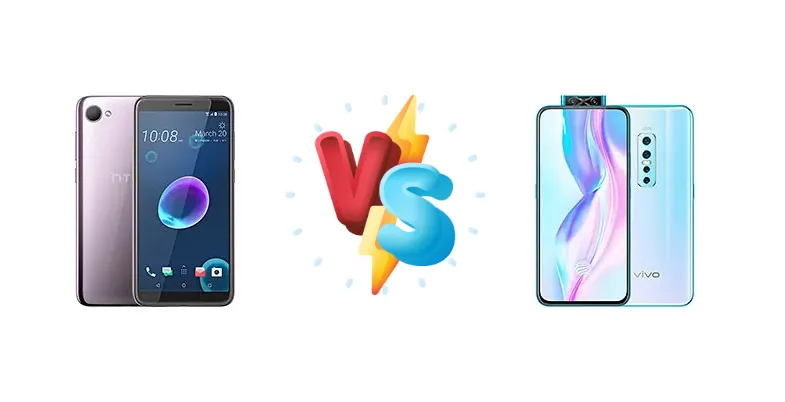
The HTC Desire 12 and vivo V17 Pro represent different approaches to the budget and mid-range smartphone market. The Desire 12, a more established name, aims for affordability, while the V17 Pro attempts to deliver a more premium experience with a focus on performance and display quality. This comparison dissects their key differences to determine which device offers the best value.
🏆 Quick Verdict
For the average user, the vivo V17 Pro is the clear winner. Its Qualcomm Snapdragon 675 chipset provides a significantly faster and more responsive experience than the Desire 12’s Mediatek MT6739. While both boast a 107-hour endurance rating, the V17 Pro’s 18W charging offers a faster top-up, making it the more practical choice.
| Network |
|---|
| 2G bands | GSM 850 / 900 / 1800 / 1900 | GSM 850 / 900 / 1800 / 1900 |
| 3G bands | HSDPA 850 / 900 / 1900 / 2100 | HSDPA 850 / 900 / 2100 |
| 4G bands | 1, 3, 5, 7, 8, 20, 28, 38, 40, 41 - Global | 1, 3, 5, 8, 38, 39, 40, 41 |
| Speed | HSPA 42.2/5.76 Mbps, LTE Cat4 150/50 Mbps | HSPA, LTE |
| Technology | GSM / HSPA / LTE | GSM / HSPA / LTE |
| | 2, 4, 5, 7, 12, 17, 28 - USA | - |
| Launch |
|---|
| Announced | 2018, March. Released 2018, May | 2019, September 20. Released 2019, September |
| Status | Discontinued | Discontinued |
| Body |
|---|
| Build | - | Glass front (Gorilla Glass 6), glass back (Gorilla Glass 6), plastic frame |
| Dimensions | 148.5 x 70.8 x 8.2 mm (5.85 x 2.79 x 0.32 in) | 159 x 74.7 x 9.8 mm (6.26 x 2.94 x 0.39 in) |
| SIM | · Nano-SIM· Nano-SIM + Nano-SIM | Nano-SIM + Nano-SIM |
| Weight | 137 g (4.83 oz) | 201.8 g (7.13 oz) |
| Display |
|---|
| Protection | - | Corning Gorilla Glass 6 |
| Resolution | 720 x 1440 pixels, 18:9 ratio (~293 ppi density) | 1080 x 2400 pixels, 20:9 ratio (~409 ppi density) |
| Size | 5.5 inches, 78.1 cm2 (~74.2% screen-to-body ratio) | 6.44 inches, 100.1 cm2 (~84.3% screen-to-body ratio) |
| Type | IPS LCD | Super AMOLED |
| Platform |
|---|
| CPU | Quad-core 1.3 GHz Cortex-A53 | Octa-core (2x2.0 GHz Kryo 460 Gold & 6x1.7 GHz Kryo 460 Silver) |
| Chipset | Mediatek MT6739 (28 nm) | Qualcomm SDM675 Snapdragon 675 (11 nm) |
| GPU | PowerVR GE8100 | Adreno 612 |
| OS | Android 7.x (Nougat) | Android 9.0 (Pie), Funtouch 9.1 |
| Memory |
|---|
| Card slot | microSDXC (dedicated slot) | No |
| Internal | 16GB 2GB RAM, 32GB 3GB RAM | 128GB 8GB RAM |
| | eMMC 5.1 | UFS 2.1 |
| Main Camera |
|---|
| Features | LED flash, HDR, panorama | LED flash, HDR, panorama |
| Quad | - | 48 MP, f/1.8, 26mm (wide), 1/2.0", 0.8µm, PDAF
8 MP, f/2.2, 16mm (ultrawide), 1/4.0", 1.12µm
13 MP, (telephoto), 1/3.1", 1.12µm, PDAF, 2x optical zoom
Auxiliary lens |
| Single | 13 MP, f/2.2, PDAF | - |
| Video | 1080p@30fps | 4K@30fps, 1080p@30fps |
| Selfie camera |
|---|
| Dual | - | Motorized pop-up 32 MP, f/2.0, 26mm (wide), 1/2.8", 0.8µm
Motorized pop-up 8 MP, 17mm (ultrawide) |
| Features | - | HDR |
| Single | 5 MP, f/2.4, 1/5.0" 1.12µm | - |
| Video | 720p | 1080p@30fps |
| Sound |
|---|
| 3.5mm jack | Yes | Yes |
| 35mm jack | Yes | Yes |
| Loudspeaker | Yes | Yes |
| Comms |
|---|
| Bluetooth | 4.2, A2DP, LE | 5.0, A2DP, LE |
| NFC | No | Yes (market/region dependent) |
| Positioning | GPS, GLONASS | GPS, GLONASS, GALILEO, BDS |
| Radio | FM radio | No |
| USB | microUSB 2.0 | USB Type-C 2.0, OTG |
| WLAN | Wi-Fi 802.11 b/g/n, Wi-Fi Direct | Wi-Fi 802.11 a/b/g/n/ac, dual-band, Wi-Fi Direct |
| Features |
|---|
| Sensors | Accelerometer, proximity, compass | Fingerprint (under display, optical), accelerometer, gyro, proximity, compass |
| Battery |
|---|
| Charging | - | 18W wired |
| Type | Li-Ion 2730 mAh, non-removable | 4100 mAh, non-removable |
| Misc |
|---|
| Colors | Cool Black, Warm Silver | Crystal Black, Crystal Sky, Midnight Ocean |
| Models | - | 1909, PD1931F_EX, 1910 |
| Price | About 130 EUR | About 200 EUR |
| SAR | - | 0.95 W/kg (head) 0.39 W/kg (body) |
| Tests |
|---|
| Audio quality | - |
Noise -93.5dB / Crosstalk -94.5dB |
| Battery life | - |
Endurance rating 107h
|
| Camera | - |
Photo / Video |
| Display | - |
Contrast ratio: Infinite (nominal) |
| Loudspeaker | - |
Voice 67dB / Noise 72dB / Ring 89dB
|
| Performance | - |
AnTuTu: 176791 (v7)
GeekBench: 6629 (v4.4)
GFXBench: 7.3fps (ES 3.1 onscreen) |
HTC Desire 12
- Extremely affordable price point
- Simple and easy-to-use interface
- Acceptable battery endurance
- Weak processor performance
- Limited display quality
- Slow charging speeds
vivo V17 Pro
- Significantly faster processor
- Brighter and more vibrant display
- Faster 18W charging
- Higher price compared to Desire 12
- May have bloatware (typical of vivo)
- Camera details are limited
Display Comparison
The vivo V17 Pro boasts a significantly brighter display, measured at 504 nits, compared to the HTC Desire 12 (brightness data unavailable). This higher brightness translates to better visibility outdoors under direct sunlight. While the Desire 12’s display specifications are limited, the V17 Pro’s ‘Infinite’ contrast ratio (nominal) suggests a superior viewing experience with deeper blacks and more vibrant colors. The lack of detailed display information for the Desire 12 suggests a more basic panel, likely impacting color accuracy and viewing angles.
Camera Comparison
Both devices feature photo and video capabilities, but detailed camera specifications are limited. The V17 Pro likely benefits from Qualcomm’s image signal processor (ISP) integrated within the Snapdragon 675, offering improved image processing and potentially better low-light performance. Without specific sensor size or aperture information for either device, it’s difficult to make a definitive judgment. However, the V17 Pro’s more powerful chipset suggests a more sophisticated camera experience overall. The Desire 12 likely relies on simpler image processing algorithms.
Performance
The performance gap between these two devices is substantial. The vivo V17 Pro’s Qualcomm Snapdragon 675 (11nm) utilizes an octa-core architecture – a combination of 2x2.0 GHz Kryo 460 Gold and 6x1.7 GHz Kryo 460 Silver cores – offering significantly more processing power than the HTC Desire 12’s quad-core 1.3 GHz Cortex-A53 processor built on a larger 28nm process. The 11nm fabrication process of the Snapdragon 675 also contributes to better thermal efficiency, reducing the likelihood of performance throttling during sustained workloads like gaming. Users seeking a responsive experience for multitasking and gaming will find the V17 Pro far superior.
Battery Life
Interestingly, both the HTC Desire 12 and vivo V17 Pro share an endurance rating of 107 hours. However, this doesn’t tell the whole story. The V17 Pro’s 18W wired charging capability provides a significant advantage, allowing for much faster charging times compared to the Desire 12, which likely supports standard charging speeds. While both may last a similar amount of time on a single charge, the V17 Pro’s faster charging minimizes downtime and offers greater convenience.
Buying Guide
Buy the HTC Desire 12 if you prioritize extreme affordability and only need a smartphone for basic tasks like calls, texts, and light social media. It’s a suitable option for first-time smartphone users or those on a very tight budget. Buy the vivo V17 Pro if you value performance for gaming, multitasking, and photography, and appreciate a brighter, more vibrant display. It’s ideal for users who want a smoother, more enjoyable smartphone experience without breaking the bank.
Frequently Asked Questions
❓ Is the Snapdragon 675 in the vivo V17 Pro capable of handling modern mobile games?
Yes, the Snapdragon 675 is a capable chipset for gaming. While it won't deliver flagship-level performance, it can comfortably run popular titles like PUBG Mobile and Call of Duty Mobile at medium to high settings with stable frame rates. The 11nm process also helps mitigate thermal throttling during extended gaming sessions.
❓ How does the Mediatek MT6739 in the HTC Desire 12 perform with multitasking?
The Mediatek MT6739 is a basic processor designed for light tasks. Multitasking with several apps open simultaneously will likely result in noticeable slowdowns and lag. It's best suited for running one app at a time and is not ideal for power users.
❓ Does the vivo V17 Pro support fast charging protocols beyond 18W?
While the V17 Pro supports 18W charging, it's likely compatible with Quick Charge 3.0 and potentially other fast charging standards. However, to achieve the full 18W charging speed, you'll need to use a compatible charger and cable.
❓ What type of storage does the HTC Desire 12 use, and is it expandable?
Unfortunately, the storage type and expandability of the HTC Desire 12 are not specified in the provided data. However, given its budget nature, it likely uses eMMC storage and includes a microSD card slot for expandable storage, though the maximum supported capacity is unknown.