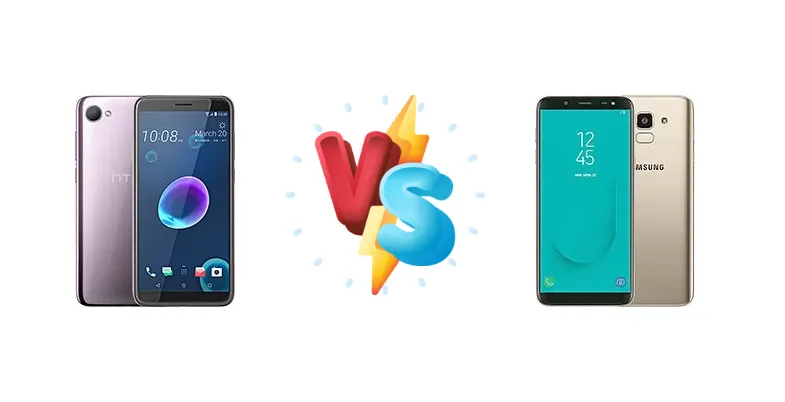
Both the HTC Desire 12 and Samsung Galaxy J6 targeted the entry-level smartphone market, but they approached it with different hardware philosophies. The Desire 12 prioritized affordability, while the J6 aimed for a balance of features and performance. This comparison dissects those choices, focusing on the core differences in their chipsets and how they impact the user experience.
🏆 Quick Verdict
For the average user, the Samsung Galaxy J6 is the superior choice. Its Exynos 7870 chipset, built on a smaller 14nm process, delivers noticeably better performance and efficiency compared to the HTC Desire 12’s Mediatek MT6739. While both phones offer a basic Android experience, the J6 handles multitasking and demanding apps with greater ease.
| Network |
|---|
| 2G bands | GSM 850 / 900 / 1800 / 1900 | GSM 850 / 900 / 1800 / 1900 |
| 3G bands | HSDPA 850 / 900 / 1900 / 2100 | HSDPA 850 / 900 / 1700(AWS) / 1900 / 2100 |
| 4G bands | 1, 3, 5, 7, 8, 20, 28, 38, 40, 41 - Global | 1, 2, 3, 4, 5, 7, 8, 12, 13, 17, 20, 28, 38, 40, 41, 66 |
| Speed | HSPA 42.2/5.76 Mbps, LTE Cat4 150/50 Mbps | HSPA, LTE |
| Technology | GSM / HSPA / LTE | GSM / HSPA / LTE |
| | 2, 4, 5, 7, 12, 17, 28 - USA | - |
| Launch |
|---|
| Announced | 2018, March. Released 2018, May | 2018, May. Released 2018, May |
| Status | Discontinued | Discontinued |
| Body |
|---|
| Build | - | Glass front (Gorilla Glass), plastic back, plastic frame |
| Dimensions | 148.5 x 70.8 x 8.2 mm (5.85 x 2.79 x 0.32 in) | 149.3 x 70.2 x 8.2 mm (5.88 x 2.76 x 0.32 in) |
| SIM | · Nano-SIM· Nano-SIM + Nano-SIM | Nano-SIM + Nano-SIM |
| Weight | 137 g (4.83 oz) | 154 g (5.43 oz) |
| Display |
|---|
| Protection | - | Corning Gorilla Glass (unspecified version) |
| Resolution | 720 x 1440 pixels, 18:9 ratio (~293 ppi density) | 720 x 1480 pixels, 18.5:9 ratio (~293 ppi density) |
| Size | 5.5 inches, 78.1 cm2 (~74.2% screen-to-body ratio) | 5.6 inches, 80.1 cm2 (~76.5% screen-to-body ratio) |
| Type | IPS LCD | Super AMOLED |
| Platform |
|---|
| CPU | Quad-core 1.3 GHz Cortex-A53 | Octa-core 1.6 GHz Cortex-A53 |
| Chipset | Mediatek MT6739 (28 nm) | Exynos 7870 Octa (14 nm) |
| GPU | PowerVR GE8100 | Mali-T830 MP1 |
| OS | Android 7.x (Nougat) | Android 8.0 (Oreo), upgradable to Android 10, One UI 2.0 |
| Memory |
|---|
| Card slot | microSDXC (dedicated slot) | microSDXC (dedicated slot) |
| Internal | 16GB 2GB RAM, 32GB 3GB RAM | 32GB 2GB RAM, 32GB 3GB RAM, 64GB 4GB RAM |
| | eMMC 5.1 | eMMC 5.1 |
| Main Camera |
|---|
| Features | LED flash, HDR, panorama | LED flash, panorama, HDR |
| Single | 13 MP, f/2.2, PDAF | 13 MP, f/1.9, 28mm (wide), AF |
| Video | 1080p@30fps | 1080p@30fps |
| Selfie camera |
|---|
| Features | - | LED flash |
| Single | 5 MP, f/2.4, 1/5.0" 1.12µm | 8 MP, f/1.9 |
| Video | 720p | 1080p@30fps |
| Sound |
|---|
| 3.5mm jack | Yes | Yes |
| 35mm jack | Yes | Yes |
| Loudspeaker | Yes | Yes |
| Comms |
|---|
| Bluetooth | 4.2, A2DP, LE | 4.2, A2DP, LE |
| NFC | No | No |
| Positioning | GPS, GLONASS | GPS, GLONASS, BDS |
| Radio | FM radio | Stereo FM radio, recording |
| USB | microUSB 2.0 | microUSB 2.0, OTG |
| WLAN | Wi-Fi 802.11 b/g/n, Wi-Fi Direct | Wi-Fi 802.11 b/g/n, Wi-Fi Direct |
| Features |
|---|
| Sensors | Accelerometer, proximity, compass | Fingerprint (rear-mounted), accelerometer, proximity |
| Battery |
|---|
| Music play | - | Up to 76 h |
| Talk time | - | Up to 21 h (3G) |
| Type | Li-Ion 2730 mAh, non-removable | Li-Ion 3000 mAh, non-removable |
| Misc |
|---|
| Colors | Cool Black, Warm Silver | Black, Gold, Blue |
| Models | - | SM-J600G, SM-J600F, SM-J600G, SM-J600FN, SM-J600GF, SM-J600GT, SM-J600L, SM-J600N |
| Price | About 130 EUR | About 180 EUR |
| SAR EU | - | 0.81 W/kg (head) 1.57 W/kg (body) |
HTC Desire 12
- Potentially lower price point (depending on market conditions)
- Simple and straightforward Android experience
- May be more readily available in certain regions
- Significantly weaker performance compared to the J6
- Less efficient chipset leads to shorter battery life
- Limited multitasking capabilities
Samsung Galaxy J6
- Superior performance thanks to the Exynos 7870
- More efficient chipset for longer battery life
- Better multitasking and app responsiveness
- May be slightly more expensive than the Desire 12
- Samsung’s software can include pre-installed bloatware
- Similar basic camera performance to the Desire 12
Display Comparison
Neither device is known for display excellence. Given the context data focuses on chipsets, we can infer both likely used LCD panels common in this price bracket. The absence of specifications like resolution or brightness suggests neither phone aimed to compete on display quality. Bezels were likely substantial on both, typical of the era. Color accuracy would have been standard for budget displays, prioritizing cost over fidelity.
Camera Comparison
Without detailed camera specifications, it’s difficult to make definitive claims. However, given the market segment, both phones likely featured basic camera setups. The presence of a 2MP macro camera on either device is likely a marketing gimmick, offering minimal practical benefit. The J6’s Exynos chipset likely provides slightly better image signal processing (ISP) capabilities, potentially resulting in marginally better image quality in good lighting conditions. However, low-light performance would likely be similar on both devices.
Performance
The core difference lies in the chipsets. The Samsung Galaxy J6’s Exynos 7870, fabricated on a 14nm process, is a clear advantage over the HTC Desire 12’s Mediatek MT6739 (28nm). The 14nm process allows for greater transistor density and improved power efficiency, meaning the J6 will generate less heat and sustain performance for longer periods. While both CPUs utilize Cortex-A53 cores, the J6’s octa-core configuration versus the Desire 12’s quad-core setup translates to significantly better multitasking capabilities. The J6 will handle app switching and background processes far more smoothly. The larger core count also provides a boost in GPU performance, making the J6 the better choice for casual gaming.
Battery Life
Battery capacity isn’t specified, but the Exynos 7870’s superior power efficiency gives the Galaxy J6 a distinct advantage in real-world battery life. The 14nm process consumes less power than the MT6739’s 28nm process, even with similar usage patterns. While charging wattage is also unknown, the J6’s more efficient chipset will likely result in faster overall charging times, even if both phones have similar battery capacities.
Buying Guide
Buy the HTC Desire 12 if your primary need is an extremely affordable smartphone for basic communication – calls, texts, and light social media. It’s a viable option for users on a very tight budget who prioritize minimal cost over performance. Buy the Samsung Galaxy J6 if you value a smoother, more responsive user experience, even for everyday tasks. The J6 is better suited for users who occasionally play mobile games, browse the web with multiple tabs, or use more demanding applications.
Frequently Asked Questions
❓ Does the Mediatek MT6739 in the HTC Desire 12 struggle with modern app updates?
Yes, the MT6739 is a relatively old and underpowered chipset. As app developers optimize for newer hardware, the Desire 12 will likely experience increasing performance issues with updates to popular apps like social media platforms and web browsers.
❓ Is the Samsung Galaxy J6 a good option for playing PUBG Mobile?
The Galaxy J6 can run PUBG Mobile, but not at maximum settings. Expect to play at low to medium graphics settings with a stable frame rate. The Exynos 7870 provides enough power for a playable experience, but don't expect flagship-level performance.
❓ Will the HTC Desire 12 overheat during prolonged use?
The Mediatek MT6739, being built on a 28nm process, is prone to generating more heat than the Exynos 7870. Prolonged use of demanding apps or gaming could lead to noticeable throttling and a warm device.
❓ How does the software experience differ between the two phones?
Both phones likely shipped with Android 8 or 9. However, Samsung’s One UI, even in its earlier iterations, typically includes more features and customization options than the stock Android experience found on the HTC Desire 12. This also means Samsung’s software may include pre-installed apps (bloatware).