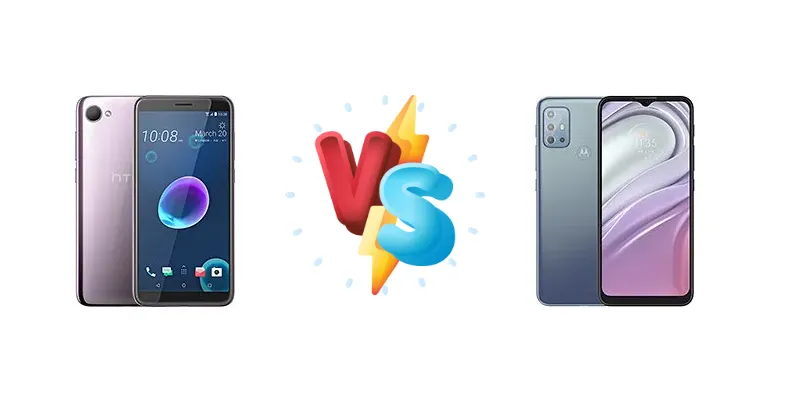
The HTC Desire 12 and Motorola Moto G20 represent the lower end of the Android smartphone market. Both aim to deliver essential functionality at an accessible price point, but they take different approaches to achieving this. The Desire 12, an older model, relies on a Mediatek chipset, while the Moto G20 utilizes a newer Unisoc processor. This comparison will dissect their key differences to determine which offers the best value for budget-conscious consumers.
🏆 Quick Verdict
For the average user, the Motorola Moto G20 is the better choice. Its Unisoc T700 chipset, featuring an octa-core CPU clocked at 1.8 GHz, provides a substantial performance uplift over the HTC Desire 12’s quad-core 1.3 GHz Mediatek MT6739. While both phones are entry-level, the G20 offers a smoother, more responsive experience for everyday tasks.
| Network |
|---|
| 2G bands | GSM 850 / 900 / 1800 / 1900 | GSM 850 / 900 / 1800 / 1900 |
| 3G bands | HSDPA 850 / 900 / 1900 / 2100 | HSDPA 850 / 900 / 1900 / 2100 |
| 4G bands | 1, 3, 5, 7, 8, 20, 28, 38, 40, 41 - Global | 1, 2, 3, 5, 7, 8, 18, 19, 20, 26, 28, 38, 40, 41 |
| Speed | HSPA 42.2/5.76 Mbps, LTE Cat4 150/50 Mbps | HSPA 42.2/5.76 Mbps, LTE Cat4 150/50 Mbps |
| Technology | GSM / HSPA / LTE | GSM / HSPA / LTE |
| | 2, 4, 5, 7, 12, 17, 28 - USA | - |
| Launch |
|---|
| Announced | 2018, March. Released 2018, May | 2021, April 26 |
| Status | Discontinued | Available. Released 2021, June 09 |
| Body |
|---|
| Build | - | Glass front, plastic frame, plastic back |
| Dimensions | 148.5 x 70.8 x 8.2 mm (5.85 x 2.79 x 0.32 in) | 165.2 x 75.7 x 9.1 mm (6.50 x 2.98 x 0.36 in) |
| SIM | · Nano-SIM· Nano-SIM + Nano-SIM | · Nano-SIM· Nano-SIM + Nano-SIM |
| Weight | 137 g (4.83 oz) | 200 g (7.05 oz) |
| | - | Water-repellent design |
| Display |
|---|
| Resolution | 720 x 1440 pixels, 18:9 ratio (~293 ppi density) | 720 x 1600 pixels, 20:9 ratio (~270 ppi density) |
| Size | 5.5 inches, 78.1 cm2 (~74.2% screen-to-body ratio) | 6.5 inches, 102.0 cm2 (~81.6% screen-to-body ratio) |
| Type | IPS LCD | IPS LCD, 90Hz |
| Platform |
|---|
| CPU | Quad-core 1.3 GHz Cortex-A53 | Octa-core 1.8 GHz |
| Chipset | Mediatek MT6739 (28 nm) | Unisoc T700 |
| GPU | PowerVR GE8100 | Mali G52 |
| OS | Android 7.x (Nougat) | Android 11 |
| Memory |
|---|
| Card slot | microSDXC (dedicated slot) | microSDXC (uses shared SIM slot) |
| Internal | 16GB 2GB RAM, 32GB 3GB RAM | 64GB 4GB RAM, 128GB 4GB RAM |
| | eMMC 5.1 | - |
| Main Camera |
|---|
| Features | LED flash, HDR, panorama | LED flash, HDR, panorama |
| Quad | - | 48 MP, f/1.7, (wide), 1/2.0", 0.8µm, PDAF
8 MP, f/2.2, 118˚ (ultrawide), 1/4.0", 1.12µm
2 MP (macro)
Auxiliary lens |
| Single | 13 MP, f/2.2, PDAF | - |
| Video | 1080p@30fps | 1080p@30fps |
| Selfie camera |
|---|
| Features | - | HDR |
| Single | 5 MP, f/2.4, 1/5.0" 1.12µm | 13 MP, f/2.2, (wide), 1/3.1", 1.12µm |
| Video | 720p | 1080p@30fps |
| Sound |
|---|
| 3.5mm jack | Yes | Yes |
| 35mm jack | Yes | Yes |
| Loudspeaker | Yes | Yes |
| Comms |
|---|
| Bluetooth | 4.2, A2DP, LE | 5.0, A2DP, LE |
| NFC | No | Yes |
| Positioning | GPS, GLONASS | GPS, GLONASS, GALILEO |
| Radio | FM radio | FM radio |
| USB | microUSB 2.0 | USB Type-C 2.0 |
| WLAN | Wi-Fi 802.11 b/g/n, Wi-Fi Direct | Wi-Fi 802.11 a/b/g/n/ac, dual-band, Wi-Fi Direct |
| Features |
|---|
| Sensors | Accelerometer, proximity, compass | Fingerprint (rear-mounted), accelerometer, gyro, proximity |
| Battery |
|---|
| Charging | - | 10W wired |
| Type | Li-Ion 2730 mAh, non-removable | Li-Po 5000 mAh |
| Misc |
|---|
| Colors | Cool Black, Warm Silver | Breeze Blue, Flamingo Pink |
| Models | - | XT2128-1, XT2128-2 |
| Price | About 130 EUR | About 160 EUR |
HTC Desire 12
- Potentially lower price (depending on availability)
- Established brand (HTC)
- Simple, straightforward Android experience
- Outdated Mediatek MT6739 chipset
- Slower performance
- Likely limited software updates
Motorola Moto G20
- More powerful Unisoc T700 chipset
- Octa-core CPU for smoother multitasking
- Potentially better image processing
- Slow 10W charging
- Motorola’s software update track record is inconsistent
- May be slightly more expensive
Display Comparison
Neither HTC nor Motorola provided display specifications beyond the basic existence of a screen. Given the price points, both likely utilize LCD panels with 720p resolutions. The Desire 12’s age suggests a potentially lower peak brightness and narrower color gamut compared to the Moto G20. Bezels are expected to be substantial on both devices, reflecting their budget nature. Color accuracy is unlikely to be a strong point for either.
Camera Comparison
Without detailed camera specifications, a direct comparison is difficult. However, given the market segment, both phones likely feature basic camera setups. It’s reasonable to assume the Moto G20 benefits from newer image processing algorithms, potentially resulting in slightly better image quality in good lighting conditions. The presence of a 2MP macro camera on either device is largely a marketing gimmick, offering minimal practical benefit. Sensor size and aperture are unknown, but likely small on both.
Performance
The core difference lies in the chipsets. The Motorola Moto G20’s Unisoc T700, with its octa-core configuration at 1.8 GHz, represents a significant leap over the HTC Desire 12’s Mediatek MT6739’s quad-core 1.3 GHz. The Unisoc T700’s higher clock speed and core count translate to faster app loading times, smoother multitasking, and improved responsiveness. The MT6739, built on a 28nm process, is less efficient, potentially leading to more heat generation under load. While neither chipset is a gaming powerhouse, the G20 will handle casual games more comfortably.
Battery Life
Battery capacity is not specified for either device. However, the Unisoc T700 in the Moto G20, while more powerful, is also built on a more efficient process. The G20’s 10W wired charging is slow by modern standards, but likely comparable to the Desire 12’s charging capabilities. Real-world battery life will depend heavily on usage patterns, but the G20’s more efficient processor could translate to slightly longer endurance despite potentially similar battery capacities.
Buying Guide
Buy the HTC Desire 12 if you prioritize brand recognition and are looking for the absolute cheapest possible smartphone for basic communication. Buy the Motorola Moto G20 if you prefer a more modern processor for improved multitasking, smoother app launches, and a slightly better overall user experience, even if it means sacrificing some potential long-term software support.
Frequently Asked Questions
❓ Will the Motorola Moto G20 struggle with popular apps like Facebook or WhatsApp?
While the Moto G20 isn't a powerhouse, the Unisoc T700 chipset should handle Facebook and WhatsApp without significant issues. Expect some loading times and occasional slowdowns with multiple apps open simultaneously, but it's generally sufficient for basic social media use.
❓ Is the HTC Desire 12 a good option for someone who primarily makes phone calls and sends texts?
Yes, the HTC Desire 12 is perfectly adequate for basic communication tasks like phone calls and text messaging. However, its older processor will make other tasks, such as browsing the web or using apps, noticeably slower compared to the Moto G20.
❓ How long will software updates be supported on the Motorola Moto G20?
Motorola’s software update commitment for the Moto G20 is limited. Expect at least one major Android update (likely to Android 12 or 13), but long-term security updates are less certain. The HTC Desire 12 is likely to have even less software support given its age.