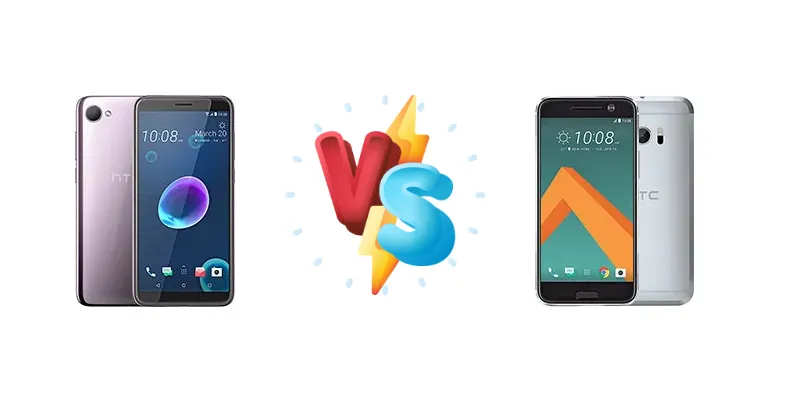
The HTC 10 represented a peak in HTC's flagship ambitions, boasting a premium build and powerful Snapdragon 820 processor. The Desire 12, released later, targets a significantly lower price point with a Mediatek chipset. This comparison dissects the trade-offs between these two devices, helping you determine if the older flagship still holds value in today's market.
🏆 Quick Verdict
For the average user prioritizing smooth performance and faster charging, the HTC 10 is the clear winner. While the Desire 12 offers a more modern release date, its Mediatek MT6739 chipset simply cannot compete with the Snapdragon 820's processing power and efficiency. The 10's 66-hour endurance rating also provides peace of mind.
| Network |
|---|
| 2G bands | GSM 850 / 900 / 1800 / 1900 | GSM 850 / 900 / 1800 / 1900 |
| 3G bands | HSDPA 850 / 900 / 1900 / 2100 | HSDPA 850 / 900 / 1900 / 2100 |
| 4G bands | 1, 3, 5, 7, 8, 20, 28, 38, 40, 41 - Global | 1, 3, 5, 7, 8, 20, 28, 38, 40, 41 |
| Speed | HSPA 42.2/5.76 Mbps, LTE Cat4 150/50 Mbps | HSPA, LTE (3CA) Cat9 450/50 Mbps |
| Technology | GSM / HSPA / LTE | GSM / HSPA / LTE |
| | 2, 4, 5, 7, 12, 17, 28 - USA | - |
| Launch |
|---|
| Announced | 2018, March. Released 2018, May | 2016, April 12. Released 2016, April 12 |
| Status | Discontinued | Discontinued |
| Body |
|---|
| Build | - | Glass front (Gorilla Glass 3), aluminum back, aluminum frame |
| Dimensions | 148.5 x 70.8 x 8.2 mm (5.85 x 2.79 x 0.32 in) | 145.9 x 71.9 x 9 mm (5.74 x 2.83 x 0.35 in) |
| SIM | · Nano-SIM· Nano-SIM + Nano-SIM | Nano-SIM |
| Weight | 137 g (4.83 oz) | 161 g (5.68 oz) |
| Display |
|---|
| Protection | - | Corning Gorilla Glass 3 |
| Resolution | 720 x 1440 pixels, 18:9 ratio (~293 ppi density) | 1440 x 2560 pixels, 16:9 ratio (~565 ppi density) |
| Size | 5.5 inches, 78.1 cm2 (~74.2% screen-to-body ratio) | 5.2 inches, 74.5 cm2 (~71.1% screen-to-body ratio) |
| Type | IPS LCD | Super LCD5 |
| Platform |
|---|
| CPU | Quad-core 1.3 GHz Cortex-A53 | Quad-core (2x2.15 GHz Kryo & 2x1.6 GHz Kryo) |
| Chipset | Mediatek MT6739 (28 nm) | Qualcomm MSM8996 Snapdragon 820 (14 nm) |
| GPU | PowerVR GE8100 | Adreno 530 |
| OS | Android 7.x (Nougat) | Android 6.0.1 (Marshmallow), upgradable to Android 8.0 (Oreo), Sense UI |
| Memory |
|---|
| Card slot | microSDXC (dedicated slot) | microSDXC (dedicated slot) |
| Internal | 16GB 2GB RAM, 32GB 3GB RAM | 32GB 4GB RAM, 64GB 4GB RAM |
| | eMMC 5.1 | - |
| Main Camera |
|---|
| Features | LED flash, HDR, panorama | Laser AF, Dual-LED dual-tone flash, HDR, panorama |
| Single | 13 MP, f/2.2, PDAF | 12 MP, f/1.8, 26mm (wide), 1/2.3", 1.55µm, OIS |
| Video | 1080p@30fps | 4K@30fps, 720p@120fps, HDR, stereo sound rec. |
| Selfie camera |
|---|
| Features | - | HDR |
| Single | 5 MP, f/2.4, 1/5.0" 1.12µm | 5 MP, f/1.8, 23mm (wide), 1/4.1", 1.34µm, OIS, AF |
| Video | 720p | 1080p@30fps |
| Sound |
|---|
| 3.5mm jack | Yes | Yes |
| 35mm jack | Yes | Yes |
| Loudspeaker | Yes | Yes, with stereo speakers |
| | - | 24-bit/192kHz audio
|
| Comms |
|---|
| Bluetooth | 4.2, A2DP, LE | 4.2, A2DP, aptX |
| NFC | No | Yes |
| Positioning | GPS, GLONASS | GPS, GLONASS/ BDS (region dependent) |
| Radio | FM radio | No |
| USB | microUSB 2.0 | USB Type-C 3.1 |
| WLAN | Wi-Fi 802.11 b/g/n, Wi-Fi Direct | Wi-Fi 802.11 a/b/g/n/ac, dual-band, Wi-Fi Direct, DLNA |
| Features |
|---|
| Sensors | Accelerometer, proximity, compass | Fingerprint (front-mounted), accelerometer, gyro, proximity, compass |
| Battery |
|---|
| Charging | - | 18W wired, QC3, 50% in 30 min |
| Stand-by | - | Up to 456 h (3G) |
| Talk time | - | Up to 27 h (3G) |
| Type | Li-Ion 2730 mAh, non-removable | Li-Ion 3000 mAh, non-removable |
| Misc |
|---|
| Colors | Cool Black, Warm Silver | Carbon Gray, Topaz Gold, Glacier Silver, Camellia Red |
| Models | - | 10, M10h, HTC6545LVW, HTV32, 2PS64, 2PS6200 |
| Price | About 130 EUR | About 300 EUR |
| SAR | - | 0.47 W/kg (head) 0.64 W/kg (body) |
| Tests |
|---|
| Audio quality | - |
Noise -90.4dB / Crosstalk -87.3dB |
| Battery life | - |
Endurance rating 66h
|
| Camera | - |
Photo / Video |
| Loudspeaker | - |
Voice 65dB / Noise 62dB / Ring 63dB
|
| Performance | - |
Basemark OS II 2.0: 1839Basemark X: 28882 |
HTC Desire 12
- Significantly faster processor (Snapdragon 820)
- More efficient chipset (14nm process)
- Faster charging (18W, QC3)
- Likely superior camera quality
- Older device, potentially limited software updates
- May be harder to find in good condition
HTC 10
- More modern release date
- Potentially lower price
- Acceptable battery life (66h endurance)
- More readily available
- Significantly slower processor (Mediatek MT6739)
- Less efficient chipset (28nm process)
- Slower charging speeds
- Likely inferior camera quality
Display Comparison
Display specifications are not provided for either device. However, given the HTC 10's flagship status, it likely features a higher-resolution and more color-accurate display than the Desire 12. The Desire 12, being a budget device, likely utilizes a lower-cost panel with narrower viewing angles. Bezels are also expected to be larger on the Desire 12, reflecting its market segment.
Camera Comparison
Both devices feature photo and video capabilities, but the HTC 10 likely boasts a superior camera system. While specific sensor details are missing, the HTC 10, as a flagship, would have employed a larger sensor and more advanced image processing algorithms. The Desire 12's camera is likely focused on basic functionality, prioritizing affordability over image quality. The absence of details suggests the Desire 12 lacks features like Optical Image Stabilization (OIS) found in higher-end phones.
Performance
The core difference lies in the chipsets. The HTC 10's Qualcomm MSM8996 Snapdragon 820 (14nm) is a significant leap ahead of the Desire 12's Mediatek MT6739 (28nm). The Snapdragon 820's Kryo cores (2x2.15 GHz & 2x1.6 GHz) offer superior single-core and multi-core performance compared to the Desire 12's quad-core 1.3 GHz Cortex-A53. The 14nm manufacturing process of the Snapdragon 820 also translates to better thermal efficiency, reducing throttling during sustained workloads. This means the HTC 10 will handle demanding apps and games more smoothly and for longer periods.
Battery Life
Both phones share an endurance rating of 66 hours, suggesting similar battery life despite the differing chipsets. However, this is likely due to the Desire 12's less demanding processor offsetting its potentially smaller battery capacity. The HTC 10 offers a significant advantage in charging speed with its 18W wired charging and Quick Charge 3.0 support, achieving 50% charge in just 30 minutes. The Desire 12's charging speed is likely considerably slower.
Buying Guide
Buy the HTC Desire 12 if you need a very basic smartphone for essential tasks like calls, texts, and light social media, and your budget is extremely limited. Buy the HTC 10 if you prioritize a responsive user experience, better camera capabilities, and faster charging, even if it means opting for an older device. The 10 is ideal for users who remember the frustration of slow phones and want a return to flagship responsiveness.
Frequently Asked Questions
❓ Will the HTC 10 still receive software updates?
Given the HTC 10's age (released in 2016), official software updates are unlikely. However, the Android community may offer custom ROMs, allowing you to run a more recent version of Android. The Desire 12, being newer, may have received more recent updates, but its long-term support is also uncertain.
❓ Is the Mediatek MT6739 in the Desire 12 powerful enough for basic gaming?
The Mediatek MT6739 can handle very basic 2D games and older 3D titles at low settings. However, it will struggle with modern, graphically demanding games. The Snapdragon 820 in the HTC 10 offers a far superior gaming experience, capable of running most games at medium to high settings.
❓ How does the 28nm process of the MT6739 affect the Desire 12's battery life?
The 28nm process is less efficient than the 14nm process used in the Snapdragon 820. This means the MT6739 consumes more power for the same level of performance, potentially reducing battery life during intensive tasks. While the endurance rating is the same, the Desire 12 will likely drain faster under heavy load.