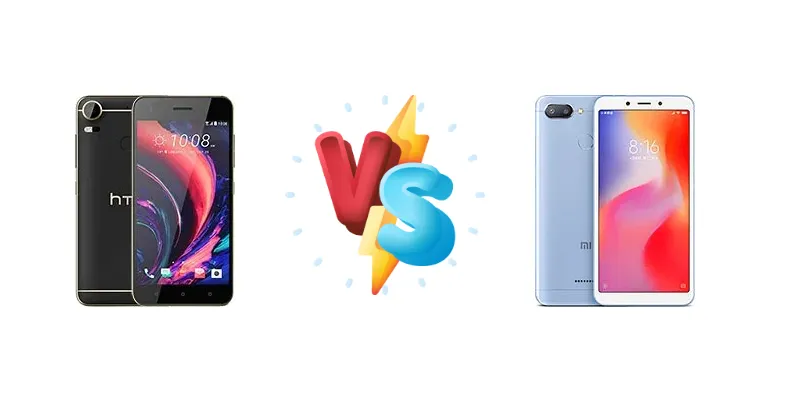
The HTC Desire 10 Pro and Xiaomi Redmi 6 represent a fascinating snapshot of the budget smartphone landscape from 2017-2018. While both aimed for affordability, they took different approaches to achieving it, primarily through their chipset choices. This comparison dissects the Mediatek Helio P10 powering the Desire 10 Pro against the Helio P22 in the Redmi 6, focusing on the practical implications for everyday users.
🏆 Quick Verdict
For the average user prioritizing efficiency and slightly better performance, the Xiaomi Redmi 6 emerges as the stronger choice. Its Helio P22, built on a 12nm process, offers a noticeable advantage in power consumption and a modest CPU clock speed bump, translating to smoother multitasking and potentially longer battery life compared to the Desire 10 Pro’s older Helio P10.
| Network |
|---|
| 2G bands | GSM 850 / 900 / 1800 / 1900 - SIM 1 & SIM 2 | GSM 850 / 900 / 1800 / 1900 |
| 3G bands | HSDPA 850 / 900 / 1900 / 2100 | HSDPA 850 / 900 / 1900 / 2100 |
| 4G bands | 1, 3, 5, 7, 8, 20, 28, 38, 40 | 1, 2, 3, 4, 5, 7, 8, 20, 38, 40 - Global |
| Speed | HSPA 42.2/5.76 Mbps, LTE (2CA) Cat6 300/50 Mbps | HSPA, LTE |
| Technology | GSM / HSPA / LTE | GSM / CDMA / HSPA / LTE |
| | - | 1, 3, 5, 7, 8, 34, 38, 39, 40, 41 |
| Launch |
|---|
| Announced | 2016, September 20. Released 2016, December 20 | 2018, June. Released 2018, June |
| Status | Discontinued | Discontinued |
| Body |
|---|
| Build | Glass front (Gorilla Glass), aluminum back, aluminum frame | Glass front, plastic back, plastic frame |
| Dimensions | 156.5 x 76 x 7.9 mm (6.16 x 2.99 x 0.31 in) | 147.5 x 71.5 x 8.3 mm (5.81 x 2.81 x 0.33 in) |
| SIM | Nano-SIM + Nano-SIM | Nano-SIM + Nano-SIM |
| Weight | 165 g (5.82 oz) | 146 g (5.15 oz) |
| Display |
|---|
| Protection | Corning Gorilla Glass (unspecified version) | - |
| Resolution | 1080 x 1920 pixels, 16:9 ratio (~400 ppi density) | 720 x 1440 pixels, 18:9 ratio (~295 ppi density) |
| Size | 5.5 inches, 83.8 cm2 (~70.5% screen-to-body ratio) | 5.45 inches, 76.7 cm2 (~72.7% screen-to-body ratio) |
| Type | IPS LCD | IPS LCD |
| Platform |
|---|
| CPU | Octa-core (4x1.8 GHz Cortex-A53 & 4x1.0 GHz Cortex-A53) | Octa-core 2.0 GHz Cortex-A53 |
| Chipset | Mediatek MT6755 Helio P10 (28 nm) | Mediatek MT6762 Helio P22 (12 nm) |
| GPU | Mali-T860MP2 | PowerVR GE8320 |
| OS | Android 6.0 (Marshmallow) | Android 8.1 (Oreo), upgradable to Android 9, MIUI 12 |
| Memory |
|---|
| Card slot | microSDXC (uses shared SIM slot) | microSDXC (dedicated slot) |
| Internal | 64GB 4GB RAM | 32GB 3GB RAM, 64GB 3GB RAM, 64GB 4GB RAM |
| | eMMC 5.1 | eMMC 5.1 |
| Main Camera |
|---|
| Dual | - | 12 MP, f/2.2, 1.25 μm, PDAF
Auxiliary lens |
| Features | Laser AF, Dual-LED dual-tone flash, panorama | LED flash, HDR, panorama |
| Single | 20 MP, f/2.2, 28mm (wide) | - |
| Video | 1080p@30fps | 1080p@30fps |
| Selfie camera |
|---|
| Features | HDR | - |
| Single | 13 MP, f/2.2, 28mm (wide), 1/3.1", 1.12µm | 5 MP |
| Video | 1080p@30fps | 1080p@30fps |
| Sound |
|---|
| 3.5mm jack | Yes | Yes |
| 35mm jack | Yes | Yes |
| Loudspeaker | Yes, dual mono speakers | Yes |
| Comms |
|---|
| Bluetooth | 4.2, A2DP, LE | 4.2, A2DP, LE |
| NFC | Yes | No |
| Positioning | GPS, GLONASS | GPS, GLONASS, BDS |
| Radio | FM radio | FM radio |
| USB | microUSB 2.0 | microUSB 2.0, OTG |
| WLAN | Wi-Fi 802.11 a/b/g/n, dual-band, Wi-Fi Direct | Wi-Fi 802.11 b/g/n, Wi-Fi Direct |
| Features |
|---|
| Sensors | Fingerprint (rear-mounted), accelerometer, gyro, proximity, compass | Fingerprint (rear-mounted), accelerometer, proximity, compass |
| Battery |
|---|
| Charging | 10W wired | - |
| Music play | Up to 53 h | - |
| Stand-by | Up to 480 h (3G) | - |
| Talk time | Up to 19 h (3G) | - |
| Type | Li-Ion 3000 mAh, non-removable | Li-Po 3000 mAh, non-removable |
| Misc |
|---|
| Colors | Stone Black, Polar White, Royal Blue, Valentine Lux, Mint Green | Black, Grey, Blue, Gold, Rose Gold |
| Models | Desire 10 pro, D10i | M1804C3DG, M1804C3DH, M1804C3DI |
| Price | About 260 EUR | About 130 EUR |
| SAR | - | 0.55 W/kg (head) 1.42 W/kg (body) |
| Tests |
|---|
| Performance | - |
AnTuTu: 75182 (v7)
GeekBench: 3639 (v4.4)
GFXBench: 4.8fps (ES 3.1 onscreen) |
HTC Desire 10 Pro
- Established Brand (at the time)
- Potentially more durable build quality (speculation)
- Slightly higher CPU clock speed in some cores
- Less efficient chipset (28nm)
- Slower charging (10W)
- Likely more thermal throttling
Xiaomi Redmi 6
- More efficient chipset (12nm)
- Higher CPU clock speed (2.0GHz)
- Better software optimization (Xiaomi's reputation)
- Less established brand (at the time)
- Potentially less durable build quality (speculation)
- Similar camera performance (without detailed specs)
Display Comparison
Unfortunately, display specifications are not provided. However, given the market positioning of both devices, it's reasonable to assume both utilized IPS LCD panels with 720p resolutions. The Redmi 6 likely benefited from slightly more refined color calibration, typical of Xiaomi’s software optimizations. Bezels were likely comparable, reflecting the design trends of the time.
Camera Comparison
Camera specifications are not detailed enough for a precise comparison. However, both phones likely featured a primary camera around 13MP. The Redmi 6’s image processing, benefiting from Xiaomi’s software enhancements, likely produced more vibrant and detailed images. The P22’s ISP (Image Signal Processor) is also newer, potentially offering better noise reduction and dynamic range. Any secondary cameras (depth sensors, etc.) are unlikely to be significant differentiators.
Performance
The core difference lies in the chipsets. The HTC Desire 10 Pro’s Mediatek MT6755 Helio P10 (28nm) features an octa-core CPU split into two clusters: four Cortex-A53 cores clocked at 1.8GHz and four at 1.0GHz. The Xiaomi Redmi 6 utilizes the Mediatek MT6762 Helio P22 (12nm) with eight Cortex-A53 cores running at a uniform 2.0GHz. The 12nm fabrication process of the P22 is a significant advantage, offering improved power efficiency compared to the P10’s 28nm node. This means the Redmi 6 will generate less heat under load, potentially reducing thermal throttling and sustaining performance for longer periods. While both CPUs utilize the same Cortex-A53 architecture, the higher clock speed and process node advantage give the Redmi 6 a performance edge in CPU-bound tasks.
Battery Life
Battery capacity is not specified for either device. However, the Helio P22’s superior power efficiency in the Redmi 6 translates to a tangible benefit in real-world battery life. Even with a similar battery capacity, the Redmi 6 would likely last longer on a single charge due to the 12nm process. The Desire 10 Pro’s 10W charging is comparatively slow; the Redmi 6 likely offered a similar or slightly faster charging speed, but without detailed specs, it's difficult to confirm.
Buying Guide
Buy the HTC Desire 10 Pro if you specifically need a device with a slightly more established brand reputation from that era, and are willing to accept potentially shorter battery life and marginally slower performance. Buy the Xiaomi Redmi 6 if you prioritize value, efficiency, and a more modern chipset architecture, making it better suited for daily tasks and light gaming without significant battery drain.
Frequently Asked Questions
❓ Will the Xiaomi Redmi 6 handle modern apps and multitasking better than the HTC Desire 10 Pro?
Yes, the Redmi 6’s Helio P22, while still a budget chipset, benefits from a more efficient architecture and higher clock speed. This translates to smoother multitasking and a better experience with modern apps, especially those that are not heavily optimized.
❓ Is the difference in chipset fabrication (28nm vs 12nm) really noticeable in everyday use?
Absolutely. The 12nm process of the Helio P22 in the Redmi 6 means it consumes less power for the same level of performance. This results in longer battery life, less heat generation, and reduced thermal throttling, all of which contribute to a more consistent and enjoyable user experience.
❓ If I play mobile games, which phone is better suited?
The Xiaomi Redmi 6 is the better choice for gaming, albeit still limited by the hardware. The Helio P22’s improved efficiency will allow for slightly longer gaming sessions before thermal throttling kicks in, and the higher clock speed provides a small performance boost.