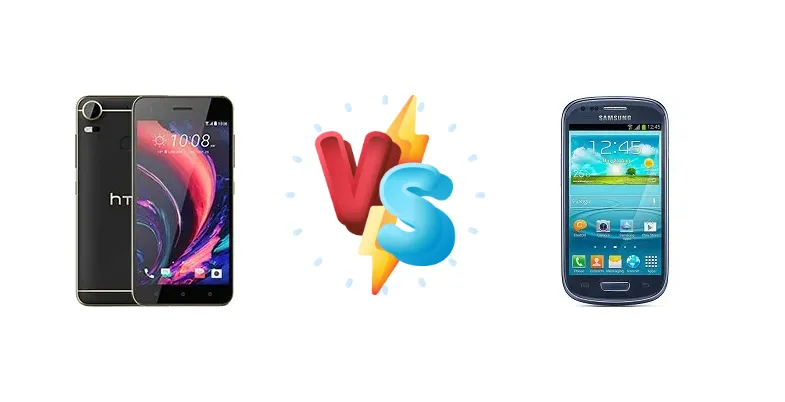
Released years apart, the HTC Desire 10 Pro and Samsung Galaxy S III mini represent distinct eras in Android smartphone development. While both aimed for accessibility, the Desire 10 Pro, benefiting from later chipset advancements, offers a significantly different user experience. This comparison dissects the core differences, focusing on performance, battery, and camera capabilities to determine which device holds up better today.
🏆 Quick Verdict
For the average user in 2024, the HTC Desire 10 Pro is the clear winner. Its Mediatek Helio P10 chipset delivers substantially better performance than the Samsung Galaxy S III mini’s NovaThor U8420, enabling smoother multitasking and app usage. While both boast similar battery endurance ratings, the Desire 10 Pro’s faster charging provides a more convenient experience.
| Network |
|---|
| 2G bands | GSM 850 / 900 / 1800 / 1900 - SIM 1 & SIM 2 | GSM 850 / 900 / 1800 / 1900 |
| 3G bands | HSDPA 850 / 900 / 1900 / 2100 | HSDPA 900 / 1900 / 2100 |
| 4G bands | 1, 3, 5, 7, 8, 20, 28, 38, 40 | - |
| Speed | HSPA 42.2/5.76 Mbps, LTE (2CA) Cat6 300/50 Mbps | HSPA 14.4/5.76 Mbps |
| Technology | GSM / HSPA / LTE | GSM / HSPA |
| Launch |
|---|
| Announced | 2016, September 20. Released 2016, December 20 | 2012, October. Released 2012, November |
| Status | Discontinued | Discontinued |
| Body |
|---|
| Build | Glass front (Gorilla Glass), aluminum back, aluminum frame | Glass front, plastic back, plastic frame |
| Dimensions | 156.5 x 76 x 7.9 mm (6.16 x 2.99 x 0.31 in) | 121.6 x 63 x 9.9 mm (4.79 x 2.48 x 0.39 in) |
| SIM | Nano-SIM + Nano-SIM | Mini-SIM |
| Weight | 165 g (5.82 oz) | 111.5 g (3.92 oz) |
| Display |
|---|
| Protection | Corning Gorilla Glass (unspecified version) | - |
| Resolution | 1080 x 1920 pixels, 16:9 ratio (~400 ppi density) | 480 x 800 pixels, 5:3 ratio (~233 ppi density) |
| Size | 5.5 inches, 83.8 cm2 (~70.5% screen-to-body ratio) | 4.0 inches, 45.5 cm2 (~59.4% screen-to-body ratio) |
| Type | IPS LCD | Super AMOLED |
| Platform |
|---|
| CPU | Octa-core (4x1.8 GHz Cortex-A53 & 4x1.0 GHz Cortex-A53) | 1.0 GHz dual-core Cortex-A9 |
| Chipset | Mediatek MT6755 Helio P10 (28 nm) | NovaThor U8420 |
| GPU | Mali-T860MP2 | Mali-400 |
| OS | Android 6.0 (Marshmallow) | Android 4.1 (Jelly Bean) |
| Memory |
|---|
| Card slot | microSDXC (uses shared SIM slot) | microSDHC (dedicated slot) |
| Internal | 64GB 4GB RAM | 8GB 1GB RAM, 16GB 1GB RAM |
| | eMMC 5.1 | - |
| Main Camera |
|---|
| Features | Laser AF, Dual-LED dual-tone flash, panorama | LED flash, panorama |
| Single | 20 MP, f/2.2, 28mm (wide) | 5 MP, f/2.6, AF |
| Video | 1080p@30fps | 720p@30fps |
| Selfie camera |
|---|
| Features | HDR | - |
| Single | 13 MP, f/2.2, 28mm (wide), 1/3.1", 1.12µm | VGA |
| Video | 1080p@30fps | - |
| Sound |
|---|
| 3.5mm jack | Yes | Yes |
| 35mm jack | Yes | Yes |
| Loudspeaker | Yes, dual mono speakers | Yes |
| Comms |
|---|
| Bluetooth | 4.2, A2DP, LE | 4.0, A2DP, EDR, LE, aptX |
| NFC | Yes | Yes (Market dependent) |
| Positioning | GPS, GLONASS | GPS, GLONASS |
| Radio | FM radio | Stereo FM radio, RDS |
| USB | microUSB 2.0 | microUSB 2.0 |
| WLAN | Wi-Fi 802.11 a/b/g/n, dual-band, Wi-Fi Direct | Wi-Fi 802.11 a/b/g/n, dual-band, Wi-Fi Direct, DLNA, hotspot |
| Features |
|---|
| Sensors | Fingerprint (rear-mounted), accelerometer, gyro, proximity, compass | Accelerometer, gyro, proximity, compass |
| Battery |
|---|
| Charging | 10W wired | - |
| Music play | Up to 53 h | - |
| Stand-by | Up to 480 h (3G) | Up to 450 h (2G) / Up to 430 h (3G) |
| Talk time | Up to 19 h (3G) | Up to 14 h 10 min (2G) / Up to 7 h 10 min (3G) |
| Type | Li-Ion 3000 mAh, non-removable | Li-Ion 1500 mAh, removable |
| Misc |
|---|
| Colors | Stone Black, Polar White, Royal Blue, Valentine Lux, Mint Green | White, Blue, Titan Gray, Amber Brown, Garnet Red, Onyx Black |
| Models | Desire 10 pro, D10i | GT-I8190, GT-I8190N, GT-I8190L, SM-G730A, SM-G730W8 |
| Price | About 260 EUR | About 130 EUR |
| SAR | - | 1.03 W/kg (head) 1.28 W/kg (body) |
| SAR EU | - | 0.52 W/kg (head) |
| Tests |
|---|
| Audio quality | - |
Noise -82.1dB / Crosstalk -80.7dB |
| Battery life | - |
Endurance rating 42h
|
| Camera | - |
Photo / Video |
| Display | - |
Contrast ratio: Infinite (nominal) / 2.422:1 (sunlight) |
| Loudspeaker | - |
Voice 66dB / Noise 63dB / Ring 76dB
|
HTC Desire 10 Pro
- Significantly faster processor for smoother performance
- Faster charging capabilities
- Likely better camera image quality
- May be larger and less pocketable than the S III mini
- Potentially less software support
Samsung I8190 Galaxy S III mini
- Extremely compact form factor
- Simple and easy-to-use interface (for its time)
- Potential collector's item appeal
- Severely outdated processor and limited performance
- Poor app compatibility with modern Android apps
- Slow charging
Display Comparison
Both devices share a reported contrast ratio of infinite (nominal) and 2.422:1 in sunlight, suggesting similar outdoor visibility. However, the Desire 10 Pro likely benefits from a more modern display panel with improved color accuracy and viewing angles, though specific details like panel type (IPS vs. TFT) are unavailable for either device. The S III mini’s smaller screen size (assumed, based on its 'mini' designation) may offer a slightly higher pixel density, but the overall visual experience will be hampered by the older display technology.
Camera Comparison
Both phones feature photo and video capabilities, but details are limited. The Desire 10 Pro likely benefits from more advanced image processing algorithms and potentially a higher-resolution sensor, though specific megapixel counts are unknown. The S III mini’s camera will likely produce noticeably lower-quality images, particularly in low-light conditions. Without further specifications, it’s difficult to assess the quality of either camera beyond acknowledging the Desire 10 Pro’s advantage due to its newer technology.
Performance
The performance disparity is stark. The HTC Desire 10 Pro’s Mediatek MT6755 Helio P10, with its octa-core CPU (4x1.8 GHz Cortex-A53 & 4x1.0 GHz Cortex-A53), represents a significant architectural leap over the Samsung Galaxy S III mini’s 1.0 GHz dual-core Cortex-A9 powered by the NovaThor U8420. The Helio P10’s more modern Cortex-A53 cores and higher clock speeds translate to substantially faster app loading times, smoother multitasking, and the ability to run more demanding applications. The S III mini will struggle with many modern apps, experiencing noticeable lag and potential crashes. The 28nm process node of the Helio P10 also offers better power efficiency compared to the likely larger process node of the NovaThor.
Battery Life
Interestingly, both devices share an endurance rating of 42 hours, suggesting comparable battery life under similar usage scenarios. However, the Desire 10 Pro’s 10W wired charging offers a significant convenience advantage over the S III mini, which likely has slower charging capabilities. While both may last a full day on a single charge with moderate use, the Desire 10 Pro allows for quicker top-ups, reducing downtime.
Buying Guide
Buy the HTC Desire 10 Pro if you need a device capable of handling modern apps and multitasking without significant lag. It’s suitable for users who prioritize a responsive experience, even if it’s not a flagship. Buy the Samsung I8190 Galaxy S III mini if you specifically desire a very compact form factor and are willing to accept severely limited performance and app compatibility. It’s best suited for basic communication and extremely light usage, or as a collector’s item.
Frequently Asked Questions
❓ Will the Samsung Galaxy S III mini be able to run popular apps like WhatsApp or Facebook in 2024?
It's highly unlikely. The NovaThor U8420 processor and limited RAM in the S III mini will struggle to run modern versions of these apps, which are optimized for more powerful hardware. You may be able to find older, compatible versions, but functionality will be limited and security risks are higher.
❓ Does the HTC Desire 10 Pro support software updates, and is it still secure to use?
Software update support for the Desire 10 Pro is likely discontinued by HTC. While it may still function, it's important to be aware of potential security vulnerabilities due to the lack of ongoing security patches. Using a reputable mobile security app is recommended if you choose to use this device.
❓ Is the battery on the Samsung Galaxy S III mini likely to still hold a charge after all these years?
The battery on the S III mini is likely significantly degraded. Lithium-ion batteries lose capacity over time, and a phone of this age will likely have a drastically reduced battery life compared to its original 42-hour endurance rating. Replacing the battery may be possible, but finding a compatible replacement could be challenging.