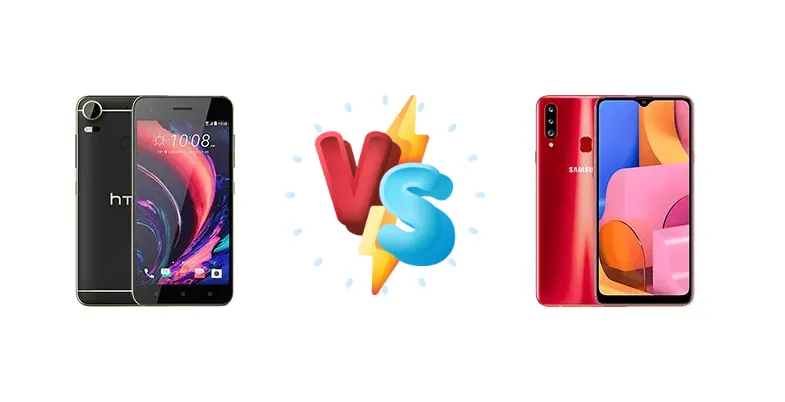
The HTC Desire 10 Pro and Samsung Galaxy A20s represent a segment of the market where value is paramount. Released in different eras, both phones aimed to deliver a functional smartphone experience without breaking the bank. This comparison dissects their core components to determine which offers the better balance of performance, efficiency, and usability for today's user.
🏆 Quick Verdict
For the average user prioritizing faster charging and potentially longer software support, the Samsung Galaxy A20s is the better choice. While the Desire 10 Pro's Helio P10 offers a slightly more complex CPU core arrangement, the A20s' Snapdragon 450 benefits from a more efficient 14nm process, resulting in better overall efficiency.
| Network |
|---|
| 2G bands | GSM 850 / 900 / 1800 / 1900 - SIM 1 & SIM 2 | GSM 850 / 900 / 1800 / 1900 |
| 3G bands | HSDPA 850 / 900 / 1900 / 2100 | HSDPA 850 / 900 / 1900 / 2100 - SM-A207F/DS |
| 4G bands | 1, 3, 5, 7, 8, 20, 28, 38, 40 | 1, 2, 3, 5, 7, 8, 20, 28, 34, 38, 39, 40, 41 - SM-A207F/DS |
| Speed | HSPA 42.2/5.76 Mbps, LTE (2CA) Cat6 300/50 Mbps | HSPA, LTE |
| Technology | GSM / HSPA / LTE | GSM / HSPA / LTE |
| | - | 1, 2, 3, 4, 5, 7, 8, 12, 13, 17, 20, 28, 38, 40, 41, 66 - SM-A207M/DS |
| Launch |
|---|
| Announced | 2016, September 20. Released 2016, December 20 | 2019, September 24. Released 2019, October 05 |
| Status | Discontinued | Discontinued |
| Body |
|---|
| Build | Glass front (Gorilla Glass), aluminum back, aluminum frame | Glass front, plastic back, plastic frame |
| Dimensions | 156.5 x 76 x 7.9 mm (6.16 x 2.99 x 0.31 in) | 163.3 x 77.5 x 8 mm (6.43 x 3.05 x 0.31 in) |
| SIM | Nano-SIM + Nano-SIM | · Nano-SIM· Nano-SIM + Nano-SIM |
| Weight | 165 g (5.82 oz) | 183 g (6.46 oz) |
| Display |
|---|
| Protection | Corning Gorilla Glass (unspecified version) | - |
| Resolution | 1080 x 1920 pixels, 16:9 ratio (~400 ppi density) | 720 x 1560 pixels, 19.5:9 ratio (~264 ppi density) |
| Size | 5.5 inches, 83.8 cm2 (~70.5% screen-to-body ratio) | 6.5 inches, 103.7 cm2 (~81.9% screen-to-body ratio) |
| Type | IPS LCD | IPS LCD |
| Platform |
|---|
| CPU | Octa-core (4x1.8 GHz Cortex-A53 & 4x1.0 GHz Cortex-A53) | Octa-core 1.8 GHz Cortex-A53 |
| Chipset | Mediatek MT6755 Helio P10 (28 nm) | Qualcomm SDM450 Snapdragon 450 (14 nm) |
| GPU | Mali-T860MP2 | Adreno 506 |
| OS | Android 6.0 (Marshmallow) | Android 9.0 (Pie), upgradable to Android 11, One UI Core 3.1 |
| Memory |
|---|
| Card slot | microSDXC (uses shared SIM slot) | microSDXC (dedicated slot) |
| Internal | 64GB 4GB RAM | 32GB 2GB RAM, 32GB 3GB RAM, 64GB 4GB RAM |
| | eMMC 5.1 | eMMC 5.1 |
| Main Camera |
|---|
| Features | Laser AF, Dual-LED dual-tone flash, panorama | LED flash, panorama, HDR |
| Single | 20 MP, f/2.2, 28mm (wide) | - |
| Triple | - | 13 MP, f/1.8, 27mm (wide), PDAF
8 MP, f/2.2, 13mm (ultrawide), 1/4.0", 1.12µm
Auxiliary lens |
| Video | 1080p@30fps | 1080p@30fps |
| Selfie camera |
|---|
| Features | HDR | - |
| Single | 13 MP, f/2.2, 28mm (wide), 1/3.1", 1.12µm | 8 MP, f/2.0 |
| Video | 1080p@30fps | 1080p@30fps |
| Sound |
|---|
| 3.5mm jack | Yes | Yes |
| 35mm jack | Yes | Yes |
| Loudspeaker | Yes, dual mono speakers | Yes |
| Comms |
|---|
| Bluetooth | 4.2, A2DP, LE | 4.2, A2DP, LE |
| NFC | Yes | No |
| Positioning | GPS, GLONASS | GPS, GLONASS, GALILEO, BDS |
| Radio | FM radio | FM radio |
| USB | microUSB 2.0 | USB Type-C 2.0 |
| WLAN | Wi-Fi 802.11 a/b/g/n, dual-band, Wi-Fi Direct | Wi-Fi 802.11 b/g/n, Wi-Fi Direct |
| Features |
|---|
| Sensors | Fingerprint (rear-mounted), accelerometer, gyro, proximity, compass | Fingerprint (rear-mounted), accelerometer, gyro, proximity, compass |
| Battery |
|---|
| Charging | 10W wired | 15W wired |
| Music play | Up to 53 h | - |
| Stand-by | Up to 480 h (3G) | - |
| Talk time | Up to 19 h (3G) | - |
| Type | Li-Ion 3000 mAh, non-removable | Li-Po 4000 mAh, non-removable |
| Misc |
|---|
| Colors | Stone Black, Polar White, Royal Blue, Valentine Lux, Mint Green | Black, Blue, Red, Green |
| Models | Desire 10 pro, D10i | SM-A207F, SM-A207M, SM-A2070 |
| Price | About 260 EUR | About 250 EUR |
| SAR | - | 0.69 W/kg (head) 1.43 W/kg (body) |
| SAR EU | - | 0.35 W/kg (head) 0.83 W/kg (body) |
HTC Desire 10 Pro
- Potentially more customization options due to older device support.
- More complex CPU core arrangement (big.LITTLE) for theoretical efficiency gains.
- Established HTC brand recognition (for some users).
- Less efficient 28nm chipset.
- Slower 10W charging.
- Likely limited software update support.
Samsung Galaxy A20s
- More efficient 14nm Snapdragon 450 chipset.
- Faster 15W charging.
- Potentially better software update support from Samsung.
- Qualcomm ISP for potentially better image processing.
- Simpler CPU core configuration.
- Samsung's software bloat (subjective).
Display Comparison
Neither device boasts a standout display. Given the context of these phones, we can assume both utilize IPS LCD panels. The focus here isn't on resolution or refresh rate, but rather on the underlying efficiency of the devices powering them. Display power draw is directly tied to chipset load, making the Snapdragon 450's efficiency a subtle advantage even in static use.
Camera Comparison
Without detailed camera specs, a direct comparison is difficult. However, given the market positioning of both devices, it’s safe to assume both feature modest camera setups. The A20s likely benefits from Qualcomm’s image signal processing (ISP), which generally offers good image quality for its class. The Desire 10 Pro’s camera performance will be heavily reliant on Mediatek’s ISP capabilities. The absence of OIS on either device suggests a reliance on software stabilization, and low-light performance will likely be a weakness for both.
Performance
The core difference lies in the chipsets. The HTC Desire 10 Pro's Mediatek MT6755 Helio P10 features an octa-core CPU split into two clusters – four Cortex-A53 cores clocked at 1.8 GHz and four at 1.0 GHz. This big.LITTLE architecture aims to balance performance and power consumption. However, the Samsung Galaxy A20s utilizes the Qualcomm Snapdragon 450, also an octa-core Cortex-A53 processor, but built on a more efficient 14nm process compared to the Helio P10’s 28nm. This smaller node translates to lower power consumption at the same performance level, and potentially better sustained performance due to reduced thermal throttling. While both CPUs peak at 1.8 GHz, the Snapdragon 450’s architecture is more streamlined and efficient.
Battery Life
Battery capacity isn't specified, but the charging wattage is a key differentiator. The Desire 10 Pro supports 10W wired charging, while the Galaxy A20s steps up to 15W. This 50% increase in charging speed translates to a significantly faster 0-100% charge time for the A20s. Coupled with the Snapdragon 450’s superior power efficiency, the A20s is likely to offer a more convenient charging experience and potentially longer usable battery life, even with a similar capacity battery.
Buying Guide
Buy the HTC Desire 10 Pro if you prioritize a potentially wider range of software customization options (rooted Android communities often focus on older devices) and are comfortable with a slower charging experience. Buy the Samsung Galaxy A20s if you prefer a more modern chipset with better power efficiency, faster 15W charging, and a higher likelihood of receiving security updates, even if limited.
Frequently Asked Questions
❓ Will the Snapdragon 450 in the Galaxy A20s handle modern apps and multitasking smoothly?
The Snapdragon 450 is a capable processor for everyday tasks like browsing, social media, and light multitasking. While it won't excel at demanding games or heavy app usage, it provides a fluid experience for most common smartphone activities. The 14nm process helps maintain performance under sustained load.
❓ Is the 10W charging on the Desire 10 Pro noticeably slow compared to the A20s' 15W?
Yes, the difference is significant. 10W charging will take considerably longer to fully charge the Desire 10 Pro, potentially adding several hours to your charging time. The A20s' 15W charging offers a much more convenient and faster top-up experience.
❓ Which phone is likely to receive more software updates and security patches?
The Samsung Galaxy A20s is almost certain to receive more software updates and security patches than the HTC Desire 10 Pro. Samsung generally provides longer software support for its devices, even in the budget segment, while HTC's update track record for older models is less consistent.