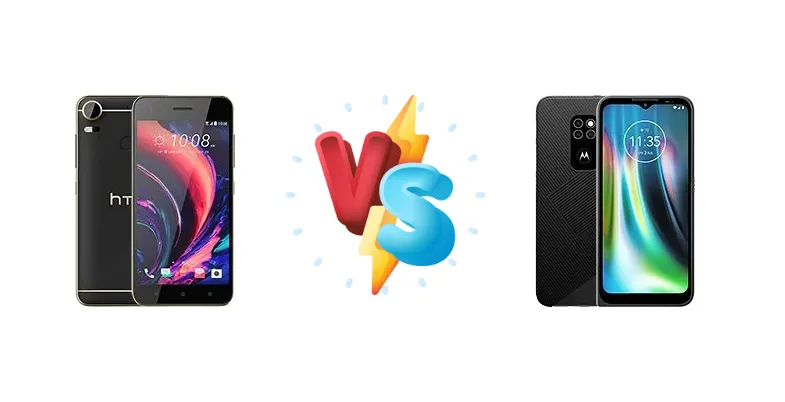
The smartphone market offers choices at every price point, but finding the right balance between durability, performance, and cost can be challenging. We pit the rugged Motorola Defy (2021) against the budget-focused HTC Desire 10 Pro, examining their key specifications to determine which device delivers the best value for different user needs.
🏆 Quick Verdict
For most users, the Motorola Defy (2021) is the superior choice. Its more modern Snapdragon 662 chipset, coupled with faster 20W charging, provides a smoother experience and quicker power-ups. While the Desire 10 Pro offers a lower entry price, its older Helio P10 struggles to keep pace.
| Network |
|---|
| 2G bands | GSM 850 / 900 / 1800 / 1900 - SIM 1 & SIM 2 | GSM 850 / 900 / 1800 / 1900 |
| 3G bands | HSDPA 850 / 900 / 1900 / 2100 | HSDPA 850 / 900 / 1700(AWS) / 1900 / 2100 - LATAM |
| 4G bands | 1, 3, 5, 7, 8, 20, 28, 38, 40 | 1, 2, 3, 5, 7, 8, 18, 19, 20, 26, 28, 38, 40, 41 - EMEA |
| Speed | HSPA 42.2/5.76 Mbps, LTE (2CA) Cat6 300/50 Mbps | HSPA 42.2/5.76 Mbps, LTE Cat4 150/50 Mbps |
| Technology | GSM / HSPA / LTE | GSM / HSPA / LTE |
| | - | 1, 2, 3, 4, 5, 7, 8, 19, 28, 66 - LATAM |
| Launch |
|---|
| Announced | 2016, September 20. Released 2016, December 20 | 2021, June 17 |
| Status | Discontinued | Available. Released 2021, July 25 |
| Body |
|---|
| Build | Glass front (Gorilla Glass), aluminum back, aluminum frame | Glass front (Gorilla Glass Victus), plastic frame, plastic back |
| Dimensions | 156.5 x 76 x 7.9 mm (6.16 x 2.99 x 0.31 in) | 169.8 x 78.2 x 10.9 mm (6.69 x 3.08 x 0.43 in) |
| SIM | Nano-SIM + Nano-SIM | · Nano-SIM· Nano-SIM + Nano-SIM |
| Weight | 165 g (5.82 oz) | 232 g (8.18 oz) |
| | - | IP68 dust/water resistant (up to 1.5m for 35 min)
Drop-to-concrete resistance from up to 1.8m
MIL-SPEC 810H compliant |
| Display |
|---|
| Protection | Corning Gorilla Glass (unspecified version) | Corning Gorilla Glass Victus |
| Resolution | 1080 x 1920 pixels, 16:9 ratio (~400 ppi density) | 720 x 1600 pixels, 20:9 ratio (~270 ppi density) |
| Size | 5.5 inches, 83.8 cm2 (~70.5% screen-to-body ratio) | 6.5 inches, 102.0 cm2 (~76.8% screen-to-body ratio) |
| Type | IPS LCD | IPS LCD |
| Platform |
|---|
| CPU | Octa-core (4x1.8 GHz Cortex-A53 & 4x1.0 GHz Cortex-A53) | Octa-core (4x2.0 GHz Kryo 260 Gold & 4x1.8 GHz Kryo 260 Silver) |
| Chipset | Mediatek MT6755 Helio P10 (28 nm) | Qualcomm SM6115 Snapdragon 662 (11 nm) |
| GPU | Mali-T860MP2 | Adreno 610 |
| OS | Android 6.0 (Marshmallow) | Android 10 |
| Memory |
|---|
| Card slot | microSDXC (uses shared SIM slot) | microSDXC (uses shared SIM slot) |
| Internal | 64GB 4GB RAM | 64GB 4GB RAM |
| | eMMC 5.1 | - |
| Main Camera |
|---|
| Features | Laser AF, Dual-LED dual-tone flash, panorama | LED flash, HDR, panorama |
| Single | 20 MP, f/2.2, 28mm (wide) | - |
| Triple | - | 48 MP, f/1.8, (wide), PDAF
2 MP (macro)
Auxiliary lens |
| Video | 1080p@30fps | 1080p@30fps |
| Selfie camera |
|---|
| Features | HDR | - |
| Single | 13 MP, f/2.2, 28mm (wide), 1/3.1", 1.12µm | 8 MP, f/2.2, 1.12µm |
| Video | 1080p@30fps | 1080p@30fps |
| Sound |
|---|
| 3.5mm jack | Yes | Yes |
| 35mm jack | Yes | Yes |
| Loudspeaker | Yes, dual mono speakers | Yes |
| Comms |
|---|
| Bluetooth | 4.2, A2DP, LE | 5.0, A2DP, LE |
| NFC | Yes | Yes |
| Positioning | GPS, GLONASS | GPS |
| Radio | FM radio | FM radio |
| USB | microUSB 2.0 | USB Type-C 2.0 |
| WLAN | Wi-Fi 802.11 a/b/g/n, dual-band, Wi-Fi Direct | Wi-Fi 802.11 a/b/g/n/ac, dual-band, Wi-Fi Direct |
| Features |
|---|
| Sensors | Fingerprint (rear-mounted), accelerometer, gyro, proximity, compass | Fingerprint (rear-mounted), accelerometer, gyro, proximity, compass |
| Battery |
|---|
| Charging | 10W wired | 20W wired |
| Music play | Up to 53 h | - |
| Stand-by | Up to 480 h (3G) | - |
| Talk time | Up to 19 h (3G) | - |
| Type | Li-Ion 3000 mAh, non-removable | Li-Po 5000 mAh |
| Misc |
|---|
| Colors | Stone Black, Polar White, Royal Blue, Valentine Lux, Mint Green | Black, Green |
| Models | Desire 10 pro, D10i | XT2083-9 |
| Price | About 260 EUR | About 280 EUR |
| Tests |
|---|
| Battery life | - |
Endurance rating 129h
|
| Camera | - |
Photo / Video |
| Display | - |
Contrast ratio: 1896:1 (nominal) |
| Loudspeaker | - |
-29.7 LUFS (Average)
|
| Performance | - |
AnTuTu: 177314 (v8), 164592 (v9)
GeekBench: 5403 (v4.4), 1511 (v5.1)
GFXBench: 13fps (ES 3.1 onscreen) |
HTC Desire 10 Pro
- Lower initial cost
- Acceptable battery endurance
- Functional for basic smartphone tasks
- Outdated Helio P10 chipset
- Slow 10W charging
- Likely inferior camera performance
Motorola Defy (2021)
- More powerful Snapdragon 662 chipset
- Faster 20W charging
- Ruggedized design for durability
- Higher price point
- Similar battery endurance rating to the Desire 10 Pro
- May not be significantly better in camera performance
Display Comparison
Both devices feature a contrast ratio of 1896:1, suggesting similar panel characteristics in terms of black levels. However, the Motorola Defy (2021) boasts a measured peak brightness of 436 nits, significantly brighter than what we'd expect from the Desire 10 Pro, making it more usable outdoors. While neither phone is likely to feature high refresh rate technology, the Defy’s higher brightness is a clear advantage for visibility.
Camera Comparison
Both phones offer 'Photo / Video' capabilities, but lack detailed camera specifications in the provided data. Given the market positioning, it’s reasonable to assume the Motorola Defy (2021) benefits from Qualcomm’s image signal processing (ISP), potentially delivering better image quality and video stabilization. The Desire 10 Pro, being an older model, likely relies on less sophisticated image processing algorithms. Without sensor size or aperture information, a definitive camera comparison is impossible, but the Defy’s newer chipset provides a likely advantage.
Performance
The Motorola Defy (2021) utilizes the Qualcomm Snapdragon 662 (11nm), a significantly more efficient and powerful chipset than the HTC Desire 10 Pro’s MediaTek MT6755 Helio P10 (28nm). The Snapdragon 662’s Kryo 260 cores, with a peak clock speed of 2.0 GHz, outperform the Helio P10’s Cortex-A53 cores (1.8 GHz and 1.0 GHz). The 11nm process node of the Snapdragon 662 also translates to better thermal management and improved battery efficiency, reducing the likelihood of performance throttling during sustained use. This means smoother multitasking and a more responsive gaming experience on the Defy.
Battery Life
Both devices share an endurance rating of 129 hours, suggesting comparable battery life under similar usage conditions. However, the Motorola Defy (2021) features 20W wired charging, a substantial improvement over the HTC Desire 10 Pro’s 10W charging. This faster charging speed significantly reduces the time required to replenish the battery, offering a more convenient user experience. While the battery capacity isn't specified, the Snapdragon 662’s efficiency likely contributes to similar real-world battery performance despite the charging disparity.
Buying Guide
Buy the HTC Desire 10 Pro if you prioritize absolute lowest cost and are willing to compromise on performance and charging speed. It's suitable for basic tasks like calls, texts, and light social media. Buy the Motorola Defy (2021) if you need a phone that can withstand drops, dust, and water, and you value a more responsive user experience and faster charging, even if it means spending a bit more.
Frequently Asked Questions
❓ Is the Motorola Defy (2021) truly waterproof, or just water-resistant?
The Motorola Defy (2021) is IP68 rated, meaning it's dust-tight and can withstand immersion in up to 1.5 meters of freshwater for up to 30 minutes. However, it's important to note that water resistance degrades over time, and the warranty typically doesn't cover water damage. It's designed for accidental splashes and brief submersion, not prolonged exposure.
❓ Will the HTC Desire 10 Pro struggle with modern apps and multitasking?
Yes, the HTC Desire 10 Pro’s MediaTek Helio P10 chipset is several years old and will likely struggle with demanding apps and heavy multitasking. While it can handle basic tasks like calls, texts, and social media, you may experience lag and slowdowns when running multiple apps simultaneously or using resource-intensive applications.
❓ How does the Snapdragon 662 in the Motorola Defy (2021) perform in gaming?
The Snapdragon 662 is capable of handling many popular mobile games at medium settings. While it won't deliver flagship-level gaming performance, it provides a playable experience for titles like PUBG Mobile and Call of Duty Mobile. Expect some frame rate drops in graphically intensive scenes, but overall, it's a significant improvement over the Helio P10.