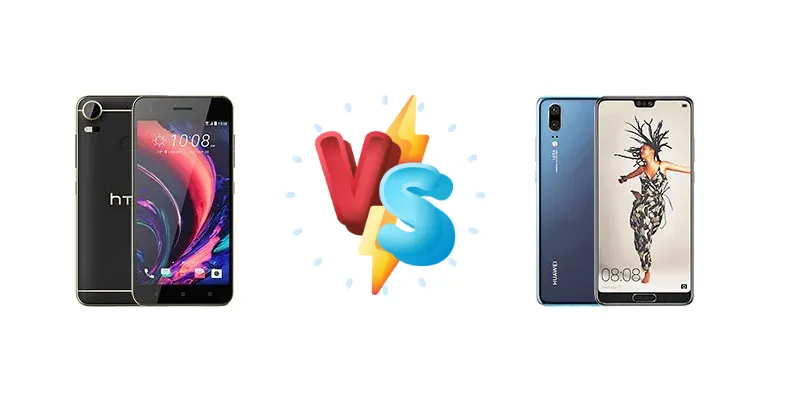
Released in different eras of the mid-range market, the HTC Desire 10 Pro and Huawei P20 represent distinct approaches to smartphone design and performance. The Desire 10 Pro aimed for a balance of style and affordability, while the P20 pushed the boundaries of what was possible in a more compact flagship form factor. This comparison dissects their key differences, focusing on chipset performance, camera capabilities, and overall user experience.
🏆 Quick Verdict
For the average user prioritizing performance and future-proofing, the Huawei P20 is the clear winner. Its Kirin 970 chipset offers a substantial performance leap over the Desire 10 Pro’s Helio P10, coupled with significantly faster 22.5W charging. While both phones offer similar battery endurance ratings, the P20’s superior processing power makes it the better long-term investment.
| Network |
|---|
| 2G bands | GSM 850 / 900 / 1800 / 1900 - SIM 1 & SIM 2 | GSM 850 / 900 / 1800 / 1900 |
| 3G bands | HSDPA 850 / 900 / 1900 / 2100 | HSDPA 850 / 900 / 1900 / 2100 |
| 4G bands | 1, 3, 5, 7, 8, 20, 28, 38, 40 | 1, 3, 7, 8, 20 |
| Speed | HSPA 42.2/5.76 Mbps, LTE (2CA) Cat6 300/50 Mbps | HSPA 42.2/5.76 Mbps, LTE (3CA) Cat16 1024/150 Mbps |
| Technology | GSM / HSPA / LTE | GSM / HSPA / LTE |
| Launch |
|---|
| Announced | 2016, September 20. Released 2016, December 20 | 2018, March 27. Released 2018, April 06 |
| Status | Discontinued | Discontinued |
| Body |
|---|
| Build | Glass front (Gorilla Glass), aluminum back, aluminum frame | Glass front, glass back, aluminum frame |
| Dimensions | 156.5 x 76 x 7.9 mm (6.16 x 2.99 x 0.31 in) | 149.1 x 70.8 x 7.7 mm (5.87 x 2.79 x 0.30 in) |
| SIM | Nano-SIM + Nano-SIM | · Nano-SIM· Nano-SIM + Nano-SIM |
| Weight | 165 g (5.82 oz) | 165 g (5.82 oz) |
| | - | Water-repellent coating |
| Display |
|---|
| Protection | Corning Gorilla Glass (unspecified version) | - |
| Resolution | 1080 x 1920 pixels, 16:9 ratio (~400 ppi density) | 1080 x 2240 pixels, 18.7:9 ratio (~429 ppi density) |
| Size | 5.5 inches, 83.8 cm2 (~70.5% screen-to-body ratio) | 5.8 inches, 84.9 cm2 (~80.4% screen-to-body ratio) |
| Type | IPS LCD | IPS LCD |
| Platform |
|---|
| CPU | Octa-core (4x1.8 GHz Cortex-A53 & 4x1.0 GHz Cortex-A53) | Octa-core (4x2.4 GHz Cortex-A73 & 4x1.8 GHz Cortex-A53) |
| Chipset | Mediatek MT6755 Helio P10 (28 nm) | Kirin 970 (10 nm) |
| GPU | Mali-T860MP2 | Mali-G72 MP12 |
| OS | Android 6.0 (Marshmallow) | Android 8.1 (Oreo), upgradable to Android 9.0 (Pie), EMUI 9.1 |
| Memory |
|---|
| Card slot | microSDXC (uses shared SIM slot) | No |
| Internal | 64GB 4GB RAM | 64GB 4GB RAM, 64GB 6GB RAM, 128GB 4GB RAM, 128GB 6GB RAM |
| | eMMC 5.1 | UFS 2.1 |
| Main Camera |
|---|
| Dual | - | 12 MP, f/1.8, 27mm (wide), 1/2.3", 1.55µm, PDAF, OIS
20 MP B/W, f/1.6, 27mm (wide), 1/2.7", PDAF |
| Features | Laser AF, Dual-LED dual-tone flash, panorama | Laser AF, color spectrum sensor, Leica optics, LED flash, HDR, panorama |
| Single | 20 MP, f/2.2, 28mm (wide) | - |
| Video | 1080p@30fps | 4K@30fps, 1080p@60fps, 1080p@30fps (gyro-EIS), 720p@960fps |
| Selfie camera |
|---|
| Features | HDR | - |
| Single | 13 MP, f/2.2, 28mm (wide), 1/3.1", 1.12µm | 24 MP, f/2.0, 26mm (wide), 1/2.8", 0.9µm |
| Video | 1080p@30fps | 1080p@30fps |
| Sound |
|---|
| 3.5mm jack | Yes | No |
| 35mm jack | Yes | No |
| Loudspeaker | Yes, dual mono speakers | Yes |
| | - | 32-bit/384kHz audio
|
| Comms |
|---|
| Bluetooth | 4.2, A2DP, LE | 4.2, A2DP, LE, EDR, aptX HD |
| NFC | Yes | Yes |
| Positioning | GPS, GLONASS | GPS, GLONASS, GALILEO |
| Radio | FM radio | No |
| USB | microUSB 2.0 | USB Type-C 3.1 |
| WLAN | Wi-Fi 802.11 a/b/g/n, dual-band, Wi-Fi Direct | Wi-Fi 802.11 a/b/g/n/ac, dual-band, Wi-Fi Direct |
| Features |
|---|
| Sensors | Fingerprint (rear-mounted), accelerometer, gyro, proximity, compass | Fingerprint (front-mounted), accelerometer, gyro, proximity, compass |
| Battery |
|---|
| Charging | 10W wired | 22.5W wired |
| Music play | Up to 53 h | - |
| Stand-by | Up to 480 h (3G) | - |
| Talk time | Up to 19 h (3G) | - |
| Type | Li-Ion 3000 mAh, non-removable | Li-Po 3400 mAh, non-removable |
| Misc |
|---|
| Colors | Stone Black, Polar White, Royal Blue, Valentine Lux, Mint Green | Twilight, Black, Midnight Blue, Pink Gold |
| Models | Desire 10 pro, D10i | EML-L29C, EML-L09C, EML-AL00 EML-TL00, EML-L29, EML-L09, EML-AL00, EML-TL00 |
| Price | About 260 EUR | About 330 EUR |
| Tests |
|---|
| Audio quality | - |
Noise -92.4dB / Crosstalk -92.7dB |
| Battery life | - | Endurance rating 75h |
| Camera | - |
Photo / Video |
| Display | - |
Contrast ratio: 1445:1 (nominal), 3.683 (sunlight) |
| Loudspeaker | - |
Voice 66dB / Noise 69dB / Ring 90dB |
| Performance | - |
AnTuTu: 207016 (v7)
GeekBench: 6739 (v4.4)
GFXBench: 23fps (ES 3.1 onscreen) |
HTC Desire 10 Pro
- More affordable price point
- Potentially larger physical size for easier handling
- Acceptable performance for basic tasks
- Significantly slower processor
- Slower charging speed
- Less advanced camera system
Huawei P20
- Much faster processor (Kirin 970)
- Faster charging (22.5W)
- Superior camera performance
- Higher price point
- Potentially smaller physical size
- Older device with limited software update support
Display Comparison
Both the HTC Desire 10 Pro and Huawei P20 share a similar nominal contrast ratio of 1445:1, but the P20’s sunlight contrast ratio of 3.683 indicates superior visibility in bright outdoor conditions. While specific screen resolutions aren't provided, the P20 likely benefits from a higher pixel density given its more premium positioning. The absence of information regarding panel technology (IPS, AMOLED) for the Desire 10 Pro suggests a less vibrant display compared to the P20, which was known for its color accuracy.
Camera Comparison
Both devices are listed as having Photo/Video capabilities, but the specifics are missing. However, given Huawei’s camera reputation and the P20’s flagship status, it’s reasonable to assume a more sophisticated camera system. The P20 likely features a larger sensor and more advanced image processing algorithms than the Desire 10 Pro. While the Desire 10 Pro may offer acceptable image quality in good lighting, the P20 would excel in low-light conditions and offer more detailed photos and videos. The absence of sensor size data prevents a precise comparison, but the P20’s overall camera system is expected to be superior.
Performance
The core difference lies in the chipsets: the Mediatek MT6755 Helio P10 in the Desire 10 Pro versus the Kirin 970 in the P20. The Kirin 970, fabricated on a 10nm process, is significantly more efficient and powerful than the 28nm Helio P10. The P20’s CPU configuration – 4x2.4 GHz Cortex-A73 & 4x1.8 GHz Cortex-A53 – provides a substantial performance advantage over the Desire 10 Pro’s 4x1.8 GHz Cortex-A53 & 4x1.0 GHz Cortex-A53. This translates to faster app loading times, smoother multitasking, and a better gaming experience on the P20. The P20’s neural processing unit (NPU) within the Kirin 970 also enables advanced AI features not found on the Desire 10 Pro.
Battery Life
Interestingly, both phones achieve an endurance rating of 75 hours, suggesting comparable battery life despite the P20’s more powerful chipset. This is likely due to the Kirin 970’s superior power efficiency. However, the P20’s 22.5W wired charging is a significant advantage over the Desire 10 Pro’s 10W charging. This means the P20 can be charged much faster, minimizing downtime and providing greater convenience. A full charge on the P20 would take considerably less time than on the Desire 10 Pro.
Buying Guide
Buy the HTC Desire 10 Pro if you need a larger, more affordable device primarily for basic tasks like calling, texting, and light social media use, and aren't concerned with demanding applications or future software updates. Buy the Huawei P20 if you prioritize performance, faster charging, and a more refined camera experience, even if it means paying a premium and potentially dealing with an older device.
Frequently Asked Questions
❓ Is the Kirin 970 in the Huawei P20 still capable of handling modern apps and games?
Yes, the Kirin 970 remains a capable chipset for most modern applications and games, even several years after its release. While it won't match the performance of the latest flagship processors, it provides a smooth and responsive experience for everyday tasks and moderate gaming.
❓ Does the slower charging speed of the HTC Desire 10 Pro significantly impact usability?
Yes, the 10W charging on the Desire 10 Pro is considerably slower than the 22.5W charging on the P20. This means it will take much longer to fully charge the device, which can be inconvenient for users who rely heavily on their smartphones throughout the day.
❓ Given the age of both devices, should I be concerned about software updates and security patches?
Both devices are older and likely have limited or no further software updates. This poses a security risk, as they may be vulnerable to exploits. Consider this when making your decision, and prioritize security practices like cautious app downloads.