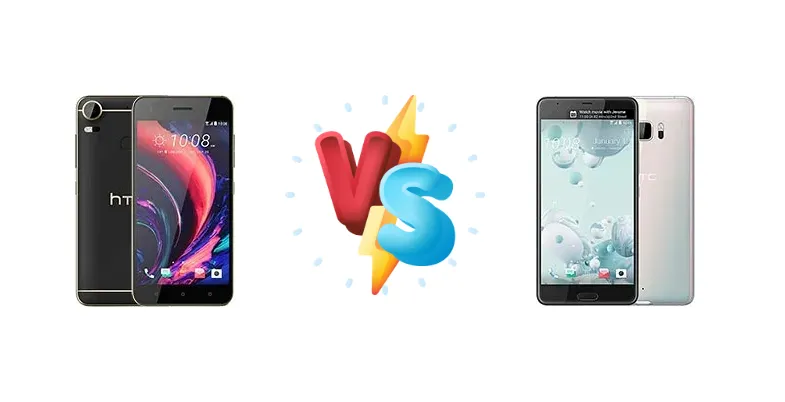
Released in different eras and targeting distinct price points, the HTC U Ultra and Desire 10 Pro represent contrasting approaches to the smartphone market. The U Ultra aimed for a premium experience with flagship specs, while the Desire 10 Pro focused on delivering a solid feature set at a more accessible price. This comparison dissects their key differences to help you determine which device best suits your needs.
🏆 Quick Verdict
For most users, the HTC U Ultra is the superior choice. Its Snapdragon 821 chipset provides significantly faster performance and smoother multitasking compared to the Desire 10 Pro’s Helio P10. While both phones offer similar battery endurance ratings, the U Ultra’s faster 18W Quick Charge 3.0 support offers a tangible convenience advantage.
| Network |
|---|
| 2G bands | GSM 850 / 900 / 1800 / 1900 - SIM 1 & SIM 2 | GSM 850 / 900 / 1800 / 1900 - SIM 1 & SIM 2 |
| 3G bands | HSDPA 850 / 900 / 1900 / 2100 | HSDPA 850 / 900 / 1700(AWS) / 1900 / 2100 |
| 4G bands | 1, 3, 5, 7, 8, 20, 28, 38, 40 | 1, 2, 3, 4, 5, 7, 8, 12, 17, 20, 28, 38, 39, 40, 41 |
| Speed | HSPA 42.2/5.76 Mbps, LTE (2CA) Cat6 300/50 Mbps | HSPA 42.2/5.76 Mbps, LTE (3CA) Cat11 600/50 Mbps |
| Technology | GSM / HSPA / LTE | GSM / HSPA / LTE |
| Launch |
|---|
| Announced | 2016, September 20. Released 2016, December 20 | 2017, January 12. Released 2017, February 21 |
| Status | Discontinued | Discontinued |
| Body |
|---|
| Build | Glass front (Gorilla Glass), aluminum back, aluminum frame | Glass front (Gorilla Glass 5 or Sapphire crystal), glass back, aluminum frame |
| Dimensions | 156.5 x 76 x 7.9 mm (6.16 x 2.99 x 0.31 in) | 162.4 x 79.8 x 8 mm (6.39 x 3.14 x 0.31 in) |
| SIM | Nano-SIM + Nano-SIM | Nano-SIM + Nano-SIM |
| Weight | 165 g (5.82 oz) | 170 g (6.00 oz) |
| Display |
|---|
| Protection | Corning Gorilla Glass (unspecified version) | Corning Gorilla Glass 5 (64 GB version)Sapphire crystal glass (128 GB version) |
| Resolution | 1080 x 1920 pixels, 16:9 ratio (~400 ppi density) | 1440 x 2560 pixels, 16:9 ratio (~513 ppi density) |
| Size | 5.5 inches, 83.8 cm2 (~70.5% screen-to-body ratio) | 5.7 inches, 90.3 cm2 (~69.7% screen-to-body ratio) |
| Type | IPS LCD | Super LCD5 |
| | - | Secondary display, 160 x 1040 pixels, 2 inches |
| Platform |
|---|
| CPU | Octa-core (4x1.8 GHz Cortex-A53 & 4x1.0 GHz Cortex-A53) | Quad-core (2x2.15 GHz Kryo & 2x1.6 GHz Kryo) |
| Chipset | Mediatek MT6755 Helio P10 (28 nm) | Qualcomm MSM8996 Snapdragon 821 (14 nm) |
| GPU | Mali-T860MP2 | Adreno 530 |
| OS | Android 6.0 (Marshmallow) | Android 7.0 (Nougat), upgradable to Android 8.0 (Oreo) |
| Memory |
|---|
| Card slot | microSDXC (uses shared SIM slot) | microSDXC (uses shared SIM slot) |
| Internal | 64GB 4GB RAM | 64GB 4GB RAM, 128GB 4GB RAM |
| | eMMC 5.1 | - |
| Main Camera |
|---|
| Features | Laser AF, Dual-LED dual-tone flash, panorama | Laser AF, Dual-LED dual-tone flash, panorama |
| Single | 20 MP, f/2.2, 28mm (wide) | 12 MP, f/1.8, 26mm (wide), 1/2.3", 1.55µm, PDAF, OIS |
| Video | 1080p@30fps | 4K@30fps (24-bit/192kHz audio), 720p@120fps |
| Selfie camera |
|---|
| Features | HDR | HDR |
| Single | 13 MP, f/2.2, 28mm (wide), 1/3.1", 1.12µm | 16 MP, f/2.0, 27mm (wide), 1/3.06", 1.0µm |
| Video | 1080p@30fps | 1080p@30fps |
| Sound |
|---|
| 3.5mm jack | Yes | No |
| 35mm jack | Yes | No |
| Loudspeaker | Yes, dual mono speakers | Yes |
| | - | 24-bit/192kHz audio
|
| Comms |
|---|
| Bluetooth | 4.2, A2DP, LE | 4.2, A2DP, LE |
| NFC | Yes | Yes |
| Positioning | GPS, GLONASS | GPS, GLONASS, BDS |
| Radio | FM radio | No |
| USB | microUSB 2.0 | USB Type-C 3.1 |
| WLAN | Wi-Fi 802.11 a/b/g/n, dual-band, Wi-Fi Direct | Wi-Fi 802.11 a/b/g/n/ac, dual-band, Wi-Fi Direct, DLNA |
| Features |
|---|
| Sensors | Fingerprint (rear-mounted), accelerometer, gyro, proximity, compass | Fingerprint (front-mounted), accelerometer, gyro, proximity, compass |
| Battery |
|---|
| Charging | 10W wired | 18W wired, QC3 |
| Music play | Up to 53 h | - |
| Stand-by | Up to 480 h (3G) | Up to 312 h (3G) |
| Talk time | Up to 19 h (3G) | Up to 26 h (3G) |
| Type | Li-Ion 3000 mAh, non-removable | Li-Ion 3000 mAh, non-removable |
| Misc |
|---|
| Colors | Stone Black, Polar White, Royal Blue, Valentine Lux, Mint Green | Brilliant Black, Cosmetic Pink, Ice White, Sapphire Blue |
| Models | Desire 10 pro, D10i | U Ultra, U-1u, 2PZF1 |
| Price | About 260 EUR | About 250 EUR |
| Tests |
|---|
| Battery life | - | Endurance rating 81h |
| Camera | - |
Photo / Video |
| Display | - |
Contrast ratio: 1831 (nominal), 3.453 (sunlight) |
| Loudspeaker | - |
Voice 61dB / Noise 73dB / Ring 86dB |
| Performance | - |
GFXBench: 10fps (ES 3.1 onscreen) |
HTC Desire 10 Pro
- More affordable price point
- Decent battery endurance
- Functional for basic smartphone tasks
- Significantly slower processor
- Less refined camera system
- Slower charging speeds
HTC U Ultra
- Flagship-level performance with Snapdragon 821
- Faster 18W Quick Charge 3.0 charging
- Likely superior camera system
- Higher price point
- Potentially shorter software support lifespan (given age)
- May exhibit some throttling under sustained load
Display Comparison
Both the HTC U Ultra and Desire 10 Pro share a contrast ratio of 1831 (nominal) and 3.453 (sunlight), suggesting similar outdoor visibility. However, the context data lacks specifics on panel type, resolution, or refresh rate. Given the U Ultra’s flagship positioning, it likely features a higher resolution display, contributing to sharper visuals. The Desire 10 Pro, being a mid-range device, likely utilizes a 1080p panel. The U Ultra’s premium build quality likely extends to a more robust display glass, offering better scratch resistance.
Camera Comparison
Both devices are listed as having 'Photo / Video' capabilities, but detailed camera specifications are absent. Considering the U Ultra’s flagship status, it likely features a more advanced camera system with a larger sensor, wider aperture, and optical image stabilization (OIS). These features would result in better low-light performance and sharper images. The Desire 10 Pro’s camera, while adequate for everyday snapshots, likely lacks the sophistication of the U Ultra’s system. Without further details, it’s difficult to assess the video recording capabilities of either device.
Performance
The performance gap between these two devices is substantial. The HTC U Ultra’s Qualcomm MSM8996 Snapdragon 821 (14nm) is a flagship-class processor with a quad-core Kryo architecture, offering significantly more processing power than the Desire 10 Pro’s Mediatek MT6755 Helio P10 (28nm). The Snapdragon 821’s smaller 14nm process node also translates to better thermal efficiency, reducing the likelihood of performance throttling during sustained workloads. The Helio P10’s octa-core configuration, while appearing impressive, relies on less powerful Cortex-A53 cores, resulting in slower single-core and multi-core performance. This difference is particularly noticeable in demanding tasks like gaming and video editing.
Battery Life
Interestingly, both the HTC U Ultra and Desire 10 Pro achieve an endurance rating of 81 hours. This suggests similar battery life despite the U Ultra’s more powerful processor. However, the U Ultra boasts 18W wired charging with Quick Charge 3.0 support, significantly faster than the Desire 10 Pro’s 10W charging. This means the U Ultra can be charged from 0-100% much quicker, offering a more convenient user experience. The U Ultra’s power efficiency gains from the 14nm Snapdragon 821 likely offset the increased power draw, contributing to the comparable endurance rating.
Buying Guide
Buy the HTC Desire 10 Pro if you prioritize affordability and a functional smartphone experience without demanding high-end performance. It’s a suitable option for basic tasks like calling, texting, and light social media use. Buy the HTC U Ultra if you value speed, responsiveness, and a more refined user experience. Its superior processor makes it ideal for gaming, demanding apps, and users who want a phone that can keep up with their fast-paced lifestyle.
Frequently Asked Questions
❓ Is the Mediatek Helio P10 in the Desire 10 Pro capable of running modern mobile games?
While the Helio P10 can run many mobile games, it will likely struggle with graphically demanding titles at higher settings. Expect lower frame rates and potential stuttering, especially in games like PUBG or Genshin Impact. The U Ultra’s Snapdragon 821 provides a much smoother gaming experience.
❓ Given both phones have an 81h endurance rating, why would I choose the U Ultra?
The endurance rating measures how long the battery lasts on a single charge under typical usage. However, the U Ultra’s 18W Quick Charge 3.0 support significantly reduces charging times. This means you can quickly top up the battery when needed, minimizing downtime, a convenience the Desire 10 Pro lacks with its slower 10W charging.
❓ Does the HTC U Ultra support software updates anymore?
As these are older devices, official software updates are unlikely. However, the Snapdragon 821 is still capable of running custom ROMs, offering a potential path to newer Android versions and security patches for advanced users.