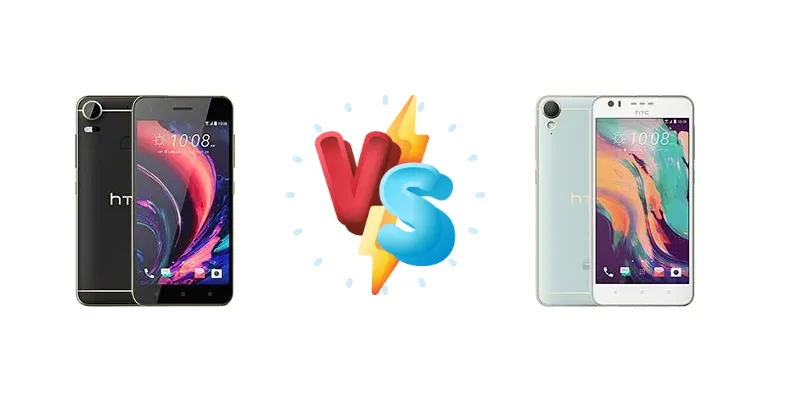
The HTC Desire 10 Pro and Desire 10 Lifestyle represent HTC's attempt to capture different segments of the budget smartphone market. While both share a similar aesthetic, significant internal differences, particularly in their chipsets, dictate their performance and suitability for various users. This comparison dives deep into those differences to help you choose the right device.
🏆 Quick Verdict
For most users, the HTC Desire 10 Pro is the superior choice. Its Mediatek Helio P10 chipset delivers significantly better performance than the Snapdragon 400 in the Lifestyle, making it more capable for multitasking, gaming, and demanding applications. While the Lifestyle may offer slightly better battery life due to its less powerful processor, the Pro's performance advantage outweighs this benefit.
| Network |
|---|
| 2G bands | GSM 850 / 900 / 1800 / 1900 - SIM 1 & SIM 2 | GSM 850 / 900 / 1800 / 1900 - SIM 1 & SIM 2 |
| 3G bands | HSDPA 850 / 900 / 1900 / 2100 | HSDPA 850 / 900 / 1900 / 2100 |
| 4G bands | 1, 3, 5, 7, 8, 20, 28, 38, 40 | 1, 3, 5, 7, 8, 20, 28, 40 |
| Speed | HSPA 42.2/5.76 Mbps, LTE (2CA) Cat6 300/50 Mbps | HSPA 42.2/5.76 Mbps, LTE Cat4 150/50 Mbps |
| Technology | GSM / HSPA / LTE | GSM / HSPA / LTE |
| Launch |
|---|
| Announced | 2016, September 20. Released 2016, December 20 | 2016, September. Released 2016, September |
| Status | Discontinued | Discontinued |
| Body |
|---|
| Build | Glass front (Gorilla Glass), aluminum back, aluminum frame | - |
| Dimensions | 156.5 x 76 x 7.9 mm (6.16 x 2.99 x 0.31 in) | 156.9 x 76.9 x 7.7 mm (6.18 x 3.03 x 0.30 in) |
| SIM | Nano-SIM + Nano-SIM | Nano-SIM + Nano-SIM |
| Weight | 165 g (5.82 oz) | 155 g (5.47 oz) |
| Display |
|---|
| Protection | Corning Gorilla Glass (unspecified version) | Corning Gorilla Glass (unspecified version) |
| Resolution | 1080 x 1920 pixels, 16:9 ratio (~400 ppi density) | 720 x 1280 pixels, 16:9 ratio (~267 ppi density) |
| Size | 5.5 inches, 83.8 cm2 (~70.5% screen-to-body ratio) | 5.5 inches, 83.4 cm2 (~69.1% screen-to-body ratio) |
| Type | IPS LCD | IPS LCD |
| Platform |
|---|
| CPU | Octa-core (4x1.8 GHz Cortex-A53 & 4x1.0 GHz Cortex-A53) | Quad-core 1.4 GHz Cortex-A7 |
| Chipset | Mediatek MT6755 Helio P10 (28 nm) | Qualcomm MSM8928 Snapdragon 400 (28 nm) |
| GPU | Mali-T860MP2 | Adreno 305 |
| OS | Android 6.0 (Marshmallow) | Android 6.0 (Marshmallow) |
| Memory |
|---|
| Card slot | microSDXC (uses shared SIM slot) | microSDXC (dedicated slot) |
| Internal | 64GB 4GB RAM | 32GB 3GB RAM |
| | eMMC 5.1 | eMMC 4.5 |
| Main Camera |
|---|
| Features | Laser AF, Dual-LED dual-tone flash, panorama | LED flash, HDR, panorama |
| Single | 20 MP, f/2.2, 28mm (wide) | 13 MP, f/2.2, 28mm (wide), AF |
| Video | 1080p@30fps | 1080p@30fps |
| Selfie camera |
|---|
| Features | HDR | HDR |
| Single | 13 MP, f/2.2, 28mm (wide), 1/3.1", 1.12µm | 5 MP, f/2.8, 34mm (standard) |
| Video | 1080p@30fps | 1080p@30fps |
| Sound |
|---|
| 3.5mm jack | Yes | Yes |
| 35mm jack | Yes | Yes |
| Loudspeaker | Yes, dual mono speakers | Yes, with stereo speakers |
| | - | 24-bit/192kHz audio |
| Comms |
|---|
| Bluetooth | 4.2, A2DP, LE | 4.1, A2DP, LE |
| NFC | Yes | No |
| Positioning | GPS, GLONASS | GPS, GLONASS |
| Radio | FM radio | FM radio |
| USB | microUSB 2.0 | microUSB 2.0 |
| WLAN | Wi-Fi 802.11 a/b/g/n, dual-band, Wi-Fi Direct | Wi-Fi 802.11 b/g/n |
| Features |
|---|
| Sensors | Fingerprint (rear-mounted), accelerometer, gyro, proximity, compass | Accelerometer, proximity, compass |
| Battery |
|---|
| Charging | 10W wired | - |
| Music play | Up to 53 h | - |
| Stand-by | Up to 480 h (3G) | Up to 672 h (3G) |
| Talk time | Up to 19 h (3G) | Up to 24 h (3G) |
| Type | Li-Ion 3000 mAh, non-removable | Li-Ion 2700 mAh, non-removable |
| Misc |
|---|
| Colors | Stone Black, Polar White, Royal Blue, Valentine Lux, Mint Green | Stone Black, Polar White, Royal Blue, Valentine Lux |
| Models | Desire 10 pro, D10i | Desire 10 lifestyle |
| Price | About 260 EUR | About 200 EUR |
HTC Desire 10 Pro
- Significantly faster processor for smoother performance
- Better multitasking capabilities
- More responsive camera experience
- Likely shorter battery life under heavy use
- Slower charging speeds (10W)
HTC Desire 10 Lifestyle
- Potentially longer battery life with light usage
- Lower price point (likely at launch)
- Sufficient for basic smartphone tasks
- Slow processor leads to lag and sluggish performance
- Poor multitasking capabilities
- Less responsive camera
Display Comparison
Unfortunately, detailed display specifications are unavailable. However, given the market positioning of both devices, it's reasonable to assume both utilize IPS LCD panels. The focus here is on internal performance, not display fidelity. Bezels were likely comparable, typical of phones in this price bracket at the time of release. Color accuracy is unlikely to be a strong point for either device.
Camera Comparison
Without detailed sensor information, a direct camera comparison is difficult. However, the processing power of the Helio P10 in the Desire 10 Pro likely allows for faster image processing and potentially better low-light performance. The Snapdragon 400 in the Lifestyle may struggle with complex image processing algorithms. It's safe to assume both phones feature similar basic camera features, but the Pro will deliver a more refined and responsive camera experience. Any 2MP auxiliary cameras on either device should be considered marketing filler rather than genuinely useful features.
Performance
The core difference lies in the chipsets. The Desire 10 Pro boasts a Mediatek MT6755 Helio P10, an octa-core processor with a Cortex-A53 arrangement split into 1.8 GHz and 1.0 GHz clusters. This architecture allows for efficient power management while still providing substantial processing power. In contrast, the Desire 10 Lifestyle uses the Qualcomm MSM8928 Snapdragon 400, a quad-core Cortex-A7 processor. The Snapdragon 400 is significantly less powerful, resulting in slower app loading times, less responsive multitasking, and a generally laggy user experience when compared to the Pro. The Helio P10's higher clock speeds and core count translate to a demonstrably smoother experience for demanding applications.
Battery Life
Battery capacity data is missing. However, the Snapdragon 400's lower power consumption in the Desire 10 Lifestyle likely results in slightly longer battery life under similar usage conditions. The Desire 10 Pro, with its more powerful Helio P10, will drain the battery faster during intensive tasks. Both devices support 10W wired charging, meaning charging times will be relatively slow compared to modern fast-charging standards. The Lifestyle's lower power draw may offset the slower charging to some extent, providing more usable time between charges.
Buying Guide
Buy the HTC Desire 10 Pro if you need a phone capable of handling more than basic tasks, enjoy occasional gaming, or value smoother multitasking. Its octa-core processor provides a noticeable performance boost. Buy the HTC Desire 10 Lifestyle if your primary needs are simple – calls, texts, and light social media – and you prioritize maximizing battery life over raw processing power. It's a suitable option for first-time smartphone users or those on a very tight budget.
Frequently Asked Questions
❓ Will the Desire 10 Pro handle modern mobile games like PUBG or Call of Duty?
While the Helio P10 can run these games, expect to play them on lower graphics settings to maintain a playable frame rate. The Snapdragon 400 in the Lifestyle will struggle significantly with these titles, likely resulting in a frustrating experience.
❓ Is the difference in performance between the two phones noticeable for everyday tasks like browsing and social media?
Yes, the difference is quite noticeable. The Desire 10 Pro will load web pages faster, switch between apps more smoothly, and generally feel more responsive during everyday use. The Lifestyle may exhibit noticeable lag when multitasking or opening multiple tabs in a browser.
❓ Does either phone support USB-C charging?
Based on the release timeframe and market segment, it's highly probable that both devices utilize Micro-USB for charging and data transfer, not USB-C.
❓ Which phone is better for taking quick photos of documents?
The Desire 10 Pro is likely better suited for this task. Its faster processor allows for quicker image capture and processing, resulting in clearer and more accurate document scans.