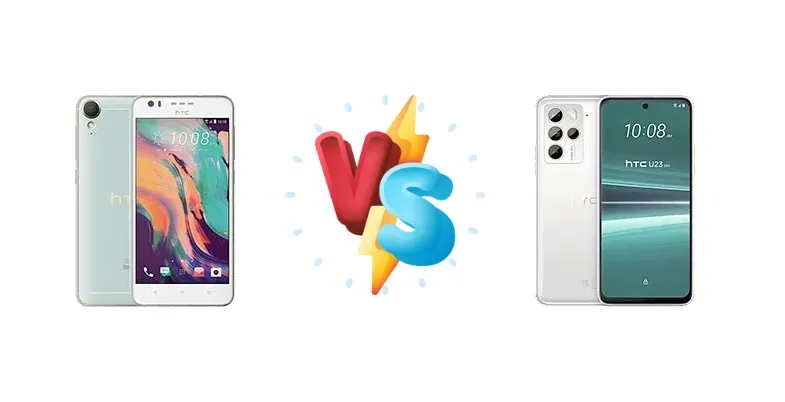
The HTC Desire 10 Lifestyle, released in 2016, represented a solid budget option in its time. Now, with the 2023 HTC U23 Pro, we're looking at a significant generational leap. This comparison isn't about direct competition; it's about understanding how far smartphone technology has advanced and whether the U23 Pro justifies consideration for users still relying on older devices.
🏆 Quick Verdict
For the vast majority of users, the HTC U23 Pro is the clear winner. Its Snapdragon 7 Gen 1 chipset delivers dramatically improved performance, a brighter and more modern display, and the convenience of fast wired and wireless charging. While the Desire 10 Lifestyle remains functional for basic tasks, the U23 Pro offers a vastly superior experience.
| Network |
|---|
| 2G bands | GSM 850 / 900 / 1800 / 1900 - SIM 1 & SIM 2 | GSM 850 / 900 / 1800 / 1900 |
| 3G bands | HSDPA 850 / 900 / 1900 / 2100 | HSDPA 850 / 900 / 1700(AWS) / 1900 / 2100 |
| 4G bands | 1, 3, 5, 7, 8, 20, 28, 40 | 1, 3, 5, 7, 8, 12, 17, 20, 28, 38, 39, 40, 41 |
| 5G bands | - | 1, 3, 7, 20, 28, 41, 78 SA/NSA |
| Speed | HSPA 42.2/5.76 Mbps, LTE Cat4 150/50 Mbps | HSPA, LTE, 5G |
| Technology | GSM / HSPA / LTE | GSM / HSPA / LTE / 5G |
| Launch |
|---|
| Announced | 2016, September. Released 2016, September | 2023, May 18 |
| Status | Discontinued | Available. Released 2023, May 18 |
| Body |
|---|
| Build | - | Glass front (Gorilla Glass Victus), plastic frame, plastic back |
| Dimensions | 156.9 x 76.9 x 7.7 mm (6.18 x 3.03 x 0.30 in) | 166.6 x 77.1 x 8.9 mm (6.56 x 3.04 x 0.35 in) |
| SIM | Nano-SIM + Nano-SIM | Nano-SIM + Nano-SIM |
| Weight | 155 g (5.47 oz) | 205 g (7.23 oz) |
| | - | IP67 dust/water resistant (up to 1m for 30 min) |
| Display |
|---|
| Protection | Corning Gorilla Glass (unspecified version) | Corning Gorilla Glass Victus |
| Resolution | 720 x 1280 pixels, 16:9 ratio (~267 ppi density) | 1080 x 2400 pixels, 20:9 ratio (~393 ppi density) |
| Size | 5.5 inches, 83.4 cm2 (~69.1% screen-to-body ratio) | 6.7 inches, 108.4 cm2 (~84.4% screen-to-body ratio) |
| Type | IPS LCD | OLED, 120Hz |
| Platform |
|---|
| CPU | Quad-core 1.4 GHz Cortex-A7 | Octa-core (1x2.4 GHz Cortex-A710 & 3x2.36 GHz Cortex-A710 & 4x1.8 GHz Cortex-A510) |
| Chipset | Qualcomm MSM8928 Snapdragon 400 (28 nm) | Qualcomm SM7450-AB Snapdragon 7 Gen 1 (4 nm) |
| GPU | Adreno 305 | Adreno 644 |
| OS | Android 6.0 (Marshmallow) | Android 13 |
| Memory |
|---|
| Card slot | microSDXC (dedicated slot) | microSDXC |
| Internal | 32GB 3GB RAM | 256GB 8GB RAM, 256GB 12GB RAM |
| | eMMC 4.5 | - |
| Main Camera |
|---|
| Features | LED flash, HDR, panorama | Dual-LED flash, HDR, panorama |
| Quad | - | 108 MP, f/1.7, (wide), 1/1.67", 0.64μm, PDAF, OIS
8 MP, f/2.4, 120˚ (ultrawide), 1/4.0", 1.12µm
5 MP (macro)
Auxiliary lens |
| Single | 13 MP, f/2.2, 28mm (wide), AF | - |
| Video | 1080p@30fps | 4K@30fps, 1080p@30fps, gyro-EIS |
| Selfie camera |
|---|
| Features | HDR | HDR |
| Single | 5 MP, f/2.8, 34mm (standard) | 32 MP, f/2.5, (wide), 1/3.2", 0.7µm |
| Video | 1080p@30fps | 1080p@30fps |
| Sound |
|---|
| 3.5mm jack | Yes | Yes |
| 35mm jack | Yes | Yes |
| Loudspeaker | Yes, with stereo speakers | Yes |
| | 24-bit/192kHz audio | - |
| Comms |
|---|
| Bluetooth | 4.1, A2DP, LE | 5.2, A2DP, LE |
| NFC | No | Yes |
| Positioning | GPS, GLONASS | GPS, GLONASS, GALILEO, BDS |
| Radio | FM radio | No |
| USB | microUSB 2.0 | USB Type-C 3.0 |
| WLAN | Wi-Fi 802.11 b/g/n | Wi-Fi 802.11 a/b/g/n/ac/6, dual-band |
| Features |
|---|
| Sensors | Accelerometer, proximity, compass | Fingerprint (side-mounted), accelerometer, gyro, proximity, compass |
| Battery |
|---|
| Charging | - | 30W wired
15W wireless
5W reverse wireless
Reverse wired |
| Stand-by | Up to 672 h (3G) | - |
| Talk time | Up to 24 h (3G) | - |
| Type | Li-Ion 2700 mAh, non-removable | Li-Ion 4600 mAh |
| Misc |
|---|
| Colors | Stone Black, Polar White, Royal Blue, Valentine Lux | Snow White, Coffee Black |
| Models | Desire 10 lifestyle | 2QC9200, 2QC9100, 2QCB100 |
| Price | About 200 EUR | About 220 EUR |
HTC Desire 10 Lifestyle
- Extremely affordable (likely)
- Functional for basic tasks
- Simple and straightforward interface
- Outdated chipset and performance
- Poor camera quality (likely)
- Limited software support
- Slow charging (likely)
HTC U23 Pro
- Powerful Snapdragon 7 Gen 1 chipset
- Bright and vibrant display
- Fast wired and wireless charging
- Modern features and software support
- Good battery endurance
- Higher price point
- Camera details are limited in provided data
Display Comparison
The HTC U23 Pro boasts a significantly brighter display, reaching a measured 727 nits, compared to the Desire 10 Lifestyle’s unspecified brightness. This difference is crucial for outdoor visibility. While the Desire 10 Lifestyle likely used an IPS LCD, the U23 Pro’s panel technology isn’t specified, but given its brightness and modern features, it’s likely AMOLED. The U23 Pro’s display is a substantial upgrade for media consumption and general usability, offering richer colors and deeper blacks. The absence of information on the Desire 10 Lifestyle’s resolution and pixel density further highlights the U23 Pro’s likely superior image quality.
Camera Comparison
The context data only mentions 'Photo / Video' for the U23 Pro, lacking specific sensor details. However, given its positioning, it’s reasonable to expect a modern camera system with features like optical image stabilization (OIS) and advanced image processing. The Desire 10 Lifestyle’s camera specifications are unknown, but it likely featured a lower-resolution sensor and lacked the computational photography capabilities of modern smartphones. The U23 Pro’s camera is expected to deliver significantly better image quality, especially in low-light conditions, and offer more versatile shooting modes.
Performance
The core difference lies in the chipsets. The Desire 10 Lifestyle’s Qualcomm MSM8928 Snapdragon 400, with its quad-core 1.4 GHz Cortex-A7 CPU, was adequate for its time but is now severely outmatched. The U23 Pro’s Snapdragon 7 Gen 1, built on a 4nm process, features an octa-core configuration (1x2.4 GHz Cortex-A710, 3x2.36 GHz Cortex-A710, and 4x1.8 GHz Cortex-A510). The 4nm node is a game-changer, offering significantly improved power efficiency and thermal performance compared to the 28nm process of the Snapdragon 400. This translates to faster app loading, smoother multitasking, and the ability to handle demanding games without significant throttling. The U23 Pro’s CPU architecture is also far more advanced, delivering a substantial performance boost in both single-core and multi-core tasks.
Battery Life
The U23 Pro’s endurance rating of 83 hours suggests a well-optimized battery life, despite the lack of specific mAh information. Crucially, it supports 30W wired charging, 15W wireless charging, and even 5W reverse wireless charging – features entirely absent on the Desire 10 Lifestyle. The Desire 10 Lifestyle’s battery capacity is unknown, but its older chipset and less efficient display likely resulted in shorter battery life and slower charging times. The U23 Pro’s charging capabilities offer significant convenience and reduce downtime.
Buying Guide
Buy the HTC Desire 10 Lifestyle if you absolutely need a functional smartphone for the most basic tasks – calls, texts, and light web browsing – and are constrained by an extremely tight budget. Buy the HTC U23 Pro if you prioritize performance for apps and media, demand a vibrant display, value fast charging, and want a phone that will remain relevant for years to come. The U23 Pro is for users who actively *use* their smartphones.
Frequently Asked Questions
❓ Is the Snapdragon 7 Gen 1 in the U23 Pro capable of handling demanding games like Genshin Impact?
Yes, the Snapdragon 7 Gen 1 is a capable mid-range chipset that can handle Genshin Impact, though you may need to adjust graphics settings for optimal performance. The 4nm process and advanced CPU architecture provide sufficient power for a smooth gaming experience, unlike the Snapdragon 400 in the Desire 10 Lifestyle which would struggle with such titles.
❓ Does the HTC U23 Pro support 5G connectivity, and will it work with all carriers?
The Snapdragon 7 Gen 1 includes an integrated 5G modem, meaning the U23 Pro supports 5G connectivity. However, carrier compatibility can vary depending on the specific bands supported by the phone and your carrier. It's crucial to check compatibility with your carrier before purchasing.
❓ What type of storage does the HTC U23 Pro use, and is it expandable?
While the context data doesn't specify, modern smartphones like the U23 Pro typically use UFS storage for faster read/write speeds. Expandability via microSD card is unlikely, as this feature is becoming less common in mid-range and flagship devices. The Desire 10 Lifestyle likely used eMMC storage, which is significantly slower.