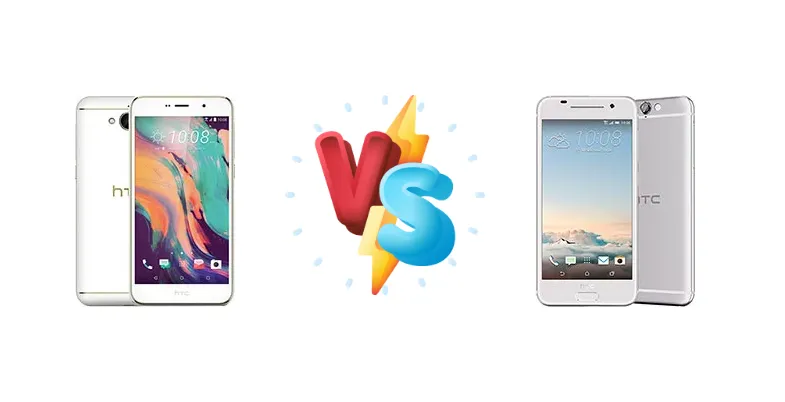
The HTC One A9 and Desire 10 Compact represent different approaches to the mid-range smartphone market. The One A9, released in 2015, aimed for a premium feel with a Snapdragon processor, while the Desire 10 Compact, launched in 2016, focused on affordability with a Mediatek chipset. This comparison dissects their key differences to determine which device holds up better today.
🏆 Quick Verdict
For the average user seeking a balance of performance and longevity, the HTC One A9 emerges as the better choice. While both phones offer similar battery endurance ratings, the Snapdragon 617’s octa-core architecture and Quick Charge 3.0 support provide a smoother user experience and faster refueling compared to the Desire 10 Compact’s Mediatek MT6737T.
| Network |
|---|
| 2G bands | GSM 850 / 900 / 1800 / 1900 - SIM 1 & SIM 2 | GSM 850 / 900 / 1800 / 1900 |
| 3G bands | HSDPA 850 / 900 / 1900 / 2100 | HSDPA 850 / 900 / 1700(AWS) / 1900 / 2100 - Americas |
| 4G bands | LTE | 2, 3, 4, 5, 7, 12, 13, 17, 29 - Americas |
| Speed | HSPA 42.2/5.76 Mbps, LTE Cat4 150/50 Mbps | HSPA, LTE Cat7 (2CA) 300/100 Mbps |
| Technology | GSM / HSPA / LTE | GSM / HSPA / LTE |
| | - | 1, 3, 5, 7, 8, 20, 28, 38, 40, 41 - EMEA/ Asia |
| Launch |
|---|
| Announced | 2017, Q1. Released 2017, Q1 | 2015, September. Released 2015, November |
| Status | Discontinued | Discontinued |
| Body |
|---|
| Dimensions | 148.6 x 72 x 7.5 mm (5.85 x 2.83 x 0.30 in) | 145.8 x 70.8 x 7.3 mm (5.74 x 2.79 x 0.29 in) |
| SIM | Nano-SIM + Micro-SIM | Nano-SIM |
| Weight | 148 g (5.22 oz) | 143 g (5.04 oz) |
| Display |
|---|
| Protection | - | Corning Gorilla Glass 3 |
| Resolution | 720 x 1280 pixels, 16:9 ratio (~294 ppi density) | 1080 x 1920 pixels, 16:9 ratio (~441 ppi density) |
| Size | 5.0 inches, 68.9 cm2 (~64.4% screen-to-body ratio) | 5.0 inches, 68.9 cm2 (~66.8% screen-to-body ratio) |
| Type | IPS LCD | AMOLED |
| Platform |
|---|
| CPU | Quad-core 1.5 GHz Cortex-A7 | Octa-core (4x1.5 GHz Cortex-A53 & 4x1.2 GHz Cortex-A53) |
| Chipset | Mediatek MT6737T (28 nm) | Qualcomm MSM8952 Snapdragon 617 (28 nm) |
| GPU | Mali-T720 | Adreno 405 |
| OS | Android 6.0 (Marshmallow) | Android 6.0 (Marshmallow), upgradable to 7.0 (Nougat), Sense UI |
| Memory |
|---|
| Card slot | microSDXC | microSDXC (dedicated slot) |
| Internal | 32GB 3GB RAM | 16GB 2GB RAM, 32GB 3GB RAM |
| | eMMC 5.0 | eMMC 5.1 |
| Main Camera |
|---|
| Features | LED flash, HDR, panorama | Dual-LED dual-tone flash, panorama, HDR |
| Single | 13 MP, f/2.2, 28mm (wide), AF | 13 MP, f/2.0, AF, OIS |
| Video | 1080p@30fps | 1080p@30fps |
| Selfie camera |
|---|
| Features | - | HDR |
| Single | 5 MP, f/2.8, 34mm (standard) | 4 MP, f/2.0, 27mm (wide), 1/3", 2µm |
| Video | - | 1080p@30fps |
| Sound |
|---|
| 3.5mm jack | Yes | Yes |
| 35mm jack | Yes | Yes |
| Loudspeaker | Yes | Yes |
| | - | 24-bit/192kHz audio |
| Comms |
|---|
| Bluetooth | 4.1, A2DP, LE | 4.1, A2DP, aptX |
| NFC | No | Yes (payments only) |
| Positioning | GPS | GPS, GLONASS |
| Radio | FM radio | FM radio |
| USB | microUSB 2.0 | microUSB 2.0, OTG |
| WLAN | Wi-Fi 802.11 b/g/n | Wi-Fi 802.11 a/b/g/n/ac, dual-band, Wi-Fi Direct, DLNA |
| Features |
|---|
| Sensors | Accelerometer, proximity | Fingerprint (front-mounted), accelerometer, gyro, proximity, compass |
| Battery |
|---|
| Charging | - | 18W wired, QC3 |
| Music play | - | Up to 60 h |
| Stand-by | - | Up to 432 h (3G) |
| Talk time | - | Up to 16 h (3G) |
| Type | Li-Ion 3300 mAh, non-removable | Li-Ion 2150 mAh, non-removable |
| Misc |
|---|
| Colors | Polar White, Stone Black | Carbon Gray, Opal Silver, Topaz Gold, Deep Garnet, Pink |
| Models | Desire 10 compact | One A9, 2PQ93, A9u, 2PQ910 |
| Price | About 150 EUR | About 300 EUR |
| SAR EU | - | 0.41 W/kg (head) |
| Tests |
|---|
| Audio quality | - |
Noise -94.8dB / Crosstalk -94.0dB |
| Battery life | - |
Endurance rating 46h
|
| Camera | - |
Photo / Video |
| Display | - |
Contrast ratio: Infinite (nominal), 4.274 (sunlight) |
| Loudspeaker | - |
Voice 65dB / Noise 64dB / Ring 67dB
|
| Performance | - |
Basemark OS II 2.0: 644Basemark X: 6617 |
HTC Desire 10 Compact
- Faster Snapdragon 617 processor for smoother performance
- Quick Charge 3.0 support for rapid charging
- Potentially better camera image quality
- Older device, potentially limited software updates
- May be harder to find in good condition
HTC One A9
- More affordable price point
- Compact size for easy one-handed use
- Similar battery endurance to the One A9
- Slower Mediatek MT6737T processor
- No fast charging support
- Potentially lower build quality
Display Comparison
Both the HTC One A9 and Desire 10 Compact share an identical contrast ratio of Infinite (nominal) and 4.274 in sunlight, suggesting similar display quality under direct sunlight. However, specific details like screen size, resolution, and panel technology (IPS vs. AMOLED) are missing. Given the One A9’s positioning, it likely features a higher resolution display, contributing to sharper visuals. The lack of information on PWM dimming rates prevents a definitive assessment of eye strain potential.
Camera Comparison
Both devices are listed with 'Photo / Video' capabilities, offering minimal insight. Without sensor size, aperture, or image processing details, a direct comparison is difficult. However, the One A9, being a slightly higher-tier device, likely benefits from a more refined camera algorithm and potentially a larger sensor, resulting in better low-light performance and dynamic range. The absence of details regarding OIS (Optical Image Stabilization) on either device suggests limited stabilization features.
Performance
The core difference lies in the chipsets. The HTC One A9’s Qualcomm MSM8952 Snapdragon 617 utilizes an octa-core configuration (4x1.5 GHz Cortex-A53 & 4x1.2 GHz Cortex-A53), offering more processing cores than the Desire 10 Compact’s Mediatek MT6737T quad-core 1.5 GHz Cortex-A7. While both are built on a 28nm process, the Snapdragon 617’s architecture provides superior multi-tasking capabilities and a smoother experience with demanding applications. The Desire 10 Compact will likely struggle with heavier workloads, exhibiting noticeable lag.
Battery Life
Interestingly, both phones share an endurance rating of 46 hours, indicating similar real-world battery life despite the differing chipsets. However, the HTC One A9 boasts 18W wired charging with Quick Charge 3.0 (QC3) support, significantly reducing charging times compared to the Desire 10 Compact, which lacks fast charging capabilities. This faster charging is a crucial advantage for users who prioritize convenience.
Buying Guide
Buy the HTC Desire 10 Compact if you prioritize extreme affordability and a smaller form factor for one-handed use, accepting compromises in processing power. Buy the HTC One A9 if you value a more responsive user experience, faster charging capabilities, and a potentially longer software support lifespan, even if it means paying a slight premium.
Frequently Asked Questions
❓ Is the Snapdragon 617 in the HTC One A9 still capable of running modern apps smoothly?
While not a flagship processor, the Snapdragon 617 remains capable of handling most everyday tasks and apps. However, demanding games or heavily multi-tasking may result in some lag. It's a significant step up from the Mediatek MT6737T in the Desire 10 Compact.
❓ Does the lack of fast charging on the Desire 10 Compact significantly impact the user experience?
Yes, the absence of fast charging is a notable drawback. Charging from 0-100% will take considerably longer on the Desire 10 Compact compared to the One A9, which supports Quick Charge 3.0. This can be inconvenient for users who need to quickly top up their battery.
❓ Which phone is more likely to receive future software updates?
Given its age, the HTC One A9 is unlikely to receive any further major Android updates. The Desire 10 Compact may have a slightly better chance of receiving a single additional update, but neither device should be expected to receive long-term software support.