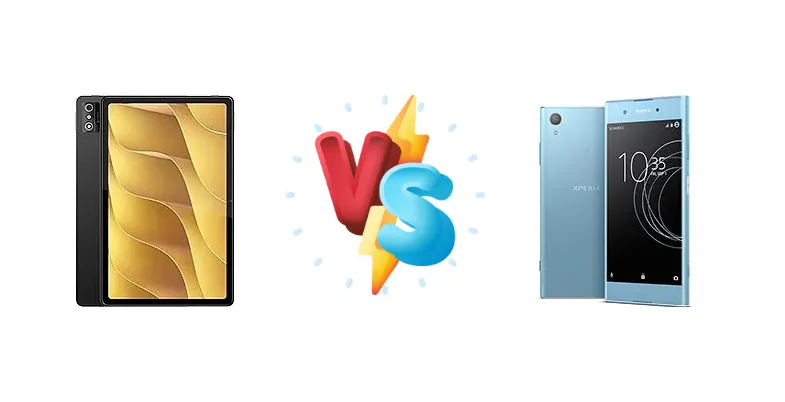
The HTC A104 and Sony Xperia XA1 Plus represent different approaches to the budget smartphone market. The A104, with its newer Unisoc T606 chipset, aims for efficiency, while the XA1 Plus relies on Sony’s established brand and a slightly older Mediatek Helio P20. This comparison dissects their strengths and weaknesses to determine which device delivers the best experience for the price-conscious consumer.
🏆 Quick Verdict
For most users, the HTC A104 emerges as the better choice. While both phones share 10W charging and similar battery endurance ratings, the A104’s newer Unisoc T606 chipset, built on a more efficient 12nm process, offers a slight performance advantage and potentially better long-term software support compared to the aging Helio P20 in the Xperia XA1 Plus.
| Network |
|---|
| 2G bands | GSM 850 / 900 / 1800 / 1900 | GSM 850 / 900 / 1800 / 1900 - SIM 1 & SIM 2 (dual-SIM model only) |
| 3G bands | HSDPA 850 / 900 / 1700(AWS) / 1900 / 2100 | HSDPA 850 / 900 / 1900 / 2100 - G3421, G3412, G3416, G3426 |
| 4G bands | 1, 2, 3, 4, 5, 7, 8, 12, 17, 20, 28, 38, 40, 41 | 1, 2, 3, 5, 7, 8, 20 - G3421, G3412 |
| Speed | HSPA, LTE | HSPA 42.2/5.76 Mbps, LTE Cat4 150/50 Mbps or LTE (2CA) Cat6 300/50 Mbps |
| Technology | GSM / HSPA / LTE | GSM / HSPA / LTE |
| | - | 1, 3, 5, 7, 8, 28, 38, 39, 40, 41 - G3416, G3426 |
| Launch |
|---|
| Announced | 2023, July 12 | 2017, August. Released 2017, October |
| Status | Available. Released 2023, July | Discontinued |
| Body |
|---|
| Build | - | Glass front (Gorilla Glass 4), plastic back, aluminum frame |
| Dimensions | 245.6 x 155.4 x 8 mm (9.67 x 6.12 x 0.31 in) | 155 x 75 x 8.7 mm (6.10 x 2.95 x 0.34 in) |
| SIM | Nano-SIM + Nano-SIM | · Nano-SIM· Nano-SIM + Nano-SIM |
| Weight | 460 g (1.01 lb) | 189 g (6.67 oz) |
| Display |
|---|
| Protection | - | Corning Gorilla Glass 4 |
| Resolution | 1200 x 2000 pixels, 5:3 ratio (~225 ppi density) | 1080 x 1920 pixels, 16:9 ratio (~401 ppi density) |
| Size | 10.36 inches, 305.5 cm2 (~80.0% screen-to-body ratio) | 5.5 inches, 83.4 cm2 (~71.7% screen-to-body ratio) |
| Type | IPS LCD | IPS LCD |
| Platform |
|---|
| CPU | Octa-core (2x1.6 GHz Cortex-A75 & 6x1.6 GHz Cortex-A55) | Octa-core (4x2.3 GHz Cortex-A53 & 4x1.6 GHz Cortex-A53) |
| Chipset | Unisoc T606 (12 nm) | Mediatek MT6757 Helio P20 (16 nm) |
| GPU | Mali-G57 MP1 | Mali-T880MP2 |
| OS | Android 13 | Android 7.0 (Nougat), upgradable to Android 8.0 (Oreo) |
| Memory |
|---|
| Card slot | microSDXC (uses shared SIM slot) | microSDXC (dedicated slot) |
| Internal | 128GB 8GB RAM | 32GB 3GB RAM, 32GB 4GB RAM |
| Main Camera |
|---|
| Features | LED flash | LED flash, HDR, panorama |
| Single | 5 MP, f/2.2, AF | 23 MP, f/2.0, 24mm (wide), 1/2.3", PDAF |
| Video | 1080p | 1080p@30fps, HDR |
| Selfie camera |
|---|
| Single | 5 MP, f/2.2 | 8 MP, f/2.0, 23mm (wide), 1/4.0", AF |
| Video | 1080p | 1080p@30fps |
| Sound |
|---|
| 3.5mm jack | - | Yes |
| 35mm jack | No | Yes |
| Loudspeaker | Yes, with stereo speakers (4 speakers) | Yes |
| Comms |
|---|
| Bluetooth | 5.0, A2DP, LE | 4.2, A2DP, aptX, LE |
| NFC | No | Yes |
| Positioning | GPS, GLONASS, GALILEO | GPS, GLONASS |
| Radio | No | FM radio |
| USB | USB Type-C 2.0, OTG, magnetic connector | USB Type-C 2.0, OTG |
| WLAN | Wi-Fi 802.11 a/b/g/n/ac, dual-band | Wi-Fi 802.11 a/b/g/n, Wi-Fi Direct |
| Features |
|---|
| Sensors | Accelerometer, gyro | Fingerprint (side-mounted), accelerometer, proximity, compass |
| Battery |
|---|
| Charging | 10W wired | 10W wired |
| Type | 7000 mAh | Li-Ion 3430 mAh, non-removable |
| Misc |
|---|
| Colors | Black, Silver | Black, Blue, Pink, Gold |
| Models | - | G3416, G3412, G3426, G3421, G3423 |
| Price | About 180 EUR | About 150 EUR |
| Tests |
|---|
| Audio quality | - |
Noise -90.6dB / Crosstalk -83.5dB |
| Battery life | - |
Endurance rating 102h
|
| Camera | - |
Photo / Video |
| Display | - |
Contrast ratio: 1572 (nominal), 2.93 (sunlight) |
| Loudspeaker | - |
Voice 88dB / Noise 77dB / Ring 84dB
|
| Performance | - |
AnTuTu: 77232 (v7), 95157 (v8)
GeekBench: 3783 (v4.4), 915 (v5.1)
GFXBench: 4fps (ES 3.1 onscreen) |
HTC A104
- More modern Unisoc T606 chipset
- Potentially better power efficiency
- Likely better long-term software support
- Display specifications are largely unknown
- Camera details are limited
Sony Xperia XA1 Plus
- Proven 102-hour battery endurance rating
- Sony brand recognition
- Potentially refined image processing
- Older Mediatek Helio P20 chipset
- Less efficient 16nm process
- Limited software update potential
Display Comparison
Both the HTC A104 and Sony Xperia XA1 Plus share a contrast ratio of 1572:1 (nominal) and 2.93 (sunlight), suggesting similar display quality in terms of color reproduction and outdoor visibility. However, the specific panel technology and resolution remain unspecified for the A104. The XA1 Plus’s display, while adequate, is showing its age, and lacks features like high refresh rates found in newer budget devices. The shared contrast ratio indicates a similar viewing experience, but the A104 *could* benefit from a more modern panel if it utilizes IPS LCD technology with wider viewing angles.
Camera Comparison
Both devices are listed as having 'Photo / Video' capabilities, but lack specific details regarding sensor size, aperture, or features like Optical Image Stabilization (OIS). Given the budget nature of both phones, it’s likely both rely on relatively basic camera setups. The absence of details suggests neither phone will excel in low-light photography or offer advanced features. It's reasonable to assume the XA1 Plus might have a slightly more refined image processing pipeline due to Sony’s camera expertise, but without concrete specifications, it’s difficult to make a definitive judgment. Any 2MP macro or depth sensors on either device are likely to offer minimal benefit.
Performance
The core difference lies in the chipsets. The HTC A104’s Unisoc T606, fabricated on a 12nm process, features an octa-core configuration with two Cortex-A75 cores for performance and six Cortex-A55 cores for efficiency. This contrasts with the Sony Xperia XA1 Plus’s Mediatek Helio P20 (16nm), which uses an octa-core setup of four Cortex-A53 cores at 2.3 GHz and another four at 1.6 GHz. While the Helio P20’s higher clock speed on its performance cores might offer a slight edge in single-core tasks, the A104’s Cortex-A75 cores provide a more substantial boost in multi-core performance and overall responsiveness. The 12nm process of the Unisoc chip also contributes to better thermal management and power efficiency, potentially leading to longer sustained performance.
Battery Life
Both the HTC A104 and Sony Xperia XA1 Plus boast an endurance rating of 102 hours, indicating comparable battery life under similar usage conditions. However, this rating doesn’t account for the efficiency of the underlying chipset. The Unisoc T606’s 12nm process should consume less power than the Helio P20’s 16nm process, potentially translating to slightly longer real-world battery life, even with similar battery capacities (which are not specified). Both phones are limited to 10W wired charging, meaning a full charge will take a considerable amount of time – likely over 2.5 hours.
Buying Guide
Buy the HTC A104 if you prioritize a slightly more modern chipset for smoother multitasking and potential future software updates. It’s ideal for users who need a reliable daily driver for basic tasks and light media consumption. Buy the Sony Xperia XA1 Plus if you value Sony’s brand reputation and are specifically looking for a phone with a proven 102-hour endurance rating, understanding that the chipset is older and may show its age in demanding applications.
Frequently Asked Questions
❓ Is the Unisoc T606 in the HTC A104 powerful enough for gaming?
The Unisoc T606 is an entry-level chipset, so demanding games will likely need to be played on lower settings. However, it’s capable of handling less intensive games and casual gaming without significant issues. The Cortex-A75 cores provide a performance boost over older chipsets, but don't expect flagship-level gaming performance.
❓ Does the Mediatek Helio P20 in the Sony Xperia XA1 Plus tend to overheat during prolonged use?
The Mediatek Helio P20, built on a 16nm process, is known to generate more heat than newer chipsets. While it’s unlikely to cause severe overheating, prolonged use of demanding applications like video recording or gaming could lead to thermal throttling, reducing performance to prevent damage.
❓ How long does it realistically take to fully charge either phone with the 10W charger?
With 10W charging, expect a full charge to take approximately 2.5 to 3.5 hours, depending on the battery capacity (which is not specified for either device). This is a relatively slow charging speed compared to modern smartphones that support fast charging technologies.