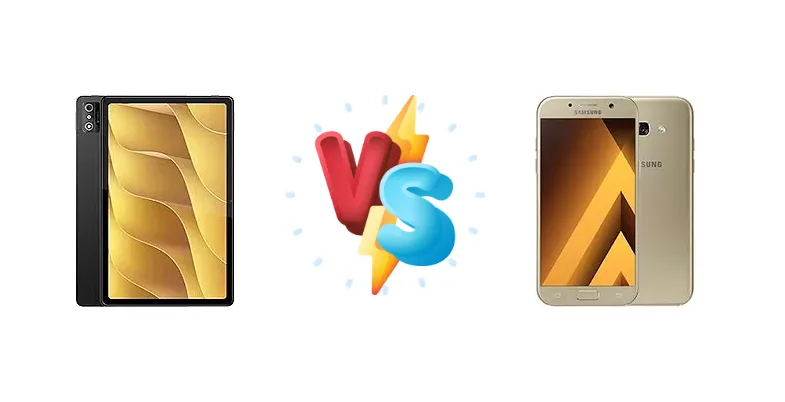
The HTC A104 and Samsung Galaxy A5 (2017) represent different approaches to the budget smartphone market. The A104, a more recent release, leverages a newer Unisoc chipset, while the A5 (2017) relies on Samsung’s older Exynos 7880. This comparison dissects their key differences to determine which device offers the best value in 2024.
🏆 Quick Verdict
For the average user prioritizing a slightly more modern chipset and potential for future software updates, the HTC A104 is the better choice. However, the Samsung Galaxy A5 (2017) counters with a proven 95-hour endurance rating and faster 18W charging, making it ideal for users who prioritize battery life and quick top-ups.
| Network |
|---|
| 2G bands | GSM 850 / 900 / 1800 / 1900 | GSM 850 / 900 / 1800 / 1900 - SIM 1 & SIM 2 (dual-SIM model only) |
| 3G bands | HSDPA 850 / 900 / 1700(AWS) / 1900 / 2100 | HSDPA 850 / 900 / 1700(AWS) / 1900 / 2100 |
| 4G bands | 1, 2, 3, 4, 5, 7, 8, 12, 17, 20, 28, 38, 40, 41 | 1, 2, 3, 4, 5, 7, 8, 17, 20, 28, 38, 40, 41 |
| Speed | HSPA, LTE | HSPA 42.2/5.76 Mbps, LTE (2CA) Cat6 300/50 Mbps |
| Technology | GSM / HSPA / LTE | GSM / HSPA / LTE |
| Launch |
|---|
| Announced | 2023, July 12 | 2017, January. Released 2017, January |
| Status | Available. Released 2023, July | Discontinued |
| Body |
|---|
| Build | - | Glass front (Gorilla Glass 4), glass back, aluminum frame |
| Dimensions | 245.6 x 155.4 x 8 mm (9.67 x 6.12 x 0.31 in) | 146.1 x 71.4 x 7.9 mm (5.75 x 2.81 x 0.31 in) |
| SIM | Nano-SIM + Nano-SIM | · Nano-SIM· Nano-SIM + Nano-SIM |
| Weight | 460 g (1.01 lb) | 157 g (5.54 oz) |
| | - | IP68 dust/water resistant (up to 1.5m for 30 mins) |
| Display |
|---|
| Protection | - | Corning Gorilla Glass 4 |
| Resolution | 1200 x 2000 pixels, 5:3 ratio (~225 ppi density) | 1080 x 1920 pixels, 16:9 ratio (~424 ppi density) |
| Size | 10.36 inches, 305.5 cm2 (~80.0% screen-to-body ratio) | 5.2 inches, 74.5 cm2 (~71.5% screen-to-body ratio) |
| Type | IPS LCD | Super AMOLED |
| | - | Always-on display |
| Platform |
|---|
| CPU | Octa-core (2x1.6 GHz Cortex-A75 & 6x1.6 GHz Cortex-A55) | Octa-core 1.9 GHz Cortex-A53 |
| Chipset | Unisoc T606 (12 nm) | Exynos 7880 (14 nm) |
| GPU | Mali-G57 MP1 | Mali-T830MP3 |
| OS | Android 13 | Android 6.0.1 (Marshmallow), upgradable to Android 8.0 (Oreo) |
| Memory |
|---|
| Card slot | microSDXC (uses shared SIM slot) | microSDXC (dedicated slot) |
| Internal | 128GB 8GB RAM | 32GB 3GB RAM, 64GB 3GB RAM |
| | - | eMMC 5.1 |
| Main Camera |
|---|
| Features | LED flash | LED flash, panorama, HDR |
| Single | 5 MP, f/2.2, AF | 16 MP, f/1.9, 27mm (wide), AF |
| Video | 1080p | 1080p@30fps |
| Selfie camera |
|---|
| Single | 5 MP, f/2.2 | 16 MP, f/1.9, 26mm (wide), 1/3.06", 1.0µm |
| Video | 1080p | 1080p@30fps |
| Sound |
|---|
| 3.5mm jack | - | Yes |
| 35mm jack | No | Yes |
| Loudspeaker | Yes, with stereo speakers (4 speakers) | Yes |
| Comms |
|---|
| Bluetooth | 5.0, A2DP, LE | 4.2, A2DP, EDR, LE |
| NFC | No | Yes |
| Positioning | GPS, GLONASS, GALILEO | GPS, GLONASS, BDS |
| Radio | No | FM radio |
| USB | USB Type-C 2.0, OTG, magnetic connector | USB Type-C 2.0 |
| WLAN | Wi-Fi 802.11 a/b/g/n/ac, dual-band | Wi-Fi 802.11 a/b/g/n/ac, dual-band, Wi-Fi Direct |
| Features |
|---|
| Sensors | Accelerometer, gyro | Fingerprint (front-mounted), accelerometer, gyro, proximity, compass, barometer |
| | - | ANT+
Samsung Pay |
| Battery |
|---|
| Charging | 10W wired | 18W wired |
| Music play | - | Up to 53 h |
| Talk time | - | Up to 16 h (3G) |
| Type | 7000 mAh | Li-Ion 3000 mAh, non-removable |
| Misc |
|---|
| Colors | Black, Silver | Black Sky, Gold Sand, Blue Mist, Peach Cloud |
| Models | - | SM-A520F, SM-A520F, SM-A520K, SM-A520L, SM-A520S, SM-A520W, SM-A520FD |
| Price | About 180 EUR | About 190 EUR |
| SAR | - | 0.88 W/kg (head) 0.55 W/kg (body) |
| SAR EU | - | 0.52 W/kg (head) 1.39 W/kg (body) |
| Tests |
|---|
| Audio quality | - |
Noise -93.1dB / Crosstalk -90.2dB |
| Battery life | - | Endurance rating 95h |
| Camera | - |
Photo / Video |
| Display | - |
Contrast ratio: Infinite (nominal), 3.804 (sunlight) |
| Loudspeaker | - |
Voice 66dB / Noise 66dB / Ring 78dB |
| Performance | - |
GFXBench: 5.2fps (ES 3.1 onscreen) |
HTC A104
- More modern Unisoc T606 chipset
- Potentially better thermal efficiency due to 12nm process
- Likely to receive more software updates
- Slower 10W charging
- Battery life is unknown
- Display specifications are limited
Samsung Galaxy A5 (2017)
- Excellent 95-hour battery endurance
- Faster 18W wired charging
- Samsung’s established image processing
- Older Exynos 7880 chipset
- Less likely to receive future software updates
- 14nm process node is less efficient
Display Comparison
Both the HTC A104 and Samsung Galaxy A5 (2017) share an 'Infinite' contrast ratio (nominal 3.804 in sunlight), suggesting similar display quality in outdoor visibility. However, the context data lacks specifics on panel type (LCD vs AMOLED) or resolution for the A104. The A5 (2017) likely benefits from Samsung’s display expertise, potentially offering more accurate color reproduction, though both are likely to be adequate for everyday use. Without further data on the A104’s display, a definitive winner is difficult to declare.
Camera Comparison
Both devices are listed as having 'Photo / Video' capabilities, but lack specific details. Given the market positioning, neither is expected to excel in photography. The absence of sensor size or aperture information makes a direct comparison impossible. It’s reasonable to assume the A5 (2017) benefits from Samsung’s image processing algorithms, potentially delivering more pleasing results in good lighting conditions. However, without concrete data, the camera performance remains largely speculative.
Performance
The Unisoc T606 in the HTC A104 utilizes a more modern CPU architecture – Cortex-A75 cores – compared to the Cortex-A53 cores in the Samsung Galaxy A5 (2017)’s Exynos 7880. While the Exynos 7880 has a slightly higher clock speed (1.9 GHz vs 1.6 GHz), the A75 cores in the T606 generally offer superior single-core performance. The T606’s 12nm process node is also more efficient than the Exynos 7880’s 14nm node, potentially leading to better thermal management. This suggests the A104 will handle demanding tasks and multitasking more smoothly, despite the A5 (2017) having a similar core count.
Battery Life
The Samsung Galaxy A5 (2017) boasts an impressive endurance rating of 95 hours, indicating excellent battery life. While the HTC A104’s battery capacity is unknown, the A5 (2017)’s endurance is a significant advantage. Furthermore, the A5 (2017) supports 18W wired charging, considerably faster than the A104’s 10W charging. This means the A5 (2017) can be topped up much quicker, minimizing downtime. The A5 (2017)'s faster charging and proven endurance give it a clear edge in this category.
Buying Guide
Buy the HTC A104 if you need a phone with a more recent processor for potentially better app compatibility and future Android updates, even if it means sacrificing some charging speed. Buy the Samsung Galaxy A5 (2017) if you prioritize exceptional battery life and faster charging, and are comfortable with an older chipset and potentially limited software support.
Frequently Asked Questions
❓ Does the Exynos 7880 in the Galaxy A5 (2017) overheat during prolonged gaming sessions?
The Exynos 7880 is known to throttle under sustained load, meaning performance will decrease over time during extended gaming. While it's not a severe issue for casual gaming, demanding titles may experience noticeable frame drops. The Unisoc T606 in the A104, with its more efficient 12nm process, is likely to manage heat better.
❓ Is the 2MP macro camera on either phone actually useful for taking detailed close-up photos?
Generally, 2MP macro cameras on budget phones produce images with limited detail and sharpness. They are often included as a marketing feature rather than offering a significant photographic benefit. Don't expect professional-quality macro shots from either device.
❓ Can the HTC A104 handle popular games like PUBG Mobile at reasonable frame rates?
The Unisoc T606 should be capable of running PUBG Mobile at medium settings with acceptable frame rates. However, don't expect to max out the graphics settings. The A75 cores provide a performance boost over the A5 (2017)'s chipset, but it's still a budget processor.
❓ How long will it take to fully charge the Samsung Galaxy A5 (2017) from 0% with the 18W charger?
While 18W charging is faster than 10W, the A5 (2017)'s battery capacity isn't specified. Expect a full charge to take approximately 1.5 to 2 hours, depending on usage during charging. It's significantly faster than the A104's 10W charging.