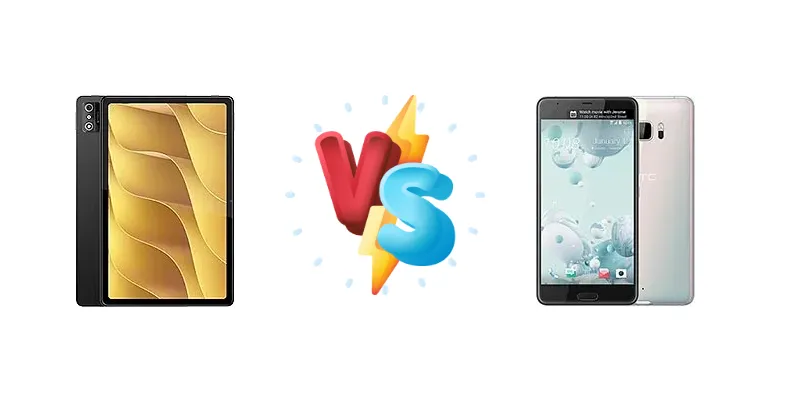
The HTC A104 and U Ultra represent vastly different eras and philosophies within HTC’s smartphone lineup. The A104 is a modern, budget-focused device, while the U Ultra, released in 2017, was a flagship aiming for premium features. This comparison dissects their key differences to determine which phone best suits your needs in today’s market.
🏆 Quick Verdict
For most users in 2024, the HTC U Ultra offers a more compelling experience despite its age. Its Snapdragon 821 chipset provides significantly better performance than the A104’s Unisoc T606, and the 81-hour endurance rating suggests superior battery life. However, the A104’s lower price point makes it a viable option for extremely budget-conscious buyers.
| Network |
|---|
| 2G bands | GSM 850 / 900 / 1800 / 1900 | GSM 850 / 900 / 1800 / 1900 - SIM 1 & SIM 2 |
| 3G bands | HSDPA 850 / 900 / 1700(AWS) / 1900 / 2100 | HSDPA 850 / 900 / 1700(AWS) / 1900 / 2100 |
| 4G bands | 1, 2, 3, 4, 5, 7, 8, 12, 17, 20, 28, 38, 40, 41 | 1, 2, 3, 4, 5, 7, 8, 12, 17, 20, 28, 38, 39, 40, 41 |
| Speed | HSPA, LTE | HSPA 42.2/5.76 Mbps, LTE (3CA) Cat11 600/50 Mbps |
| Technology | GSM / HSPA / LTE | GSM / HSPA / LTE |
| Launch |
|---|
| Announced | 2023, July 12 | 2017, January 12. Released 2017, February 21 |
| Status | Available. Released 2023, July | Discontinued |
| Body |
|---|
| Build | - | Glass front (Gorilla Glass 5 or Sapphire crystal), glass back, aluminum frame |
| Dimensions | 245.6 x 155.4 x 8 mm (9.67 x 6.12 x 0.31 in) | 162.4 x 79.8 x 8 mm (6.39 x 3.14 x 0.31 in) |
| SIM | Nano-SIM + Nano-SIM | Nano-SIM + Nano-SIM |
| Weight | 460 g (1.01 lb) | 170 g (6.00 oz) |
| Display |
|---|
| Protection | - | Corning Gorilla Glass 5 (64 GB version)Sapphire crystal glass (128 GB version) |
| Resolution | 1200 x 2000 pixels, 5:3 ratio (~225 ppi density) | 1440 x 2560 pixels, 16:9 ratio (~513 ppi density) |
| Size | 10.36 inches, 305.5 cm2 (~80.0% screen-to-body ratio) | 5.7 inches, 90.3 cm2 (~69.7% screen-to-body ratio) |
| Type | IPS LCD | Super LCD5 |
| | - | Secondary display, 160 x 1040 pixels, 2 inches |
| Platform |
|---|
| CPU | Octa-core (2x1.6 GHz Cortex-A75 & 6x1.6 GHz Cortex-A55) | Quad-core (2x2.15 GHz Kryo & 2x1.6 GHz Kryo) |
| Chipset | Unisoc T606 (12 nm) | Qualcomm MSM8996 Snapdragon 821 (14 nm) |
| GPU | Mali-G57 MP1 | Adreno 530 |
| OS | Android 13 | Android 7.0 (Nougat), upgradable to Android 8.0 (Oreo) |
| Memory |
|---|
| Card slot | microSDXC (uses shared SIM slot) | microSDXC (uses shared SIM slot) |
| Internal | 128GB 8GB RAM | 64GB 4GB RAM, 128GB 4GB RAM |
| Main Camera |
|---|
| Features | LED flash | Laser AF, Dual-LED dual-tone flash, panorama |
| Single | 5 MP, f/2.2, AF | 12 MP, f/1.8, 26mm (wide), 1/2.3", 1.55µm, PDAF, OIS |
| Video | 1080p | 4K@30fps (24-bit/192kHz audio), 720p@120fps |
| Selfie camera |
|---|
| Features | - | HDR |
| Single | 5 MP, f/2.2 | 16 MP, f/2.0, 27mm (wide), 1/3.06", 1.0µm |
| Video | 1080p | 1080p@30fps |
| Sound |
|---|
| 3.5mm jack | - | No |
| 35mm jack | No | No |
| Loudspeaker | Yes, with stereo speakers (4 speakers) | Yes |
| | - | 24-bit/192kHz audio
|
| Comms |
|---|
| Bluetooth | 5.0, A2DP, LE | 4.2, A2DP, LE |
| NFC | No | Yes |
| Positioning | GPS, GLONASS, GALILEO | GPS, GLONASS, BDS |
| Radio | No | No |
| USB | USB Type-C 2.0, OTG, magnetic connector | USB Type-C 3.1 |
| WLAN | Wi-Fi 802.11 a/b/g/n/ac, dual-band | Wi-Fi 802.11 a/b/g/n/ac, dual-band, Wi-Fi Direct, DLNA |
| Features |
|---|
| Sensors | Accelerometer, gyro | Fingerprint (front-mounted), accelerometer, gyro, proximity, compass |
| Battery |
|---|
| Charging | 10W wired | 18W wired, QC3 |
| Stand-by | - | Up to 312 h (3G) |
| Talk time | - | Up to 26 h (3G) |
| Type | 7000 mAh | Li-Ion 3000 mAh, non-removable |
| Misc |
|---|
| Colors | Black, Silver | Brilliant Black, Cosmetic Pink, Ice White, Sapphire Blue |
| Models | - | U Ultra, U-1u, 2PZF1 |
| Price | About 180 EUR | About 250 EUR |
| Tests |
|---|
| Battery life | - | Endurance rating 81h |
| Camera | - |
Photo / Video |
| Display | - |
Contrast ratio: 1831 (nominal), 3.453 (sunlight) |
| Loudspeaker | - |
Voice 61dB / Noise 73dB / Ring 86dB |
| Performance | - |
GFXBench: 10fps (ES 3.1 onscreen) |
HTC A104
- Extremely affordable price point
- Modern software (potentially)
- Compact and lightweight design (likely)
- Weak performance due to Unisoc T606 chipset
- Slow 10W charging
- Likely basic camera system
HTC U Ultra
- Powerful Snapdragon 821 processor
- Excellent 81-hour battery endurance
- Fast 18W Quick Charge 3.0 support
- Older device with potentially outdated software
- May not receive future software updates
- Potentially higher price than the A104
Display Comparison
Both the HTC A104 and U Ultra share a contrast ratio of 1831 (nominal) and 3.453 (sunlight), suggesting similar outdoor visibility. However, the U Ultra, being a former flagship, likely benefits from a higher quality panel with potentially better color accuracy. The A104’s display specifications are not detailed enough to assess its panel technology, but given its price point, it likely utilizes a simpler IPS LCD. The U Ultra’s display, while older, likely offers a more refined viewing experience.
Camera Comparison
Both devices are listed as having 'Photo / Video' capabilities, but detailed camera specifications are absent. Given the U Ultra’s flagship status, it likely features a more sophisticated camera system with a larger sensor and optical image stabilization (OIS). The A104, targeting the budget market, likely employs a simpler camera setup. Without specific sensor sizes or aperture information, it’s difficult to make a definitive judgment, but the U Ultra is expected to capture higher-quality images and videos.
Performance
The performance gap between these devices is substantial. The HTC U Ultra’s Qualcomm Snapdragon 821 (14nm) is a quad-core processor built on a smaller fabrication process than the A104’s Unisoc T606 (12nm). The Snapdragon 821’s Kryo cores, with a peak clock speed of 2.15 GHz, deliver significantly more processing power than the A104’s Cortex-A75 and A55 cores clocked at 1.6 GHz. This translates to faster app loading times, smoother multitasking, and a more responsive user interface on the U Ultra. The A104 will struggle with demanding applications and games.
Battery Life
The HTC U Ultra boasts an impressive endurance rating of 81 hours, indicating excellent battery life. While the exact battery capacity isn’t specified, this rating suggests efficient power management and a sizable battery. The A104, with its 10W wired charging, will take considerably longer to charge than the U Ultra’s 18W wired charging with Quick Charge 3 (QC3) support. The U Ultra’s faster charging and superior endurance make it the clear winner in this category.
Buying Guide
Buy the HTC A104 if you need a functional, extremely affordable smartphone for basic tasks like calling, texting, and light social media use. You’ll prioritize cost above all else. Buy the HTC U Ultra if you prefer a smoother, more responsive user experience, better camera capabilities, and a longer-lasting battery, even if it means paying a premium and accepting an older device.
Frequently Asked Questions
❓ Is the Snapdragon 821 in the HTC U Ultra still capable of handling modern apps and games?
While the Snapdragon 821 is an older chipset, it remains surprisingly capable. It can handle most modern apps and games at medium settings, though demanding titles may require reduced graphics settings. It will provide a significantly smoother experience than the Unisoc T606 in the A104.
❓ How concerned should I be about software updates on the HTC U Ultra, given its age?
Software updates are a significant concern with the U Ultra. It’s unlikely to receive any further major Android version updates. However, the core functionality should remain stable, and you may be able to find custom ROMs developed by the community to extend its software support.
❓ Does the 10W charging on the HTC A104 make it impractical for daily use?
Yes, the 10W charging on the A104 is quite slow by today's standards. Expect several hours to fully charge the device, which can be inconvenient for users who rely on frequent charging.
❓ What kind of user would benefit most from the HTC U Ultra's long battery life?
The U Ultra's 81-hour endurance is ideal for users who travel frequently, spend long periods away from power outlets, or simply prefer not to worry about charging their phone multiple times a day. It's a significant advantage over the A104.