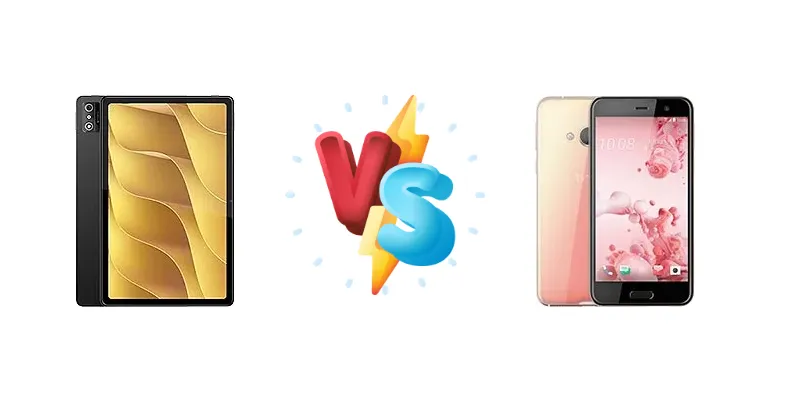
The HTC A104 and U Play represent different approaches to the entry-level smartphone market. The U Play, released earlier, relies on the Mediatek Helio P10, while the A104 utilizes the newer Unisoc T606. This comparison dissects the architectural differences and real-world implications of these chipsets, helping you determine which device offers the best experience for your needs.
🏆 Quick Verdict
For most users, the HTC A104 emerges as the better choice. While both phones offer 10W charging, the Unisoc T606’s more modern architecture and efficient Cortex-A75 cores provide a noticeable performance uplift over the older Helio P10, making it better suited for everyday tasks and light multitasking.
| Network |
|---|
| 2G bands | GSM 850 / 900 / 1800 / 1900 | GSM 850 / 900 / 1800 / 1900 - SIM 1 & SIM 2 |
| 3G bands | HSDPA 850 / 900 / 1700(AWS) / 1900 / 2100 | HSDPA 850 / 900 / 1900 / 2100 |
| 4G bands | 1, 2, 3, 4, 5, 7, 8, 12, 17, 20, 28, 38, 40, 41 | 1, 3, 5, 7, 8, 20, 28, 38, 40 |
| Speed | HSPA, LTE | HSPA 42.2/5.76 Mbps, LTE (2CA) Cat6 300/50 Mbps |
| Technology | GSM / HSPA / LTE | GSM / HSPA / LTE |
| Launch |
|---|
| Announced | 2023, July 12 | 2017, January. Released 2017, February |
| Status | Available. Released 2023, July | Discontinued |
| Body |
|---|
| Build | - | Glass front (Gorilla Glass), plastic back, plastic frame |
| Dimensions | 245.6 x 155.4 x 8 mm (9.67 x 6.12 x 0.31 in) | 146 x 72.9 x 8 mm (5.75 x 2.87 x 0.31 in) |
| SIM | Nano-SIM + Nano-SIM | Nano-SIM + Nano-SIM |
| Weight | 460 g (1.01 lb) | 145 g (5.11 oz) |
| Display |
|---|
| Protection | - | Corning Gorilla Glass (unspecified version) |
| Resolution | 1200 x 2000 pixels, 5:3 ratio (~225 ppi density) | 1080 x 1920 pixels, 16:9 ratio (~428 ppi density) |
| Size | 10.36 inches, 305.5 cm2 (~80.0% screen-to-body ratio) | 5.2 inches, 73.2 cm2 (~68.7% screen-to-body ratio) |
| Type | IPS LCD | Super LCD |
| Platform |
|---|
| CPU | Octa-core (2x1.6 GHz Cortex-A75 & 6x1.6 GHz Cortex-A55) | Octa-core (4x2.0 GHz Cortex-A53 & 4x1.1 GHz Cortex-A53) |
| Chipset | Unisoc T606 (12 nm) | Mediatek MT6755 Helio P10 (28 nm) |
| GPU | Mali-G57 MP1 | Mali-T860MP2 |
| OS | Android 13 | Android 6.0 (Marshmallow) |
| Memory |
|---|
| Card slot | microSDXC (uses shared SIM slot) | microSDXC (uses shared SIM slot) |
| Internal | 128GB 8GB RAM | 32GB 3GB RAM, 64GB 4GB RAM |
| | - | eMMC 5.1 |
| Main Camera |
|---|
| Features | LED flash | Dual-LED dual-tone flash, panorama |
| Single | 5 MP, f/2.2, AF | 16 MP, f/2.0, 28mm (wide), 1/3.1", 1.0µm, PDAF, OIS |
| Video | 1080p | 1080p@30fps |
| Selfie camera |
|---|
| Features | - | HDR |
| Single | 5 MP, f/2.2 | 16 MP, f/2.0, 27mm (wide), 1/3.06", 1.0µm |
| Video | 1080p | 1080p@30fps |
| Sound |
|---|
| 3.5mm jack | - | No |
| 35mm jack | No | No |
| Loudspeaker | Yes, with stereo speakers (4 speakers) | Yes |
| Comms |
|---|
| Bluetooth | 5.0, A2DP, LE | 4.2, A2DP, LE |
| NFC | No | Yes |
| Positioning | GPS, GLONASS, GALILEO | GPS, GLONASS |
| Radio | No | No |
| USB | USB Type-C 2.0, OTG, magnetic connector | USB Type-C 2.0 |
| WLAN | Wi-Fi 802.11 a/b/g/n/ac, dual-band | Wi-Fi 802.11 a/b/g/n/ac, dual-band, Wi-Fi Direct, DLNA |
| Features |
|---|
| Sensors | Accelerometer, gyro | Fingerprint (front-mounted), accelerometer, gyro, proximity, compass |
| Battery |
|---|
| Charging | 10W wired | 10W wired |
| Stand-by | - | Up to 427 h (3G) |
| Talk time | - | Up to 15 h (3G) |
| Type | 7000 mAh | Li-Ion 2500 mAh, non-removable |
| Misc |
|---|
| Colors | Black, Silver | Brilliant Black, Cosmetic Pink, Ice White, Sapphire Blue |
| Models | - | U Play, U-2u, 2PZM3 |
| Price | About 180 EUR | About 150 EUR |
HTC A104
- More modern and efficient Unisoc T606 chipset
- Potentially smoother app performance
- Likely better power efficiency
- Limited information available on display and camera specs
- 10W charging is relatively slow
HTC U Play
- May be available at a lower price point
- Simple and straightforward user experience
- Reliable for basic tasks
- Older and less efficient Mediatek Helio P10 chipset
- Slower app loading and multitasking
- Potentially shorter battery life under load
Display Comparison
Neither HTC provides display specifications beyond the basic panel type. Given the target market, both likely utilize IPS LCD panels. However, the age difference suggests the A104 *may* benefit from slightly improved color calibration and viewing angles. The absence of high refresh rates or advanced features like LTPO is expected in this price bracket, meaning the display experience will be fairly standard on both devices.
Camera Comparison
Without detailed camera specs, a direct comparison is difficult. Both phones likely feature basic camera setups geared towards casual photography. The absence of information suggests neither device boasts advanced features like OIS or large sensors. Image quality will likely be heavily reliant on software processing, and the A104’s newer chipset *could* offer slightly improved image processing capabilities, but this is speculative. The focus should be on adequate performance in good lighting conditions, rather than expecting flagship-level results.
Performance
The core difference lies in the chipsets. The Unisoc T606 (12nm) features a modern octa-core configuration with 2x 1.6 GHz Cortex-A75 cores and 6x 1.6 GHz Cortex-A55 cores. This contrasts with the Mediatek Helio P10 (28nm) which uses 4x 2.0 GHz Cortex-A53 cores and 4x 1.1 GHz Cortex-A53 cores. The T606’s Cortex-A75 cores offer significantly higher single-core performance, crucial for app launch speeds and general responsiveness. The Helio P10’s older Cortex-A53 cores, while numerous, are less efficient and deliver lower peak performance. The 12nm process node of the T606 also contributes to better power efficiency, potentially leading to longer battery life under load. The larger process node of the Helio P10 means more power consumption for the same tasks.
Battery Life
Both the HTC A104 and U Play support 10W wired charging, indicating a similar charging experience – expect around 2-3 hours for a full charge. Battery capacity isn’t specified for either device, but given the target market, both likely house batteries in the 3000-4000 mAh range. The Unisoc T606’s superior power efficiency could translate to slightly longer battery life on the A104, especially during demanding tasks, offsetting any potential difference in battery capacity.
Buying Guide
Buy the HTC A104 if you prioritize responsiveness and future-proofing, even within the budget segment. Its Unisoc T606 chipset delivers a smoother experience for daily use and app loading. Buy the HTC U Play if you find it at a significantly lower price point and your usage is limited to very basic tasks like calls, texts, and light social media browsing, accepting the performance trade-offs.
Frequently Asked Questions
❓ Is the Unisoc T606 in the HTC A104 capable of handling popular social media apps like TikTok and Instagram smoothly?
Yes, the Unisoc T606’s Cortex-A75 cores provide sufficient processing power for smooth operation of popular social media apps. While it won’t offer the same performance as flagship chipsets, it should handle scrolling, video playback, and basic editing without significant lag.
❓ Will the Mediatek Helio P10 in the HTC U Play struggle with multitasking, such as switching between several apps?
The Helio P10’s older Cortex-A53 cores and limited RAM (likely 2-3GB) will likely result in noticeable slowdowns when multitasking. Switching between several apps may require reloading, and performance will be significantly impacted with more demanding applications open simultaneously.
❓ Does the 10W charging on either phone support quick charging standards like USB Power Delivery?
No, 10W charging is a standard, slow charging speed and neither phone is expected to support faster quick charging standards like USB Power Delivery. Expect a full charge to take approximately 2-3 hours.
❓ Given the price range, should I expect frequent software updates for either the HTC A104 or U Play?
Historically, HTC’s software update support for budget devices has been limited. Do not expect frequent or long-term software updates for either the A104 or U Play. The A104, being newer, *might* receive a slightly longer support window, but this is not guaranteed.