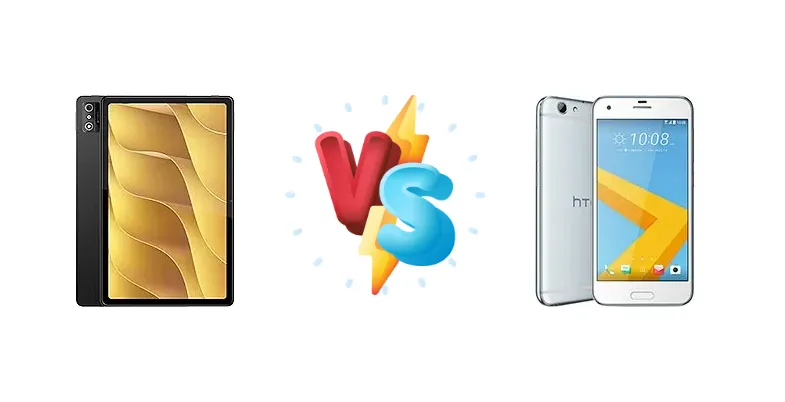
The HTC A104 and HTC One A9s represent HTC's attempts to capture the budget smartphone market. While both devices aim for affordability, they differ significantly in their underlying hardware. The A104 utilizes a newer Unisoc T606 chipset, while the A9s relies on the older Mediatek Helio P10. This comparison will dissect these differences to determine which phone delivers the best experience for the price.
🏆 Quick Verdict
For the average user prioritizing modern architecture and potentially better long-term software support, the HTC A104 is the superior choice. Its Unisoc T606 chipset, built on a 12nm process, offers a more efficient and potentially faster experience than the A9s’ older 28nm Helio P10, despite similar overall performance.
| Network |
|---|
| 2G bands | GSM 850 / 900 / 1800 / 1900 | GSM 850 / 900 / 1800 / 1900 |
| 3G bands | HSDPA 850 / 900 / 1700(AWS) / 1900 / 2100 | HSDPA 850 / 900 / 1900 / 2100 |
| 4G bands | 1, 2, 3, 4, 5, 7, 8, 12, 17, 20, 28, 38, 40, 41 | 1, 2, 3, 4, 5, 7, 8, 12, 17, 28, 38, 40 |
| Speed | HSPA, LTE | HSPA 42.2/5.76 Mbps, LTE (2CA) Cat6 300/50 Mbps |
| Technology | GSM / HSPA / LTE | GSM / HSPA / LTE |
| Launch |
|---|
| Announced | 2023, July 12 | 2016, September. Released 2016, November |
| Status | Available. Released 2023, July | Discontinued |
| Body |
|---|
| Dimensions | 245.6 x 155.4 x 8 mm (9.67 x 6.12 x 0.31 in) | 146.5 x 71.5 x 8 mm (5.77 x 2.81 x 0.31 in) |
| SIM | Nano-SIM + Nano-SIM | Nano-SIM |
| Weight | 460 g (1.01 lb) | 149.8 g (5.29 oz) |
| Display |
|---|
| Protection | - | Corning Gorilla Glass (unspecified version) |
| Resolution | 1200 x 2000 pixels, 5:3 ratio (~225 ppi density) | 720 x 1280 pixels, 16:9 ratio (~294 ppi density) |
| Size | 10.36 inches, 305.5 cm2 (~80.0% screen-to-body ratio) | 5.0 inches, 68.9 cm2 (~65.8% screen-to-body ratio) |
| Type | IPS LCD | Super LCD |
| Platform |
|---|
| CPU | Octa-core (2x1.6 GHz Cortex-A75 & 6x1.6 GHz Cortex-A55) | Octa-core (4x1.8 GHz Cortex-A53 & 4x1.0 GHz Cortex-A53) |
| Chipset | Unisoc T606 (12 nm) | Mediatek MT6755 Helio P10 (28 nm) |
| GPU | Mali-G57 MP1 | Mali-T860MP2 |
| OS | Android 13 | Android 6.0 (Marshmallow), Sense UI |
| Memory |
|---|
| Card slot | microSDXC (uses shared SIM slot) | microSDXC (dedicated slot) |
| Internal | 128GB 8GB RAM | 16GB 2GB RAM, 32GB 3GB RAM |
| | - | eMMC 5.1 |
| Main Camera |
|---|
| Features | LED flash | LED flash, panorama, HDR |
| Single | 5 MP, f/2.2, AF | 13 MP, f/2.2, 28mm (wide), 1.12µm, AF |
| Video | 1080p | 1080p@30fps |
| Selfie camera |
|---|
| Single | 5 MP, f/2.2 | 5 MP, f/2.8, 34mm (standard), 1/5.0", 1.12µm |
| Video | 1080p | - |
| Sound |
|---|
| 3.5mm jack | - | Yes |
| 35mm jack | No | Yes |
| Loudspeaker | Yes, with stereo speakers (4 speakers) | Yes |
| Comms |
|---|
| Bluetooth | 5.0, A2DP, LE | 4.2, A2DP |
| NFC | No | Yes (payments only) |
| Positioning | GPS, GLONASS, GALILEO | GPS, GLONASS |
| Radio | No | FM radio |
| USB | USB Type-C 2.0, OTG, magnetic connector | microUSB 2.0 |
| WLAN | Wi-Fi 802.11 a/b/g/n/ac, dual-band | Wi-Fi 802.11 a/b/g/n |
| Features |
|---|
| Sensors | Accelerometer, gyro | Fingerprint (front-mounted), accelerometer, proximity, compass |
| Battery |
|---|
| Charging | 10W wired | 10W wired |
| Stand-by | - | Up to 432 h (3G) |
| Talk time | - | Up to 13 h (3G) |
| Type | 7000 mAh | Li-Ion 2300 mAh, non-removable |
| Misc |
|---|
| Colors | Black, Silver | Black, Silver, Gold |
| Models | - | One A9s |
| Price | About 180 EUR | About 150 EUR |
HTC A104
- More modern CPU architecture (Cortex-A75)
- More efficient 12nm process
- Potential for better long-term software support
- Limited availability
- 10W charging is slow
HTC One A9s
- Potentially lower price point
- Mature software optimization (due to older chipset)
- Widely available
- Outdated 28nm process
- Less efficient CPU architecture (Cortex-A53)
- Potentially limited software updates
Display Comparison
Neither HTC provides detailed display specifications. However, given their market positioning, both likely feature LCD panels. The A9s, being an older model, may suffer from narrower viewing angles and lower color accuracy. The A104’s newer chipset *could* indicate a slightly better display panel, but this is speculative. Bezels are likely substantial on both devices, typical of this price bracket.
Camera Comparison
Detailed camera specifications are unavailable. Given the price point, both devices likely feature basic camera setups. It's safe to assume both will struggle in low-light conditions. The presence of a 2MP macro camera on either device is largely marketing fluff and offers minimal practical benefit. Image processing will likely be basic on both, prioritizing speed over quality. Without sensor size information, it’s difficult to definitively declare a winner, but the A104’s newer ISP (Image Signal Processor) within the Unisoc T606 *could* offer slightly improved image processing capabilities.
Performance
The core difference lies in the chipsets. The Unisoc T606 in the A104 utilizes a more modern CPU architecture with 2x Cortex-A75 cores alongside 6x Cortex-A55 cores, fabricated on a 12nm process. This contrasts with the Helio P10’s 4x Cortex-A53 cores and another 4x Cortex-A53 cores on a significantly older 28nm process. While clock speeds aren't everything, the A75 cores in the A104 offer a substantial performance uplift per core compared to the A53 cores in the A9s. The 12nm process of the T606 also translates to better thermal efficiency, potentially reducing throttling during sustained workloads. However, the A9s’ older chipset may benefit from more mature software optimization.
Battery Life
Both devices are limited to 10W wired charging. This means charging times will be relatively slow, taking several hours to reach a full charge. Battery capacity is not specified, but given the similar form factors and target market, they likely fall within the 3000-4000 mAh range. The Unisoc T606’s 12nm process offers better power efficiency, potentially translating to slightly longer battery life on the A104, even with a similar capacity battery. However, real-world battery life will heavily depend on usage patterns.
Buying Guide
Buy the HTC A104 if you need a device with a more modern chipset architecture for improved efficiency and potential future software updates. This phone is ideal for users who prioritize a slightly smoother experience with everyday tasks and light multitasking. Buy the HTC One A9s if you are looking for the absolute lowest price point and are willing to compromise on chipset efficiency and potentially long-term software support. It's a viable option for basic communication and minimal app usage.
Frequently Asked Questions
❓ Will the Unisoc T606 in the A104 handle popular apps like WhatsApp and Facebook smoothly?
Yes, the Unisoc T606, with its Cortex-A75 cores, is more than capable of handling everyday apps like WhatsApp, Facebook, and web browsing without significant lag. It offers a noticeable improvement over the Helio P10 in responsiveness for these common tasks.
❓ Is the 10W charging on either phone a significant drawback?
Yes, 10W charging is relatively slow by today's standards. Expect a full charge to take upwards of 2-3 hours. Neither phone prioritizes fast charging, so users should plan to charge overnight.
❓ Does the HTC A104 receive regular software updates?
HTC's update track record is inconsistent. However, the A104, being a newer device, has a higher likelihood of receiving at least some security updates compared to the older A9s. Don't expect major Android version upgrades, though.
❓ Is the Helio P10 in the A9s likely to struggle with multitasking?
Yes, the Helio P10's older architecture and less efficient cores will struggle with heavy multitasking. Switching between multiple apps may result in noticeable lag and slowdowns. It's best suited for running one app at a time.