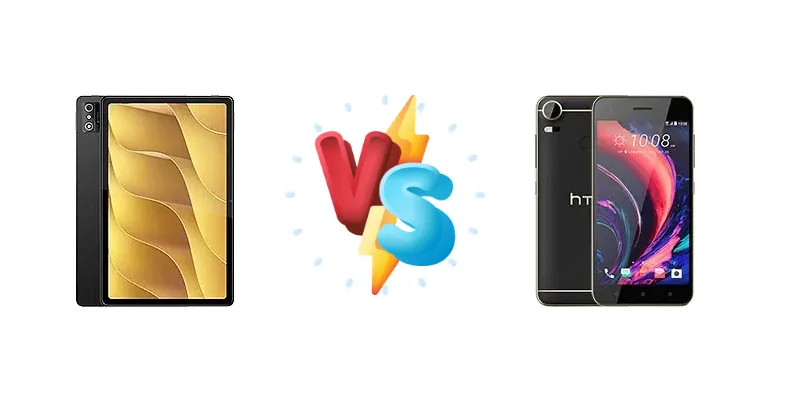
The HTC A104 and Desire 10 Pro represent different eras of HTC's budget smartphone strategy. The A104, a more recent release, leverages the efficiency of a newer chipset, while the Desire 10 Pro relies on the older, but still capable, Mediatek Helio P10. This comparison dissects the key differences to determine which device delivers the best experience for today's user.
🏆 Quick Verdict
For the average user prioritizing efficiency and potential for future software updates, the HTC A104 is the better choice. Its Unisoc T606 chipset, built on a 12nm process, offers a more modern architecture and improved power efficiency compared to the Desire 10 Pro’s 28nm Helio P10, despite similar clock speeds.
| Network |
|---|
| 2G bands | GSM 850 / 900 / 1800 / 1900 | GSM 850 / 900 / 1800 / 1900 - SIM 1 & SIM 2 |
| 3G bands | HSDPA 850 / 900 / 1700(AWS) / 1900 / 2100 | HSDPA 850 / 900 / 1900 / 2100 |
| 4G bands | 1, 2, 3, 4, 5, 7, 8, 12, 17, 20, 28, 38, 40, 41 | 1, 3, 5, 7, 8, 20, 28, 38, 40 |
| Speed | HSPA, LTE | HSPA 42.2/5.76 Mbps, LTE (2CA) Cat6 300/50 Mbps |
| Technology | GSM / HSPA / LTE | GSM / HSPA / LTE |
| Launch |
|---|
| Announced | 2023, July 12 | 2016, September 20. Released 2016, December 20 |
| Status | Available. Released 2023, July | Discontinued |
| Body |
|---|
| Build | - | Glass front (Gorilla Glass), aluminum back, aluminum frame |
| Dimensions | 245.6 x 155.4 x 8 mm (9.67 x 6.12 x 0.31 in) | 156.5 x 76 x 7.9 mm (6.16 x 2.99 x 0.31 in) |
| SIM | Nano-SIM + Nano-SIM | Nano-SIM + Nano-SIM |
| Weight | 460 g (1.01 lb) | 165 g (5.82 oz) |
| Display |
|---|
| Protection | - | Corning Gorilla Glass (unspecified version) |
| Resolution | 1200 x 2000 pixels, 5:3 ratio (~225 ppi density) | 1080 x 1920 pixels, 16:9 ratio (~400 ppi density) |
| Size | 10.36 inches, 305.5 cm2 (~80.0% screen-to-body ratio) | 5.5 inches, 83.8 cm2 (~70.5% screen-to-body ratio) |
| Type | IPS LCD | IPS LCD |
| Platform |
|---|
| CPU | Octa-core (2x1.6 GHz Cortex-A75 & 6x1.6 GHz Cortex-A55) | Octa-core (4x1.8 GHz Cortex-A53 & 4x1.0 GHz Cortex-A53) |
| Chipset | Unisoc T606 (12 nm) | Mediatek MT6755 Helio P10 (28 nm) |
| GPU | Mali-G57 MP1 | Mali-T860MP2 |
| OS | Android 13 | Android 6.0 (Marshmallow) |
| Memory |
|---|
| Card slot | microSDXC (uses shared SIM slot) | microSDXC (uses shared SIM slot) |
| Internal | 128GB 8GB RAM | 64GB 4GB RAM |
| | - | eMMC 5.1 |
| Main Camera |
|---|
| Features | LED flash | Laser AF, Dual-LED dual-tone flash, panorama |
| Single | 5 MP, f/2.2, AF | 20 MP, f/2.2, 28mm (wide) |
| Video | 1080p | 1080p@30fps |
| Selfie camera |
|---|
| Features | - | HDR |
| Single | 5 MP, f/2.2 | 13 MP, f/2.2, 28mm (wide), 1/3.1", 1.12µm |
| Video | 1080p | 1080p@30fps |
| Sound |
|---|
| 3.5mm jack | - | Yes |
| 35mm jack | No | Yes |
| Loudspeaker | Yes, with stereo speakers (4 speakers) | Yes, dual mono speakers |
| Comms |
|---|
| Bluetooth | 5.0, A2DP, LE | 4.2, A2DP, LE |
| NFC | No | Yes |
| Positioning | GPS, GLONASS, GALILEO | GPS, GLONASS |
| Radio | No | FM radio |
| USB | USB Type-C 2.0, OTG, magnetic connector | microUSB 2.0 |
| WLAN | Wi-Fi 802.11 a/b/g/n/ac, dual-band | Wi-Fi 802.11 a/b/g/n, dual-band, Wi-Fi Direct |
| Features |
|---|
| Sensors | Accelerometer, gyro | Fingerprint (rear-mounted), accelerometer, gyro, proximity, compass |
| Battery |
|---|
| Charging | 10W wired | 10W wired |
| Music play | - | Up to 53 h |
| Stand-by | - | Up to 480 h (3G) |
| Talk time | - | Up to 19 h (3G) |
| Type | 7000 mAh | Li-Ion 3000 mAh, non-removable |
| Misc |
|---|
| Colors | Black, Silver | Stone Black, Polar White, Royal Blue, Valentine Lux, Mint Green |
| Models | - | Desire 10 pro, D10i |
| Price | About 180 EUR | About 260 EUR |
HTC A104
- More efficient Unisoc T606 chipset
- Modern CPU architecture (Cortex-A75)
- Potential for longer software support
- Likely better power management
- Limited 10W charging
- Display specs unknown
HTC Desire 10 Pro
- Potentially more mature software (though likely unpatched)
- Slightly higher peak CPU clock speeds (on some cores)
- Established Mediatek chipset
- May be available at a lower price point
- Inefficient 28nm Helio P10 chipset
- Older CPU architecture (Cortex-A53)
- Likely shorter battery life
- Limited software updates
Display Comparison
Neither HTC provides detailed display specifications in the provided data. However, given their market positioning, both likely feature LCD panels. The age difference suggests the A104 *may* benefit from slightly improved color accuracy and viewing angles, but this is speculative. The larger concern is the lack of information regarding PWM dimming rates, which could impact users sensitive to flicker. We can assume both displays are 720p or 1080p, typical for this price bracket.
Camera Comparison
Without sensor details, a direct camera comparison is difficult. However, the market segment suggests both phones feature basic camera setups. The Desire 10 Pro’s age means its image processing algorithms are likely less refined than those found in the A104. The A104’s newer chipset *may* include a more capable ISP (Image Signal Processor), leading to better dynamic range and noise reduction. It’s safe to assume both phones include a primary camera and potentially a depth sensor, but image quality will be heavily reliant on software optimization.
Performance
The core difference lies in the chipsets. The Unisoc T606 in the A104 utilizes a more modern architecture with Cortex-A75 performance cores alongside A55 efficiency cores, built on a 12nm process. This contrasts with the Helio P10’s older Cortex-A53 cores across the board, fabricated on a less efficient 28nm node. While the Helio P10 boasts a higher peak clock speed on some cores (1.8GHz vs 1.6GHz), the architectural improvements of the T606 translate to better sustained performance and significantly improved power efficiency. This means the A104 will likely handle everyday tasks and light multitasking more smoothly and with less heat buildup. Gaming performance will be limited on both, but the A104 will likely offer a more stable experience.
Battery Life
Both devices are limited to 10W wired charging, meaning neither will charge particularly quickly. The actual battery capacity isn't specified, but the Unisoc T606’s superior power efficiency in the A104 will likely result in longer battery life despite potentially having a similar or even slightly smaller battery capacity. The 12nm process node significantly reduces power draw compared to the Helio P10’s 28nm process, translating to more screen-on time.
Buying Guide
Buy the HTC A104 if you need a phone that balances basic functionality with improved power efficiency for all-day use and potentially longer software support. Buy the HTC Desire 10 Pro if you prioritize a slightly more mature software ecosystem (though likely no longer actively updated) and are comfortable with a chipset known for moderate performance in its time, but now showing its age.
Frequently Asked Questions
❓ Will the Unisoc T606 in the A104 struggle with demanding apps like social media or web browsing?
No, the Unisoc T606 is designed for everyday tasks. While it won't excel at high-end gaming, it will handle social media, web browsing, and basic productivity apps without significant lag. The Cortex-A75 cores provide a noticeable performance boost over the older Cortex-A53 cores in the Desire 10 Pro.
❓ Is the 10W charging on either phone a significant drawback?
Yes, 10W charging is relatively slow by today's standards. Expect a full charge to take over two hours. However, the A104’s more efficient chipset means you’ll likely be charging it less frequently, mitigating the impact of the slow charging speed.
❓ Given the age of the Desire 10 Pro, is it still secure to use with current Android app versions?
That's a valid concern. The Desire 10 Pro is likely running an outdated version of Android with limited security updates. This makes it more vulnerable to security threats. The A104, being newer, has a higher chance of receiving at least some security patches.
❓ Does the Helio P10 in the Desire 10 Pro overheat during prolonged use?
The 28nm process of the Helio P10 is known to generate more heat than newer chipsets. While it likely won't cause critical overheating, you may experience noticeable warmth and potential performance throttling during extended gaming sessions or demanding tasks.