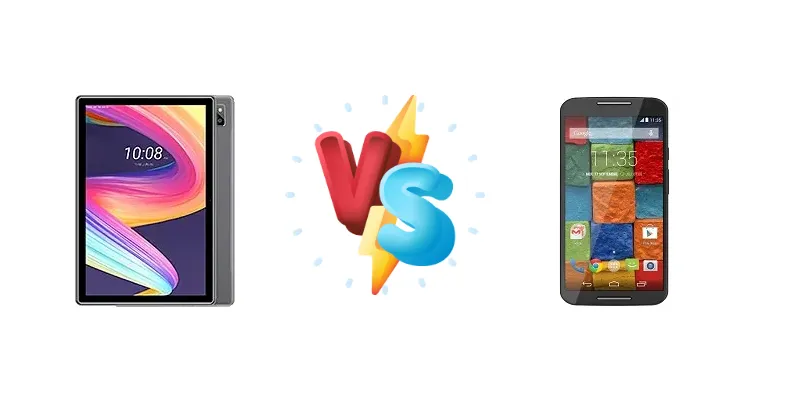
We're pitting a relic of Motorola's flagship past – the Moto X (2nd Gen) from 2014 – against the modern, ultra-budget HTC A103. This isn't about crowning a 'winner' in the traditional sense, but understanding how a high-end chipset from a decade ago fares against current entry-level silicon, and who each phone serves best in today's market.
🏆 Quick Verdict
For the average user in 2024, the Motorola Moto X (2nd Gen) offers a surprisingly capable experience thanks to its significantly more powerful Snapdragon 801. While the HTC A103 benefits from newer software support, the performance gap is too large to ignore for anyone beyond the most basic smartphone tasks.
| Network |
|---|
| 2G bands | GSM 850 / 900 / 1800 / 1900 | GSM 850 / 900 / 1800 / 1900 - all versions |
| 3G bands | HSDPA 900 / 2100 | HSDPA 850 / 900 / 1900 / 2100 - EU, AT&T, Verizon |
| 4G bands | 1, 3, 5, 7, 8, 20, 38, 40, 41 | 2, 3, 4, 5, 7, 17 - XT1097 AT&T, XT1095 T-Mobile |
| Speed | HSPA, LTE | HSPA 42.2/5.76 Mbps, LTE Cat4 150/50 Mbps |
| Technology | GSM / HSPA / LTE | GSM / CDMA / HSPA / LTE |
| | - | 1, 3, 7, 20 - India |
| Launch |
|---|
| Announced | 2023, July | 2014, September. Released 2014, September |
| Status | Available. Released 2023, August | Discontinued |
| Body |
|---|
| Dimensions | 244 x 162.6 x 8.5 mm (9.61 x 6.40 x 0.33 in) | 140.8 x 72.4 x 10 mm (5.54 x 2.85 x 0.39 in) |
| SIM | Nano-SIM + Nano-SIM | Nano-SIM |
| Weight | 440 g (15.52 oz) | 144 g (5.08 oz) |
| | - | Water resistant |
| Display |
|---|
| Protection | - | Corning Gorilla Glass 3 |
| Resolution | 800 x 1280 pixels, 16:10 ratio (~149 ppi density) | 1080 x 1920 pixels, 16:9 ratio (~424 ppi density) |
| Size | 10.1 inches, 295.8 cm2 (~74.6% screen-to-body ratio) | 5.2 inches, 74.5 cm2 (~73.1% screen-to-body ratio) |
| Type | IPS LCD | AMOLED |
| Platform |
|---|
| CPU | Quad-core 2.0 GHz Cortex-A53 | Quad-core 2.5 GHz Krait 400 |
| Chipset | Mediatek MT6761B Helio A22 (12 nm) | Qualcomm MSM8974AC Snapdragon 801 (28 nm) |
| GPU | PowerVR GE8320 | Adreno 330 |
| OS | Android 13 | Android 4.4.4 (KitKat), upgradable to 6.0 (Marshmallow) |
| Memory |
|---|
| Card slot | microSDXC (uses shared SIM slot) | No |
| Internal | 64GB 4GB RAM | 16GB 2GB RAM, 32GB 2GB RAM, 64GB 2GB RAM (AT&T, T-Mobile) |
| | - | eMMC 5.0 |
| Main Camera |
|---|
| Features | LED flash | Dual-LED flash, panorama, HDR |
| Single | 5 MP | 13 MP, f/2.2, 29mm (standard), 1/3.1", 1.13µm, AF |
| Video | 1080p | 4K@30fps, 1080p@30fps, HDR |
| Selfie camera |
|---|
| Single | 5 MP, f/2.2 | 2 MP, f/2.2 |
| Video | 720p | 1080p@30fps |
| Sound |
|---|
| 3.5mm jack | - | Yes |
| 35mm jack | Yes | Yes |
| Loudspeaker | Yes, with stereo speakers | Yes |
| Comms |
|---|
| Bluetooth | 5.0, A2DP, LE | 4.0, A2DP, EDR, LE, aptX |
| NFC | No | Yes |
| Positioning | GPS, GLONASS | GPS, GLONASS |
| Radio | No | No |
| USB | USB Type-C 2.0, OTG | microUSB 2.0, OTG |
| WLAN | Wi-Fi 802.11 a/b/g/n/ac, dual-band | Wi-Fi 802.11 a/b/g/n/ac, dual-band, DLNA, hotspot |
| Features |
|---|
| Sensors | Accelerometer, gyro | Accelerometer, gyro, proximity, compass, barometer, temperature |
| Battery |
|---|
| Charging | 10W wired | 15W wired, QC2 |
| Type | Li-Po 6000 mAh | Li-Ion 2300 mAh, non-removable |
| Misc |
|---|
| Colors | Gray, Silver | Black, White |
| Models | - | XT1097, XT1096, XT1095, XT1092, XT1085, XT1093 |
| Price | About 140 EUR | About 320 EUR |
| SAR | - | 1.46 W/kg (head) 1.27 W/kg (body) |
| SAR EU | - | 0.49 W/kg (head) 0.69 W/kg (body) |
| Tests |
|---|
| Audio quality | - |
Noise -93.5dB / Crosstalk -93.8dB |
| Battery life | - |
Endurance rating 48h
|
| Camera | - |
Photo / Video |
| Loudspeaker | - |
Voice 66dB / Noise 66dB / Ring 72dB
|
| Performance | - |
Basemark OS II 2.0: 1176Basemark X: 11855 |
HTC A103
- Newer software support (potentially)
- More modern manufacturing process (12nm)
- Likely lower price point
- Significantly weaker performance
- Likely lower quality display
- Limited camera capabilities
Motorola Moto X (2nd Gen)
- Far superior performance (Snapdragon 801)
- AMOLED display (better contrast and colors)
- Faster charging (15W with QC2)
- Old device – limited software support
- Battery degradation
- Potentially harder to find
Display Comparison
Display specifications are unavailable for the HTC A103. The Motorola Moto X (2nd Gen) featured a 5.2-inch AMOLED display. The key advantage here isn't resolution, but the AMOLED panel itself, offering superior contrast and color vibrancy compared to the likely LCD panel on the A103. The older Moto X also benefits from a more mature display calibration process, potentially resulting in better color accuracy. However, the A103's newer manufacturing process *could* lead to improved power efficiency, though this is speculative without display specs.
Camera Comparison
Both devices offer photo and video capabilities, but details are limited. The Motorola Moto X (2nd Gen) was known for its relatively good low-light performance for its time, thanks to its larger sensor and image processing algorithms. The A103’s camera performance is likely to be significantly lower, typical of budget smartphones. Without sensor size or aperture information for either device, a detailed comparison is impossible, but the Moto X’s age doesn’t necessarily equate to a worse camera experience, given the advancements in computational photography since its release.
Performance
The performance disparity is stark. The Motorola Moto X (2nd Gen) boasts a Qualcomm MSM8974AC Snapdragon 801 with a quad-core 2.5 GHz Krait 400 CPU, built on a 28nm process. This significantly outpaces the HTC A103’s Mediatek MT6761B Helio A22 (12nm) and its 2.0 GHz Cortex-A53 cores. The Snapdragon 801’s Krait architecture was a performance leader in its time, offering substantially better single-core and multi-core performance. While the Helio A22 benefits from a smaller 12nm node, the architectural advantage of the Snapdragon 801 is overwhelming. This translates to faster app loading, smoother multitasking, and the ability to handle more demanding applications. The Moto X will also be far more capable with older, but still popular, Android games.
Battery Life
The Motorola Moto X (2nd Gen) achieved an impressive 48-hour endurance rating in its prime. The HTC A103 offers 10W wired charging. While the A103’s battery capacity is unknown, the Moto X’s endurance rating suggests a well-optimized combination of battery size and power efficiency. The Moto X also supports 15W charging with Quick Charge 2.0, offering faster replenishment than the A103. However, battery degradation over the past decade will impact the Moto X’s real-world battery life, potentially narrowing the gap.
Buying Guide
Buy the HTC A103 if you absolutely need a phone with guaranteed software updates and are primarily focused on extremely light tasks like calls, texts, and basic messaging apps. Buy the Motorola Moto X (2nd Gen) if you prioritize performance for older games, smoother multitasking, and a more responsive user experience, and are comfortable with a device that's past its official software support lifecycle.
Frequently Asked Questions
❓ Will the Motorola Moto X (2nd Gen) struggle with modern apps?
While the Snapdragon 801 is surprisingly capable, the Moto X (2nd Gen) will likely struggle with the most demanding modern apps and games. Apps optimized for newer architectures will run slower, and some may not be compatible at all. However, it should handle most common tasks like web browsing, social media, and messaging without issue.
❓ Is the lack of software updates on the Motorola Moto X (2nd Gen) a major security risk?
Yes, the lack of security updates is a significant concern. Without regular security patches, the Moto X (2nd Gen) is vulnerable to known exploits. It's strongly recommended to avoid using it for sensitive tasks like online banking or storing personal information.
❓ How much does the 10W charging on the HTC A103 impact usability?
10W charging is quite slow by today's standards. Expect a significantly longer time to fully charge the HTC A103 compared to the Motorola Moto X (2nd Gen)'s 15W Quick Charge 2.0. This means you'll need to plan ahead and charge the phone overnight or during extended periods of inactivity.
❓ Can I expect to play modern mobile games on the HTC A103?
The Helio A22 in the HTC A103 is a very basic chipset. While it can handle some older or less demanding games, you'll likely experience significant lag and low frame rates in most modern titles. It's not a gaming-focused device.