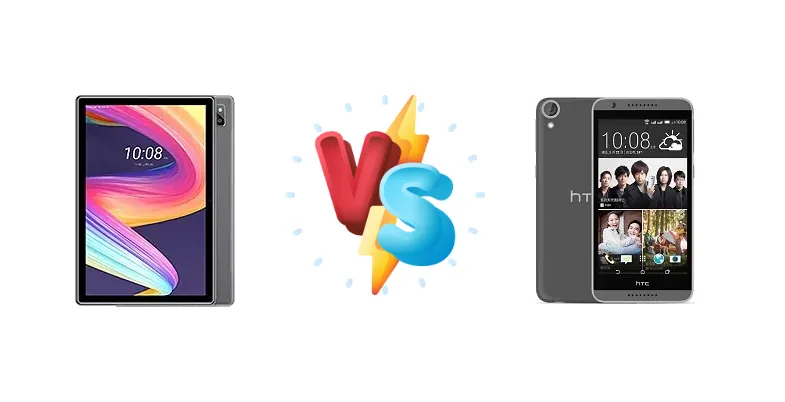
The HTC A103 and Desire 820G+ represent different approaches to the budget smartphone market. The A103, with its newer chipset, aims for efficiency and a streamlined Android experience, while the 820G+ relies on an older, octa-core processor to deliver more raw processing power. This comparison dissects their key differences to determine which device offers the best value.
🏆 Quick Verdict
For the average user prioritizing battery life and a smoother, more modern software experience, the HTC A103 is the better choice. Its Mediatek MT6761B Helio A22, despite having fewer cores, is built on a more efficient 12nm process, resulting in better power management than the Desire 820G+'s older 28nm MT6592.
| Network |
|---|
| 2G bands | GSM 850 / 900 / 1800 / 1900 | GSM 850 / 900 / 1800 / 1900 - SIM 1 & SIM 2 |
| 3G bands | HSDPA 900 / 2100 | HSDPA 850 / 900 / 2100 |
| 4G bands | 1, 3, 5, 7, 8, 20, 38, 40, 41 | - |
| Speed | HSPA, LTE | HSPA |
| Technology | GSM / HSPA / LTE | GSM / HSPA |
| Launch |
|---|
| Announced | 2023, July | 2015, May. Released 2015, June |
| Status | Available. Released 2023, August | Discontinued |
| Body |
|---|
| Dimensions | 244 x 162.6 x 8.5 mm (9.61 x 6.40 x 0.33 in) | 157.7 x 78.7 x 7.7 mm (6.21 x 3.10 x 0.30 in) |
| SIM | Nano-SIM + Nano-SIM | Nano-SIM + Nano-SIM |
| Weight | 440 g (15.52 oz) | 154.5 g (5.47 oz) |
| Display |
|---|
| Resolution | 800 x 1280 pixels, 16:10 ratio (~149 ppi density) | 720 x 1280 pixels, 16:9 ratio (~267 ppi density) |
| Size | 10.1 inches, 295.8 cm2 (~74.6% screen-to-body ratio) | 5.5 inches, 83.4 cm2 (~67.2% screen-to-body ratio) |
| Type | IPS LCD | IPS LCD |
| Platform |
|---|
| CPU | Quad-core 2.0 GHz Cortex-A53 | Octa-core 1.7 GHz Cortex-A7 |
| Chipset | Mediatek MT6761B Helio A22 (12 nm) | Mediatek MT6592 (28 nm) |
| GPU | PowerVR GE8320 | Mali-450MP4 |
| OS | Android 13 | Android 4.4.2 (KitKat), Sense UI 6 |
| Memory |
|---|
| Card slot | microSDXC (uses shared SIM slot) | microSDHC (dedicated slot) |
| Internal | 64GB 4GB RAM | 16GB 1GB RAM |
| Main Camera |
|---|
| Features | LED flash | LED flash, HDR, panorama |
| Single | 5 MP | 13 MP, f/2.2, 28mm (wide), AF |
| Video | 1080p | 1080p@30fps |
| Selfie camera |
|---|
| Single | 5 MP, f/2.2 | 8 MP, f/2.3 |
| Video | 720p | 1080p@30fps |
| Sound |
|---|
| 35mm jack | Yes | Yes |
| Loudspeaker | Yes, with stereo speakers | Yes, with stereo speakers |
| Comms |
|---|
| Bluetooth | 5.0, A2DP, LE | 4.0, A2DP |
| NFC | No | No |
| Positioning | GPS, GLONASS | GPS |
| Radio | No | FM radio |
| USB | USB Type-C 2.0, OTG | microUSB 2.0 |
| WLAN | Wi-Fi 802.11 a/b/g/n/ac, dual-band | Wi-Fi 802.11 b/g/n, hotspot |
| Features |
|---|
| Sensors | Accelerometer, gyro | Accelerometer, proximity, compass |
| Battery |
|---|
| Charging | 10W wired | - |
| Stand-by | - | Up to 600 h (2G) / Up to 560 h (3G) |
| Talk time | - | Up to 32 h (2G) / Up to 12 h (3G) |
| Type | Li-Po 6000 mAh | Li-Po 2600 mAh, non-removable |
| Misc |
|---|
| Colors | Gray, Silver | Marble White, Dovetail gray |
| Models | - | Desire 820G PLUS dua, Desire_820G_PLUS_dua |
| Price | About 140 EUR | About 180 EUR |
HTC A103
- More efficient processor (12nm)
- Potentially longer battery life
- Likely benefits from newer software optimizations
- Fewer CPU cores
- Lower peak performance in multi-threaded tasks
HTC Desire 820G+ dual sim
- Octa-core processor for multitasking
- Potentially better performance in specific apps
- Dual SIM functionality
- Less efficient processor (28nm)
- Shorter battery life
- Older chipset architecture
Display Comparison
Neither HTC provides detailed display specifications. However, given their market positioning, both likely feature LCD panels with 720p resolutions. The key difference lies in the underlying architecture impacting power draw. The A103’s newer chipset likely allows for more efficient display management, potentially extending battery life during media consumption. Bezels are expected to be substantial on both devices, typical of this price bracket.
Camera Comparison
Without detailed camera specifications, a direct comparison is difficult. Both phones likely feature basic camera setups geared towards casual photography. Given the age of the Desire 820G+, its image processing capabilities are likely less refined than what the A103 can offer, even with similar sensor sizes. The A103’s newer chipset may include improved image signal processing (ISP) features, resulting in better dynamic range and noise reduction. We can assume both phones will have a primary camera and potentially a secondary depth or VGA sensor.
Performance
The core difference here is architectural. The HTC Desire 820G+ boasts an octa-core 1.7 GHz Cortex-A7 processor built on a 28nm process. While eight cores sound impressive, the Cortex-A7 is an older architecture. The HTC A103 utilizes a quad-core 2.0 GHz Cortex-A53 processor fabricated on a much more efficient 12nm process. This smaller node allows for lower voltage operation, translating to less heat and better battery life. While the 820G+ may show an advantage in heavily multi-threaded tasks, the A103’s efficiency will be more noticeable in everyday use. The A103’s CPU clock speed is also higher, potentially offsetting the core count difference in single-core performance.
Battery Life
Battery capacity is not specified for either device. However, the A103’s 12nm chipset and efficient CPU architecture give it a significant advantage in battery life. The 820G+'s 28nm process is inherently less efficient, meaning it will consume more power for the same tasks. The A103 supports 10W wired charging, while the 820G+'s charging speed is unknown but likely similar. The A103’s efficiency will translate to longer usage times between charges, even with a potentially smaller battery capacity.
Buying Guide
Buy the HTC A103 if you need a phone that lasts throughout the day on a single charge and benefits from a cleaner, potentially Android Go-optimized software experience. Buy the HTC Desire 820G+ dual sim if you prioritize multitasking and running more demanding apps, understanding that this will come at the cost of reduced battery life and potentially slower software updates.
Frequently Asked Questions
❓ Will the HTC Desire 820G+ struggle with modern apps due to its older processor?
Yes, the Mediatek MT6592, while capable for its time, is showing its age. Expect slower loading times and potential lag when running newer, more demanding applications. The A103’s Helio A22, despite having fewer cores, is a more modern design and will handle these tasks more smoothly.
❓ Is the dual SIM functionality of the Desire 820G+ useful for travel?
The dual SIM capability of the Desire 820G+ is highly beneficial for travelers who want to use a local SIM card alongside their primary SIM, avoiding roaming charges. However, the A103 may also offer dual SIM functionality depending on the specific regional variant.
❓ Does the HTC A103 support Android updates?
Given its budget nature, the A103 is unlikely to receive major Android version updates. However, it may receive security patches for a limited time. The Desire 820G+ is even less likely to receive updates due to its age.