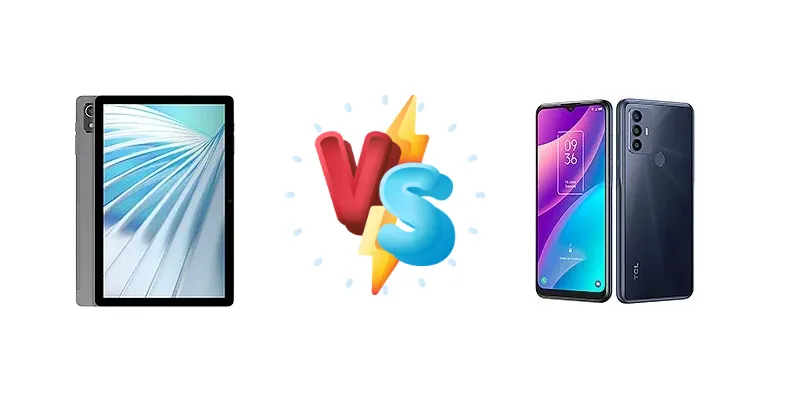
The HTC A103 Plus and TCL 30 SE represent the lower end of the Android smartphone market, targeting users prioritizing affordability. Both devices utilize Mediatek chipsets, but subtle differences in processing power and charging capabilities create a clear distinction for those seeking the best value in this segment. This comparison dissects these nuances to help you choose the right phone.
🏆 Quick Verdict
For the average user, the TCL 30 SE emerges as the better choice. While both phones share a similar CPU core configuration, the Helio G25 chipset offers a slight performance edge, coupled with the convenience of 15W fast charging, making it a more practical daily driver.
| Network |
|---|
| 2G bands | GSM 850 / 900 / 1800 / 1900 | GSM 850 / 900 / 1800 / 1900 |
| 3G bands | HSDPA 850 / 900 / 2100 | HSDPA 850 / 900 / 1900 / 2100 - EMEA/APAC |
| 4G bands | 1, 3, 5, 7, 8, 20, 38, 40, 41 | 1, 3, 5, 7, 8, 20, 28, 38, 40, 41 - EMEA |
| Speed | HSPA, LTE | HSPA 42.2/11.5 Mbps, LTE Cat4 150/50 Mbps |
| Technology | GSM / HSPA / LTE | GSM / HSPA / LTE |
| | - | 2, 3, 4, 5, 7, 8, 12, 13, 17, 26, 28, 66 - LATAM |
| Launch |
|---|
| Announced | 2023, July 19 | 2022, February 27 |
| Status | Available. Released 2023, August | Available. Released 2022, April 20 |
| Body |
|---|
| Build | - | Glass front, plastic frame, plastic back |
| Dimensions | 239.2 x 157.9 x 7.9 mm (9.42 x 6.22 x 0.31 in) | 165.2 x 75.5 x 8.9 mm (6.50 x 2.97 x 0.35 in) |
| SIM | Nano-SIM + Nano-SIM | · Nano-SIM· Nano-SIM + Nano-SIM |
| Weight | 430 g (15.17 oz) | 190 g (6.70 oz) |
| Display |
|---|
| Resolution | 1200 x 1920 pixels, 16:10 ratio (~224 ppi density) | 720 x 1600 pixels, 20:9 ratio (~269 ppi density) |
| Size | 10.1 inches, 295.8 cm2 (~78.3% screen-to-body ratio) | 6.52 inches, 102.6 cm2 (~82.3% screen-to-body ratio) |
| Type | IPS LCD | IPS LCD, 450 nits (typ) |
| Platform |
|---|
| CPU | Octa-core (4x2.0 GHz Cortex-A53 & 4x1.5 GHz Cortex-A53) | Octa-core (4x2.0 GHz Cortex-A53 & 4x1.5 GHz Cortex-A53) |
| Chipset | Mediatek MT8768A (12 nm) | Mediatek MT6762G Helio G25 (12 nm) |
| GPU | PowerVR GE8320 | PowerVR GE8320 |
| OS | Android 13 | Android 12, TCL UI 4.0 |
| Memory |
|---|
| Card slot | microSDXC (uses shared SIM slot) | microSDXC (dedicated slot) |
| Internal | 64GB 4GB RAM | 64GB 4GB RAM, 128GB 4GB RAM |
| | - | eMMC 5.1 |
| Main Camera |
|---|
| Features | LED flash | LED flash, HDR, panorama |
| Single | 5 MP, f/2.2, AF | 8 MP, f/2.0, 26mm (wide), 1/4", 1.12µm |
| Triple | - | 50 MP, f/1.9, 28mm (wide), 1/2.76", 0.64µm, PDAF
2 MP (macro)
Auxiliary lens |
| Video | 1080p | 1080p@30fps |
| Selfie camera |
|---|
| Features | - | HDR |
| Single | 5 MP | 8 MP, f/2.0, 26mm (wide), 1/4.0", 1.12µm |
| Video | 1080p | 1080p@30fps |
| Sound |
|---|
| 3.5mm jack | - | Yes |
| 35mm jack | No | Yes |
| Loudspeaker | Yes | Yes |
| Comms |
|---|
| Bluetooth | 5.0, A2DP, LE | 5.0, A2DP, LE |
| NFC | No | Yes (6165H/6165H1 only) |
| Positioning | GPS, GLONASS, GALILEO | GPS, GLONASS, GALILEO, BDS |
| Radio | No | Unspecified |
| USB | USB Type-C 2.0, OTG | USB Type-C 2.0 |
| WLAN | Wi-Fi 802.11 a/b/g/n/ac, dual-band | Wi-Fi 802.11 b/g/n, Wi-Fi Direct |
| Features |
|---|
| Sensors | Accelerometer, gyro, proximity | Fingerprint (rear-mounted), accelerometer, proximity, compass |
| Battery |
|---|
| Charging | 10W wired | 15W wired |
| Type | Li-Po 6000 mAh | Li-Po 5000 mAh |
| Misc |
|---|
| Colors | Gray | Atlantic Blue, Space Gray, Glacial Blue |
| Models | - | 6165H, 6156H1, 6165A, 6165A1, 6165S |
| Price | About 190 EUR | - |
HTC A103 Plus
- Potential for cleaner software experience (though updates are unlikely)
- Established brand recognition
- May be available through specific carrier channels
- Slower 10W charging
- Less powerful chipset (MT8768A)
- Limited software support
TCL 30 SE
- Faster 15W charging
- Slightly more capable chipset (Helio G25)
- Competitive price point
- TCL's software skin can be bloated
- Camera quality is likely average
- Build quality may feel less premium
Display Comparison
Neither HTC nor TCL provide display specifications beyond the basic panel type. Given the price point, both likely utilize IPS LCD panels with 720p+ resolution. The absence of details like peak brightness or color gamut coverage suggests a focus on cost reduction. Bezels are expected to be substantial on both devices, impacting the overall screen-to-body ratio. Color accuracy will likely be standard for this segment, prioritizing power efficiency over fidelity.
Camera Comparison
Camera details are sparse for both devices. It's safe to assume both feature a primary rear camera, likely around 8-13MP, and a basic front-facing camera for video calls. The inclusion of a 2MP macro camera on the TCL 30 SE is largely a marketing tactic, offering limited practical benefit due to the low resolution and lack of optical image stabilization (OIS). Image processing will be basic on both, relying heavily on software algorithms to enhance image quality. Expect acceptable results in well-lit conditions, but poor performance in low light.
Performance
Both the HTC A103 Plus and TCL 30 SE are powered by octa-core processors with the same core configuration: four Cortex-A53 cores clocked at 2.0 GHz and four at 1.5 GHz. However, the TCL 30 SE utilizes the Mediatek Helio G25 (MT6762G), while the HTC A103 Plus uses the MT8768A. The Helio G25 benefits from a slightly newer architecture and potentially optimized power management, resulting in marginally better performance in everyday tasks and light gaming. Both devices will struggle with demanding applications, but the G25 offers a smoother experience for social media, web browsing, and basic productivity. RAM configurations are not specified, but both are likely to feature 2GB or 3GB, impacting multitasking capabilities.
Battery Life
Battery capacity is not specified for either device, but both likely house batteries in the 4000-5000 mAh range, typical for this price segment. The TCL 30 SE’s 15W wired charging is a significant advantage over the HTC A103 Plus’s 10W charging. This translates to a faster 0-100% charge time, reducing downtime and improving usability. While a larger battery capacity would be ideal, the faster charging speed of the TCL 30 SE mitigates the impact of a potentially smaller battery.
Buying Guide
Buy the HTC A103 Plus if you prioritize brand recognition and a potentially cleaner software experience, though software updates are unlikely. Buy the TCL 30 SE if you value faster charging speeds, a marginally more capable chipset for multitasking, and a more competitive price point, making it ideal for first-time smartphone users or those needing a reliable backup device.
Frequently Asked Questions
❓ Will the TCL 30 SE handle popular social media apps like TikTok and Instagram smoothly?
Yes, the Helio G25 chipset in the TCL 30 SE is sufficient for running social media applications like TikTok and Instagram without significant lag. However, expect some slowdown when multitasking or running other demanding apps simultaneously.
❓ Is the 10W charging on the HTC A103 Plus noticeably slower than the 15W charging on the TCL 30 SE?
Yes, the difference between 10W and 15W charging is noticeable. The TCL 30 SE will charge approximately 30-50% faster, reducing the time spent tethered to a power outlet. This is particularly beneficial for users who frequently need to top up their battery throughout the day.
❓ Can either of these phones run PUBG Mobile, and if so, at what settings?
Both phones can technically run PUBG Mobile, but only at the lowest graphics settings and frame rates. Expect significant frame drops and a less-than-ideal gaming experience. These phones are not designed for demanding gaming.
❓ Do either of these phones support software updates beyond the initial Android version?
Software update support is limited for both devices. Given their price point and target market, it's unlikely they will receive major Android version updates or frequent security patches. Expect a basic Android Go edition experience on at least one of the devices.