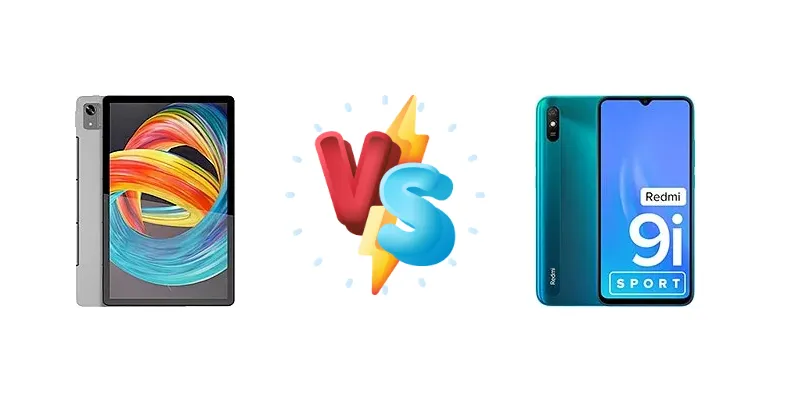
Both the HTC A102 and Xiaomi Redmi 9i Sport target the ultra-budget smartphone market, but they take different approaches to delivering value. The A102 prioritizes processing power with a more capable chipset, while the Redmi 9i Sport focuses on affordability. This comparison dissects the key differences to determine which device best suits your needs.
🏆 Quick Verdict
For users prioritizing responsiveness and smoother multitasking, the HTC A102 is the clear winner. Its Mediatek Helio G85 chipset, featuring Cortex-A75 cores, provides a noticeable performance advantage over the Redmi 9i Sport’s Helio G25. However, the Redmi 9i Sport remains a viable option for basic usage and those on the tightest of budgets.
| Network |
|---|
| 2G bands | GSM 850 / 900 / 1800 / 1900 | GSM 850 / 900 / 1800 / 1900 |
| 3G bands | HSDPA 850 / 900 / 1700(AWS) / 1900 / 2100 | HSDPA 850 / 900 / 2100 |
| 4G bands | 1, 2, 3, 4, 5, 7, 8, 20, 38, 39, 40, 41 | 1, 3, 5, 8, 40, 41 |
| Speed | HSPA, LTE | HSPA, LTE |
| Technology | GSM / CDMA / HSPA / CDMA2000 / LTE | GSM / HSPA / LTE |
| Launch |
|---|
| Announced | 2023, July 13 | 2021, September 28 |
| Status | Available. Released 2023, August | Available. Released 2021, September 28 |
| Body |
|---|
| Dimensions | 257.9 x 162.5 x 7.9 mm (10.15 x 6.40 x 0.31 in) | 164.9 x 77.1 x 9 mm (6.49 x 3.04 x 0.35 in) |
| SIM | Nano-SIM + Nano-SIM | Nano-SIM + Nano-SIM |
| Weight | 533 g (1.18 lb) | 194 g (6.84 oz) |
| | - | Water-repellent coating |
| Display |
|---|
| Resolution | 1200 x 2000 pixels, 5:3 ratio (~212 ppi density) | 720 x 1600 pixels, 20:9 ratio (~269 ppi density) |
| Size | 11.0 inches, 344.4 cm2 (~82.2% screen-to-body ratio) | 6.53 inches, 102.9 cm2 (~81.0% screen-to-body ratio) |
| Type | IPS LCD | IPS LCD, 400 nits (typ) |
| Platform |
|---|
| CPU | Octa-core (2x2.0 GHz Cortex-A75 & 6x1.8 GHz Cortex-A55) | Octa-core (4x2.0 GHz Cortex-A53 & 4x1.5 GHz Cortex-A53) |
| Chipset | Mediatek MT6769 Helio G85 (12 nm) | Mediatek MT6762G Helio G25 (12 nm) |
| GPU | Mali-G52 MC2 | PowerVR GE8320 |
| OS | Android 12 | Android 10, MIUI 12 |
| Memory |
|---|
| Card slot | microSDXC (uses shared SIM slot) | microSDXC (dedicated slot) |
| Internal | 128GB 8GB RAM | 64GB 4GB RAM, 128GB 4GB RAM |
| | - | eMMC 5.1 |
| Main Camera |
|---|
| Features | LED flash | LED flash, HDR |
| Single | 20 MP, f/2.2, AF | 13 MP, f/2.2, 28mm (wide), 1.0µm, PDAF |
| Video | 1080p | 1080p@30fps |
| Selfie camera |
|---|
| Features | - | HDR |
| Single | 8 MP, f/2.2 | 5 MP, f/2.2, (wide), 1.12µm |
| Video | 720p | 1080p@30fps |
| Sound |
|---|
| 3.5mm jack | - | Yes |
| 35mm jack | No | Yes |
| Loudspeaker | Yes | Yes |
| Comms |
|---|
| Bluetooth | 5.0, A2DP, LE | 5.0, A2DP, LE |
| NFC | No | No |
| Positioning | GPS, GLONASS, GALILEO | GPS, GLONASS, BDS |
| Radio | No | FM radio |
| USB | USB Type-C 2.0, OTG, magnetic connector | microUSB 2.0, OTG |
| WLAN | Wi-Fi 802.11 a/b/g/n/ac, dual-band | Wi-Fi 802.11 а/b/g/n, Wi-Fi Direct |
| Features |
|---|
| Sensors | Accelerometer, gyro, proximity | Accelerometer, proximity, compass |
| Battery |
|---|
| Charging | 18W wired | 10W wired |
| Type | Li-Po 8000 mAh | Li-Po 5000 mAh |
| Misc |
|---|
| Colors | Gray | Carbon Black, Coral Green, Metallic Blue |
| Price | About 170 EUR | About 100 EUR |
HTC A102
- Significantly faster processor for smoother performance
- Faster 18W charging for reduced downtime
- More capable GPU for gaming
- Likely a slightly higher price point
- May not have significantly better camera performance without knowing sensor details
Xiaomi Redmi 9i Sport
- More affordable price
- Decent battery life for basic usage
- Reliable for essential smartphone functions
- Slower processor struggles with demanding tasks
- Slow 10W charging
- Limited gaming capabilities
Display Comparison
Neither device boasts a standout display. Given the context data focuses on processing, we can infer both likely utilize standard LCD panels. The real difference lies in how the chipsets drive them. The A102’s more powerful GPU will likely result in smoother scrolling and animations, even if the resolution and refresh rate are identical. Bezels are likely comparable given the price point, and color accuracy is unlikely to be a strong suit on either.
Camera Comparison
Without specific camera specs, it’s safe to assume both phones feature basic camera setups geared towards casual photography. The A102’s more powerful ISP (Image Signal Processor) within the Helio G85 will likely result in slightly better image processing, particularly in low-light conditions. However, the overall image quality will be heavily dependent on the sensor size and lens aperture, which are unknown. It’s probable both phones include a 2MP macro camera, which offers limited practical benefit due to its low resolution.
Performance
The core difference between these phones is the chipset. The HTC A102’s Mediatek Helio G85 features a CPU configuration of 2x2.0 GHz Cortex-A75 cores and 6x1.8 GHz Cortex-A55 cores. This is a significant upgrade over the Redmi 9i Sport’s Helio G25, which uses 4x2.0 GHz Cortex-A53 cores and 4x1.5 GHz Cortex-A53 cores. The Cortex-A75 cores in the A102 offer substantially higher single-core performance, translating to faster app launch times and a more responsive user interface. The A102 will handle demanding tasks and multitasking far more effectively. The G85 also has a more capable GPU, making it better suited for gaming. The Redmi 9i Sport’s G25 is adequate for basic tasks, but will struggle with graphically intensive games.
Battery Life
While the battery capacity isn’t specified, the charging wattage is a key differentiator. The HTC A102 supports 18W wired charging, while the Redmi 9i Sport is limited to 10W. This means the A102 will charge significantly faster, reducing downtime. Even if the A102 has a slightly smaller battery, the faster charging speed will likely result in a more convenient user experience. A full charge on the Redmi 9i Sport will take considerably longer.
Buying Guide
Buy the HTC A102 if you need a phone capable of handling moderate gaming, running multiple apps simultaneously, or simply desire a more fluid user experience. It’s ideal for students or users who frequently use social media and streaming services. Buy the Xiaomi Redmi 9i Sport if you prioritize absolute affordability and only require a phone for basic tasks like calls, texts, and light web browsing. It’s a good choice for first-time smartphone users or as a reliable backup device.
Frequently Asked Questions
❓ Will the HTC A102 handle popular games like PUBG Mobile or Call of Duty Mobile?
The Helio G85 in the HTC A102 is capable of running PUBG Mobile and Call of Duty Mobile, but you’ll likely need to lower the graphics settings to achieve a smooth frame rate. The Redmi 9i Sport’s Helio G25 will struggle with these games, even on the lowest settings.
❓ How long will it take to fully charge each phone?
With 18W charging, the HTC A102 should fully charge in approximately 2-2.5 hours, assuming a typical battery capacity for this segment. The Redmi 9i Sport’s 10W charging will take significantly longer, likely around 3.5-4 hours for a full charge.
❓ Is the difference in processors noticeable for everyday tasks like browsing and social media?
Yes, the difference is noticeable. The HTC A102’s Cortex-A75 cores provide a snappier experience when opening apps, scrolling through web pages, and multitasking. The Redmi 9i Sport may exhibit slight lag or delays during these tasks.
❓ Does either phone support fast charging protocols beyond the advertised wattage (e.g., Power Delivery)?
It's unlikely either phone supports advanced fast charging protocols like Power Delivery. They are both entry-level devices and typically utilize standard charging technologies. Using a higher-wattage charger *may* not result in faster charging speeds.