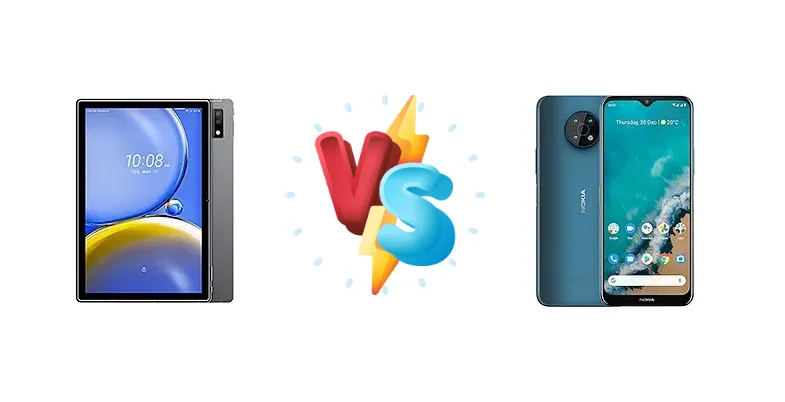
The HTC A101 and Nokia G50 represent two approaches to the budget 5G smartphone market. The A101 leverages Unisoc’s Tiger T618 chipset, while the Nokia G50 opts for Qualcomm’s Snapdragon 480. This comparison dissects their core components to determine which device delivers the best value for users prioritizing connectivity and affordability.
🏆 Quick Verdict
For the average user, the Nokia G50 is the stronger choice. Its Snapdragon 480, built on an 8nm process, offers superior efficiency and 5G performance compared to the A101’s 12nm Unisoc T618. While the A101 is a viable option, the G50’s faster 18W charging and more refined chipset provide a smoother overall experience.
| Network |
|---|
| 2G bands | GSM 850 / 900 / 1800 / 1900 | GSM 850 / 900 / 1800 / 1900 |
| 3G bands | HSDPA 850 / 900 / 1700(AWS) / 1900 / 2100 | HSDPA 850 / 900 / 1900 / 2100 - EU, ROW, China |
| 4G bands | 1, 2, 3, 4, 5, 7, 8, 20, 38, 39, 40, 41 | 1, 3, 5, 7, 8, 20, 28, 38, 39, 40, 41 - EU, ROW, China |
| 5G bands | - | 1, 3, 5, 7, 28, 38, 40, 41, 78 SA/NSA/Sub6 - EU, ROW, China |
| Speed | HSPA, LTE | HSPA, LTE, 5G |
| Technology | GSM / CDMA / HSPA / CDMA2000 / LTE | GSM / HSPA / LTE / 5G |
| | - | 2, 5, 7, 38, 41, 66, 71, 78 SA/NSA/Sub6 - NA |
| Launch |
|---|
| Announced | 2022, July 04 | 2021, September 22 |
| Status | Available. Released 2022, August | Available. Released 2021, October 13 |
| Body |
|---|
| Dimensions | 241.5 x 160.3 x 8.4 mm (9.51 x 6.31 x 0.33 in) | 173.8 x 77.7 x 8.9 mm (6.84 x 3.06 x 0.35 in) |
| SIM | Nano-SIM + Nano-SIM | · Nano-SIM· Nano-SIM + Nano-SIM |
| Weight | 530 g (1.17 lb) | 220 g (7.76 oz) |
| Display |
|---|
| Resolution | 1200 x 1920 pixels, 16:10 ratio (~224 ppi density) | 720 x 1560 pixels, 19.5:9 ratio (~252 ppi density) |
| Size | 10.1 inches, 295.8 cm2 (~76.4% screen-to-body ratio) | 6.82 inches, 114.2 cm2 (~84.5% screen-to-body ratio) |
| Type | IPS LCD | IPS LCD, 450 nits (typ) |
| Platform |
|---|
| CPU | Octa-core (2x2.0 GHz Cortex-A75 & 6x2.0 GHz Cortex-A55) | Octa-core (2x2.0 GHz Kryo 460 & 6x1.8 GHz Kryo 460) |
| Chipset | Unisoc Tiger T618 (12 nm) | Qualcomm SM4350 Snapdragon 480 5G (8 nm) |
| GPU | Mali G52 MP2 | Adreno 619 |
| OS | Android 11 | Android 11, upgradable to Android 13 |
| Memory |
|---|
| Card slot | microSDXC (uses shared SIM slot) | microSDXC |
| Internal | 128GB 8GB RAM | 64GB 4GB RAM, 128GB 4GB RAM, 128GB 6GB RAM |
| Main Camera |
|---|
| Dual | 16 MP, f/2.2, (wide), AF
2 MP, f/2.2, (ultrawide) | - |
| Features | LED flash | LED flash, HDR, panorama |
| Single | - | 8 MP, (wide) |
| Triple | - | 48 MP, f/1.8, (wide), PDAF
5 MP, (ultrawide)
Auxiliary lens |
| Video | 1080p | 1080p@30fps |
| Selfie camera |
|---|
| Single | 5 MP, f/2.2 | 8 MP, (wide) |
| Video | 720p | 1080p@30fps |
| Sound |
|---|
| 3.5mm jack | - | Yes |
| 35mm jack | Yes | Yes |
| Loudspeaker | Yes, with stereo speakers | Yes |
| Comms |
|---|
| Bluetooth | 5.0, A2DP, LE | 5.0, A2DP, LE |
| NFC | No | Yes (market/region dependent) |
| Positioning | GPS, GLONASS, GALILEO | GPS, GALILEO, BDS |
| Radio | No | FM radio |
| USB | USB Type-C 2.0, OTG, magnetic connector | USB Type-C 2.0, OTG |
| WLAN | Wi-Fi 802.11 a/b/g/n/ac, dual-band | Wi-Fi 802.11 a/b/g/n/ac/6, dual-band |
| Features |
|---|
| Sensors | Accelerometer, gyro, proximity | Fingerprint (side-mounted), accelerometer, gyro, proximity, compass |
| Battery |
|---|
| Charging | 10W wired | 18W wired |
| Type | Li-Po 7000 mAh | Li-Po 5000 mAh |
| Misc |
|---|
| Colors | Gray, Silver | Midnight Sun, Ocean Blue |
| Models | - | TA-1358, TA-1390, TA-1370, TA-1367, TA-1361 |
| Price | About 300 EUR | About 180 EUR |
| SAR | - | 0.79 W/kg (head) 0.96 W/kg (body) |
| SAR EU | - | 1.15 W/kg (head) 1.13 W/kg (body) |
HTC A101
- Potentially lower price point
- Simple and straightforward user experience
- Functional for basic tasks
- Less efficient Unisoc chipset
- Slower 10W charging
- Likely lower performance in demanding apps
Nokia G50
- More efficient Snapdragon 480 chipset
- Faster 18W charging
- Better 5G performance
- Smoother user experience
- May be slightly more expensive
- Software updates may be less frequent (Nokia's update track record is mixed)
Display Comparison
Neither device boasts a standout display. Both likely utilize LCD panels, common in this price bracket. The focus here isn't on visual fidelity, but on efficiency. Without specific display specs, it's difficult to differentiate, but the Nokia G50's more efficient chipset could translate to slightly better battery life during display-intensive tasks.
Camera Comparison
Without detailed camera specifications, a direct comparison is limited. However, given the market segment, both phones likely feature modest camera setups. The focus will be on computational photography to enhance image quality. The Nokia G50’s more powerful chipset could provide a slight edge in image processing speed, but the sensor size and lens quality will be the primary determinants of image quality. We can assume both will include a standard wide and potentially a depth sensor, but detailed analysis requires more data.
Performance
The core difference lies in the chipsets. The Nokia G50’s Qualcomm Snapdragon 480 (8nm) is a clear advantage over the HTC A101’s Unisoc Tiger T618 (12nm). The smaller fabrication process of the Snapdragon 480 translates to better power efficiency and thermal management. While both CPUs feature a 2x2.0 GHz core configuration, the Snapdragon’s Kryo 460 cores are architecturally more advanced than the A101’s Cortex-A75 cores, resulting in improved single-core performance. This impacts app launch times and overall system responsiveness. The A101 will likely struggle more with demanding multitasking.
Battery Life
The Nokia G50’s 18W wired charging is a significant advantage over the HTC A101’s 10W charging. This translates to substantially faster top-up times. While battery capacity isn’t specified, the Snapdragon 480’s superior efficiency means the G50 will likely deliver comparable or better battery life despite potentially having a similar capacity. The faster charging is a key benefit for users who need to quickly replenish their battery throughout the day.
Buying Guide
Buy the HTC A101 if you prioritize a potentially lower upfront cost and are comfortable with a more basic user experience. It’s suitable for users who primarily need a phone for calls, texts, and light social media. Buy the Nokia G50 if you value 5G connectivity, faster charging, and a more responsive user interface. This phone is ideal for streaming, casual gaming, and users who want a more future-proof device.
Frequently Asked Questions
❓ Will the Unisoc Tiger T618 in the HTC A101 struggle with graphically intensive games like PUBG Mobile?
Yes, the Unisoc Tiger T618 is likely to struggle with demanding games like PUBG Mobile, especially at higher settings. The Snapdragon 480 in the Nokia G50, with its more efficient architecture, will provide a smoother gaming experience, though still limited to lower settings for optimal performance.
❓ How much faster is the 18W charging on the Nokia G50 compared to the 10W charging on the HTC A101?
The 18W charging on the Nokia G50 will significantly reduce charging times. While exact 0-100% times depend on battery capacity, expect the G50 to charge roughly 40-60% faster than the A101. This is a substantial difference for users who frequently need to top up their battery.
❓ Does the Nokia G50's Snapdragon 480 offer a noticeable improvement in 5G speeds compared to the HTC A101?
Yes, the Snapdragon 480 is designed for 5G connectivity and offers a more optimized 5G experience than the Unisoc T618. While both support 5G, the Snapdragon 480's modem is more efficient and capable of achieving higher download and upload speeds in areas with strong 5G coverage.